
c. 975 – 1016·Feast May 30
St. Walstan
Anglo-Saxon prince who became a farm laborer
Overview
Walstan — Walston in some records — was an Anglo-Saxon prince of East Anglia who traded a royal inheritance for the life of a hired farmhand and became one of the distinctive local saints of medieval Norfolk. Born around 975, the son of Benedict and Blida of Martham — his mother a kinswoman of King Æthelred the Unready and Edmund Ironside — he received a pious education and showed devotion to God from childhood. At the age of twelve he renounced his privilege and, with his parents' blessing, gave himself to a life of prayer, though not within a monastery. He became a farm worker at Taverham near Norwich, distributing his belongings to the poor and laboring with such humility that the miracles which attended his death made him famous. Told by an angel of his approaching death, he made his confession and directed that his two bulls should draw his body wherever God willed. He died on 30 May 1016, and as the ox-cart made its way from Taverham through Costessey to Bawburgh, springs rose miraculously along the route. Buried at Bawburgh, he was venerated through the Middle Ages as the patron of farms, farm workers, and farm animals, and his feast is still kept in the village each year.
The Complete Life
A Prince of Royal Kindred
Tradition places Walstan's birth in the vill of Bawburgh in Norfolk around the year 975, though his Latin Life names Blythburgh in Suffolk as his birthplace instead. What both lives agree upon is the rank he was born to: descended from royalty, he was the son of Benedict and Blithe, or Blida, of Martham, reckoned kin to King Æthelred the Unready and to that king's son Edmund Ironside. His mother's own cult would later flourish at Martham, where a chapel was dedicated in her honor and bequests made to her for more than four centuries. The sources tell that the boy was given a devout schooling, loved God deeply, and abounded in divine grace. The kingdom into which he was born was one of the wealthiest regions of Anglo-Saxon England, and the prospects before a prince of his line were correspondingly great. It was against that background of privilege that his earliest religious resolve took shape — a determination that would strike his contemporaries as strange precisely because he gave up so much of what his birth had promised him.
§ Legend
From Court to Cart and Plough
At the age of twelve, with his parents' permission, Walstan renounced his life of privilege and resolved to devote himself to a life of prayer — deliberately, the sources note, not as a monk. He became a serf and hired himself out as a farm hand to a man at Taverham near Norwich, distributing his belongings among the needy and giving his very shoes to a poor man. His master's wife, witness to that act of charity, cruelly ordered him to load a cart with prickly plants; Walstan was miraculously preserved from injuring his feet, and the woman begged his forgiveness. His master, won over, declared his wish to make the young laborer his heir, but Walstan refused the inheritance and accepted only the gift of a pregnant cow. The animal bore two calves, and Walstan cared for them without knowing that one day they would pull his body to the place of his burial. In this chosen obscurity — a prince carrying thorns, minding cattle, and working for a wage — the medieval imagination saw a perfect mirror of the Gospel poverty his kingdom had never required of him, and it is this exchange of riches for rags that his cult never ceased to commemorate.
§ Legend
An Exemplar of Humble Labor
Walstan's sanctity was of an unusual kind for his age: not the sanctity of the cloister, the battlefield, or the episcopal throne, but of the hired hand. The two surviving lives were shaped for different readerships — the Latin Life for monastic readers, the later English Life for the laity, which stresses the duty of working faithfully for one's master. Historian Kellie Robertson has described him as a model of family affection, generosity, love of labor, and fidelity to the Church, and as a good instance of the localized cults that showed the vibrancy of lay popular piety in the Middle Ages. His patience under the cruel command to handle thorns, his forgiveness of the woman who imposed it, and his rejection of his master's inheritance all marked him out as a model for working people. He has been compared with Godric of Finchale, another East Anglian remembered for kindness to animals. That his name is absent from medieval liturgical calendars is taken as a sign of how local his cult remained; yet precisely because it was local, it belonged to the farm workers and villagers of Norfolk in a way that the great national saints never could.
§ Hagiographical and medieval sources
Death and the Miracle of the Springs
The legend gives Walstan's death a precise and tender setting. One Friday, as he swung his scythe in the fields, an angel came to him with word that on the third day he would enter paradise. Walstan went at once to make his confession to a priest, rested from his labors the following day, and on the Monday told his master and the bystanders that his two bulls, after his death, were to haul the cart bearing him wherever God ordained. He died that day, 30 May 1016, and those present saw a white dove fly from his mouth to heaven. The funeral cart left Taverham and came to Costessey, where the two animals drew it over a deep pool without sinking; a spring welled up there, and another rose near Bawburgh, afterwards found to cure the infirm. At Bawburgh he was laid to rest inside the church, with a bishop and his monks in attendance, though the legend does not identify them. In the years that followed, people came to his shrine seeking cures for themselves and their animals, and the wells along his funeral route became objects of devotion in their own right.
§ Legend
A Saint Before the Conquest
Walstan is held to have been declared a saint before the Norman Conquest of England, a pre-congregation saint in the language of the calendars. Yet no images of him or versions of his life are known from before the composition of the Latin Life centuries after his death, and he appears in none of the early medieval calendars of saints — an absence historians attribute to the local character of his cult. The uncertainty that surrounds his very identity is bound up with the late survival of his sources: the earliest is the De Sancto Walstano Confessore in John Capgrave's Nova Legenda Angliæ, printed by Wynkyn de Worde in 1516, where Walstan numbers among fifteen saints added onto the main compilation, the ultimate source of de Worde's information remaining unknown. The second life, the Lambeth or English Life, was copied on 29 September 1658 from a lost medieval triptych that had once belonged to Bawburgh church, in the keeping of Clarke, a recusant of Norfolk. In 2002 a lead plaque — perhaps a burial inscription — came to light beside Bawburgh church, leading Tim Pestell to suggest that devotion to Walstan may already have been established there before the Normans came.
§ Hagiographical and medieval sources
Shrine, Wells, and the Fields of Norfolk
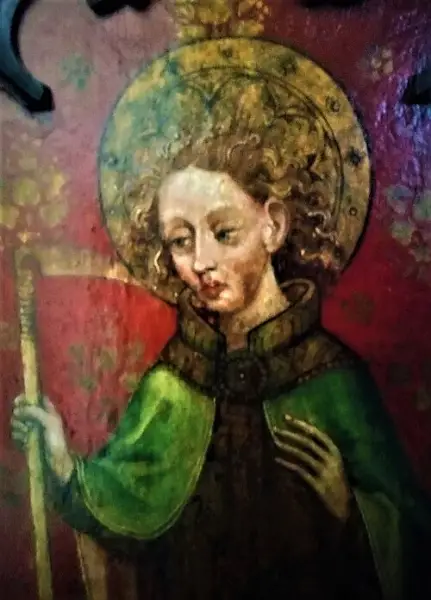
A small chapel was built onto the existing church at Bawburgh, which received a new dedication to Mary and Walstan, and throughout the Middle Ages his shrine and wells drew the farmers and laborers of the region. By 1309 pilgrim revenues at Bawburgh could support six priests and the church vicar and still finance the rebuilding of the chancel. The shrine later fell ruinous and was rebuilt in the fifteenth century, when Robertson connects the saint's popularity with the unrest of East Anglian agricultural workers under the restrictive laws that followed the great plague of 1349; once the monasteries were dissolved the church fell again into neglect, until the nineteenth century restored its prosperity through miracles credited to the water of the well, which the Eastern Daily Press in 1913 called the Lourdes of Norfolk. The well can still be seen at Bawburgh, while at Costessey the second spring had dried up by 1750, though the site, now on a golf course, is marked with a sign. At least five medieval rood screens show Walstan crowned with a scythe and cattle near him, and pre-Reformation churches in Norfolk carry his dedication — as, uniquely outside England, does a church in Rongai, Kenya. St Walstan's Day is still kept at Bawburgh with a special Patronal Service on the Sunday nearest 30 May, though some seventeenth- and eighteenth-century calendars placed it on 28 December.
§ Legacy and veneration
Timeline
- 975
Born, according to tradition, at Bawburgh in Norfolk, into a family descended from royalty.
§ Legend
- 30 May 1016
Died at Taverham after an angel foretold his death; his body was drawn by his two bulls to burial at Bawburgh.
§ Legend
- 1086
The Domesday Book recorded details of Bawburgh, the site of his medieval shrine, without marking the church there as notable.
§ Hagiographical and medieval sources
- 1309
Pilgrim revenues at Bawburgh sufficed to support six priests and the vicar and to finance the rebuilding of the chancel.
§ Legacy and veneration
- 1516
Wynkyn de Worde printed the De Sancto Walstano Confessore of John Capgrave's Nova Legenda Angliæ, one of the two surviving lives of the saint.
§ Hagiographical and medieval sources
- 29 Sep 1658
The Lambeth Life was copied out by a scribe from the lost medieval triptych that had once stood in Bawburgh church.
§ Hagiographical and medieval sources
- 1913
The Eastern Daily Press named the revived well at Bawburgh the Lourdes of Norfolk.
§ Legacy and veneration
- Apr 1978
The dried-up well at Costessey, where his hearse had rested, was recorded as a deep circular pit about four metres across.
§ Legacy and veneration
- 2002
A lead plaque, possibly a burial inscription, was found near Bawburgh church, suggesting devotion to Walstan had taken hold there before the Norman conquest.
§ Hagiographical and medieval sources
- Jan 2015
The hollow left by the Costessey well could still be made out, and a proposal was made to fence the spot and erect a plaque.
§ Legacy and veneration
In Their Own Words
Brother Walstan, on the third day from today you will enter paradise.
The Record
- Patron of
- farms·farm workers·farm animals
- Symbols
- crown and sceptre·scythe·cattle
- Canonization
- Pre-Congregation; declared a saint before the Norman Conquest of England
Prayer
Bibliography
Show 9 sources
- Twinch, Carol (2015). Saint Walstan: The Third Search. Media Associates. ISBN 978-0-9521499-4-1
- Robertson, Kellie (2005). The Laborer's Two Bodies: Literary and Legal Productions in Britain, 1350-1500. Basingstoke: Palgrave Macmillan. ISBN 9-781-13706-784-5
- Pestell, Tim (2004). Landscapes of monastic foundation: the establishment of religious houses in East Anglia c. 650-1200. Woodbridge, Suffolk: Boydell Press. ISBN 9-781-84383-062-7
- James, M.R. (1916). "Lives of St Walstan of Bawburgh". Norfolk Archaeology. 19 (3): 238–267
- Farmer, David Hugh (2011). The Oxford Dictionary of Saints. Oxford: Oxford University Press. ISBN 9-780-19959-660-7
- Harper-Bill, Christopher (2002). "Searching for Salvation in Anglo-Norman East Anglia". East Anglia's History: Studies in Honour of Norman Scarfe. Woodbridge, Suffolk: The Boydell Press
- Blomefield, Francis (1805). "Hundred of Forehoe: Bawburgh". An Essay Towards A Topographical History of the County of Norfolk. Vol. 2. London. pp. 387–393
- Husenbeth, Frederick Charles (1850). Emblems of saints: by which they are distinguished in works of art. London: Burns and Lambert
- Tullett, Andrew (11 June 2019). "Norfolk on a stick: The saint who gave up riches for rags". Eastern Daily Press
Profile text adapted from the Wikipedia article, licensed CC BY-SA 4.0.
Pray with this saint every day
Save St. Walstan to your favorites, read the full profile, and get feast-day reminders in the Saints app.
Get the Saints AppFree on the App Store for iPhone and iPad