
c. 907-935·Feast September 28
St. Wenceslaus I, Duke of Bohemia
Duke, Martyr and Patron of the Czech State
Overview
Václav was born around 907, son of Duke Vratislaus I of the Přemyslid line; his grandparents Bořivoj and Ludmila had been baptized by Cyril and Methodius, while his mother Drahomíra, a Havelli chief's daughter, was christened only at her marriage. Ludmila saw to the boy's education in the Old Church Slavonic liturgy and sent him to the college at Budeč. When Vratislaus died in 921, Ludmila became regent — until Drahomíra, jealous of her influence, had her strangled at Tetín on 15 September 921. At eighteen Wenceslaus took power with the Christian nobles' backing, exiled his mother, curbed the restless dependent dukes, and used the faith to strengthen his state. He welcomed German priests and the Latin rite, and founded at Prague Castle the rotunda of St. Vitus that grew into the present cathedral. Pressed in 929 by King Henry the Fowler and Duke Arnulf at Prague's gates, he resumed an old tribute. On 28 September 935, at his brother Boleslav's invitation to the feast of Cosmas and Damian at Stará Boleslav, conspirators stabbed him, and Boleslav ran him through with a lance. A cult rose at once.
The Complete Life
Early Life
Wenceslaus, Vaclav in Czech, was born around 907, the son of Vratislaus I, duke of the Premyslid dynasty of Bohemia, and his pagan or superficially Christian wife Drahomira. His grandparents Borivoj and Ludmila had been the first Christian rulers of Bohemia, baptized through the mission of Cyril and Methodius, and his grandmother Ludmila, the first Czech Christian of royal blood, undertook his education, teaching him the faith of the Slavonic church of Moravia. On Vratislaus's death in 921 the boy's mother Drahomira ruled as regent, and the friction between the Christian party of Ludmila and the anti-Christian party around the dowager ended with Ludmila's murder at Tetin, traditionally by strangling, at the queen's instigation. Wenceslaus, raised between a murdered grandmother who was a saint and a mother who had killed her, came of age and took the government of Bohemia around 924, while still a teenager, and set aside his mother's regency.
§ Biography
Mission and Ministry
Duke Wenceslaus's short reign was the work of a Christian prince building a Christian state. His biographies, written within a few decades of his death, record his personal austerity, his nocturnal visits to churches, his distribution of alms, and, above all, the incident of the barefoot duke carrying firewood by night to a poor man in a winter storm, the scene the later English carol fixed. He founded and endowed the church of Saint Vitus at Prague, importing relics of the saint from Saxony and making it the future cathedral of Bohemia. He received clergy from Saxony, hosted missionaries, and conducted the diplomacy of a small duchy between the German king Henry the Fowler's empire to the west and the pagan Polabian Slavs to the north, paying the tribute demanded of him rather than fight, a prudence that his war party read as weakness and that his biographers read as peaceable Christian statecraft.
§ Reign
Trial and Final Years
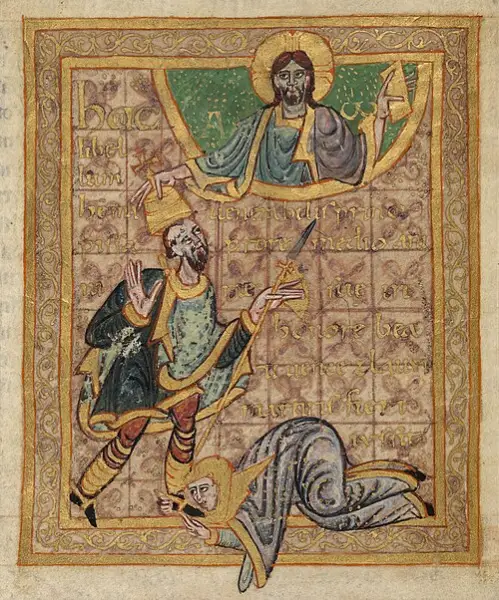
The opposition to Wenceslaus gathered around his younger brother Boleslaus, whose retainers and whose mother's party stood for the old order and the German connection's enemies. In September 935, or in 929, by the tradition that gives two dates, Wenceslaus went to Stará Boleslav to attend the feast of Saints Cosmas and Damian at his brother's church, and on the morning of the feast, 28 September, as he made his way to the early liturgy, Boleslaus's men set upon him at the door of the church. The tradition holds that Boleslaus struck the first blow himself, wounding his brother, and that Wenceslaus was killed by the conspirators in the entrance of the sanctuary, his last words asking God's mercy on his brother. His blood on the threshold of his brother's own church fixed the deed in Bohemia's memory as a martyrdom, and the court's swift burial at Stará Boleslav was undone within three years, when his remains were translated to Saint Vitus in Prague amid popular grief.
§ Introduction
Canonization
Wenceslaus is a pre-congregation saint, and his cult is one of the earliest of the Slavonic world. He was honored as a martyr almost at once, and the translation of his relics to Prague in the years after his death functioned as his church's recognition. The Bohemian church kept his feast on 28 September, the day of his death, and the Emperor Otto I, in the settlement of Bohemian affairs, confirmed the family's standing in terms that treated the dead duke as the dynasty's sacred ancestor. In the middle ages he was posthumously declared a king, hence the crown of Saint Wenceslaus, the crown of the Bohemian kings, and the office of king of Bohemia was held to begin with him, though he never bore the title in life.
§ Veneration
Legacy
Wenceslaus is the patron saint of the Czech state and the Czech nation, and his cult is the oldest continuous institution in Bohemia, older than the archbishopric of Prague and surviving every change of dynasty, empire, and regime. His crown, kept with the Bohemian coronation jewels, sanctified the Bohemian kingship, and the chapel of Saint Wenceslaus in Saint Vitus Cathedral, built over his tomb, has been the sacred center of Czech statehood for a thousand years. The 1853 carol Good King Wenceslas, written by John Mason Neale to a spring carol melody, carried him into the English-speaking world as the type of the charitable ruler, and its legend of the page and the fireside peasant is all the world knows of him. Behind the carol stands the real duke: a young Christian sovereign murdered at a church door by his own family, whose grave became the altar of a nation's identity.
§ Legacy
Timeline
- 907
Born c. 907, son of Duke Vratislaus I of the Přemyslid dynasty; educated by his grandmother Ludmila and at the college of Budeč
§ Biography
- 13 Feb 921
Succeeds his father Vratislaus I as Duke of Bohemia, aged about thirteen
§ Introduction
- 15 Sep 921
His grandmother and regent Ludmila is murdered at Tetín Castle on his mother Drahomíra's orders
§ Biography
- 929
A sudden attack by Henry the Fowler and Arnulf of Bavaria reaches Prague, forcing him to resume paying tribute
§ Reign
- 28 Sep 935
Stabbed to death at Stará Boleslav by companions of his brother Boleslav, who then ran him through with a lance
§ Assassination
- 938
His relics are translated, an event still commemorated on 4 March
§ Veneration
The Record
- Patron of
- The Czech state and Bohemia
- Symbols
- Duke's armour and helmet (preserved at Prague Castle)·Equestrian figure (the statue on Prague's Wenceslaus Square)
- Canonization
- Venerated as a martyr and saint immediately after his death; posthumously granted the title of king by Emperor Otto I
Prayer
Bibliography
Show 2 sources
- ↑ Most frequently cited year of birth; other cited years are 908 [ 3 ] or 911.
- ↑ According to legend; otherwise the place of birth is unknown. [ 3 ]
Profile text adapted from the Wikipedia article, licensed CC BY-SA 4.0.
Pray with this saint every day
Save St. Wenceslaus I, Duke of Bohemia to your favorites, read the full profile, and get feast-day reminders in the Saints app.
Get the Saints AppFree on the App Store for iPhone and iPad