
died c. 492·Feast October 18
St. Wenna
Welsh princess and martyr, daughter of Brychan
Overview
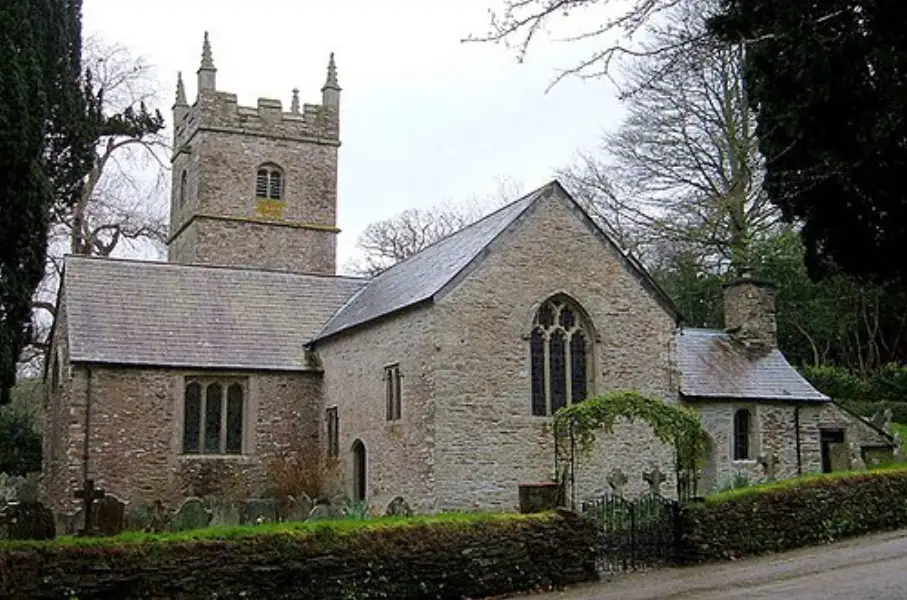
Wenna, called Gwen in Welsh, belongs to the celebrated holy kindred of Brychan, the king of Brycheiniog whose many children were all remembered as saints. According to the twelfth-century Life of Nectan, she was one of Brychan's twelve daughters, sister to Nectan, Mabyn, Ninnoc, and a host of other Brythonic saints whose cults spread across Wales, Cornwall, and Devon. Tradition holds that she won the crown of martyrdom at Talgarth, put to death by Saxons around the year 492. Her cult endured in the far southwest of Britain, where churches and chapels at Cheristow in Hartland parish in Devon, at St Wenn in Cornwall, at St Kew, and at Morval were dedicated under her name, and where a holy well at St Wenn may also have borne it. Her feast is kept on 18 October, a date she shares with a second Saint Wenna — a fifth-century Cornish queen and sister of Saint Non — whose story has often been tangled with her own. Through these dedications she remains part of the dense family of saints that Brythonic Christianity honored along its western edge.
The Complete Life
A Daughter of Brychan's House
Wenna's story is inseparable from the family into which she was born. Her father, Brychan, was the legendary king of Brycheiniog, a kingdom in what is now Wales, and medieval tradition credited him with an extraordinary posterity: a great company of sons and daughters, nearly all of whom were honored as saints in Wales, Cornwall, and Brittany. The twelfth-century Life of Nectan names Wenna among his twelve daughters, alongside such figures as her brother Nectan and her sisters Mabyn and Ninnoc, each of whom carried the faith to a different corner of the Celtic west. To belong to Brychan's house was to belong to a family whose holiness became a literary and devotional tradition in its own right, genealogies and lives multiplying around the royal kindred in the centuries after their time. Within that tradition Wenna's own portion was martyrdom: the sources that preserve her memory relate that she was put to death by Saxons at Talgarth around the year 492, a victim of the struggle between the Brittonic peoples and the incoming English. Her death in her father's own region closed a life about which otherwise almost nothing certain is recorded.
§ Life
Dedications in Cornwall and Devon
Wenna's lasting presence is in the church dedications of the southwest. Four foundations have been made to a saint of her name: a twelfth-century chapel at Cheristow in Hartland parish in Devon, the thirteenth-century parish church of St Wenn in Cornwall, a fourteenth-century chapel at St Kew, and the fifteenth-century parish church of Morval. A holy well at St Wenn is also said to have been dedicated to her, though no specific records confirm the attribution. Her cult has always been complicated by a case of mistaken identity, for the Middle Ages remembered two holy women of this name. The dedication at Morval is sometimes assigned instead to her namesake, the fifth-century queen of Cornwall whose sister Saint Non was the mother of Saint David. The two share the same feast day, 18 October, so that their commemorations fall together in the calendar. Behind the confusion stands a single enduring fact: for the communities of Cornwall and Devon, a woman of Brychan's royal line who died a martyr remained worthy of a church, a well, and an annual feast for a thousand years after her death.
§ Veneration
The Record
- Canonization
- Pre-congregation; venerated as a martyr since the early medieval period
Prayer
Bibliography
Show 5 sources
- Orme, Nicholas (6 January 2000). The Saints of Cornwall. Oxford University Press. p. 251. ISBN 978-0-19-154289-3
- Nash Ford, David. "Children of Brychan Brycheiniog". Early British Kingdoms
- Bond, Andrew; Mabin, Nicholas (1979). Saints of the British Isles. Bognor Regis, West Sussex: New Horizon. p. 134. ISBN 978-0-86116-211-6
- The Book of saints; a dictionary of servants of God canonised by the Catholic church; extracted from the Roman & other martyrologies (3rd ed.). St Augustine's Abbey (Ramsgate, England): New York, Macmillan; London, A. & C. Black. 1934. p. 131
- Nash Ford, David. "St. Wenna of Talgarth". Early British Kingdoms
Profile text adapted from the Wikipedia article, licensed CC BY-SA 4.0.
Pray with this saint every day
Save St. Wenna to your favorites, read the full profile, and get feast-day reminders in the Saints app.
Get the Saints AppFree on the App Store for iPhone and iPad