
died c. 650·Feast November 3
St. Winifred
Welsh virgin martyr of the holy well
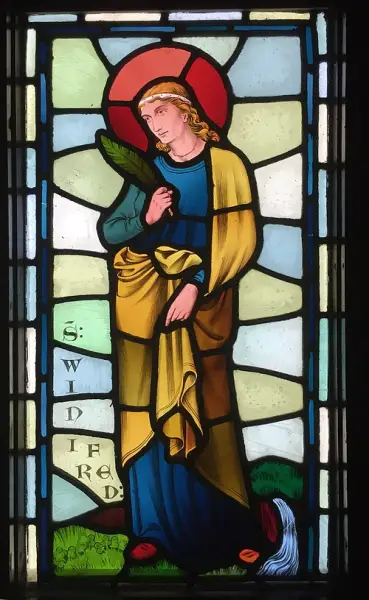
Overview
Saint Winifred, or Winefride — Gwenffrewi in Welsh, Wenefreda in Latin — was a Welsh virgin martyr of the seventh century whose cult became one of the most celebrated in Britain. The daughter of the nobleman Tyfid ap Eiludd, a chieftain of Tegeingl in modern Flintshire, she was kin to Saint Beuno through her mother Wenlo. According to the legend first set down in the twelfth century, she chose the religious life, and when she would not yield to her suitor Caradog he struck off her head; a healing spring burst from the earth where it fell, and Beuno restored her to life. After eight years at Holywell she withdrew inland, becoming a nun and abbess at Gwytherin in Conwy, where she died. The spring that welled up at the place of her beheading — the well at Holywell that bears her name — has become one of the most anciently frequented pilgrimage places in all Britain, called the Lourdes of Wales, and in November 2023 it was proclaimed a National Shrine for England and Wales. Her relics were translated to Shrewsbury Abbey in 1138, and though doubt has been cast on her story since the nineteenth century, an eighth-century reliquary discovered in 1991 gives strikingly early evidence that her cult began within living memory of her death.
The Complete Life
Daughter of Tegeingl
The oldest surviving accounts of Winifred's life were written in the twelfth century, and everything the sources tell of her childhood comes through that later hagiography. According to legend, she was born at Tegeingl, the region of modern Flintshire in northeast Wales, the daughter of Tyfid ap Eiludd, a Welsh nobleman and the district's chieftain. Through her mother Wenlo, a niece of Saint Beuno — that great Welsh abbot and confessor — her family was closely tied to the rulers of south Wales. Winifred thus grew up in a household where the Christian faith had deep roots and where the ascetic movement of the Welsh saints was close at hand. From the same tradition come the darker outlines of her story: a determined resolve to consecrate herself to God as a nun, and a suitor whose wounded pride would turn her vocation into martyrdom. Because the written lives are so much later than the saint herself, modern scholars have questioned whether she existed at all; she appears in no Welsh pedigree of saints and not in the thirteenth-century calendar of Welsh saints. Yet the antiquity of her cult, attested independently of the legends, is not in doubt.
§ Life and legend
The Vow and the Sword
The heart of Winifred's legend is the collision between her resolve and the violence it provoked. Her suitor Caradog flew into a rage at her resolve to enter religion and her refusal of his advances, and struck off her head. Where her head fell, a healing spring burst from the ground — the spring that pilgrims would venerate for the next thousand years at Holywell. Through the efforts of Saint Beuno, her mother's uncle, the head was rejoined to the body and Winifred was restored to life. When the saint saw her murderer resting on his sword in an insolent, defiant posture, Beuno called down heaven's chastisement upon him, and Caradog dropped dead where he stood; the people believed the ground had opened to swallow him. Before Beuno left the place to return to Caernarfon, tradition relates that he took his seat on a stone — the same that now rests in the outer well pool — and promised in God's name that anyone who knelt three times on that spot asking a boon from God in St. Winefride's name would receive what was asked, provided it served the soul's good. From the beginning, then, the place of violence became a place of healing and intercession.
§ Life and legend
From Holywell to Gwytherin
Restored to life, Winifred did not remain at the scene of her martyrdom. She spent eight years at Holywell, and then, receiving an inspiration to leave and retire inland, set out on pilgrimage to seek a place of rest. Her journey brought her to Gwytherin, near the source of the River Elwy in what is now Conwy County Borough, and there she embraced the religious life in earnest, becoming a nun and, in time, abbess of the community. The move transformed the story of a martyr into that of a religious leader: the woman who had suffered violence for her vow went on to govern others in the keeping of the same vows. More elaborate versions of her tale multiply further details, relating among other things a pilgrimage that took Winifred herself to Rome. The kernel that all versions preserve is the same — a founding figure of Welsh religious life whose authority as abbess at Gwytherin completed what her sacrifice at Holywell had begun. In her iconography this triple character appears plainly: the learned virgin, the honorary martyr bearing the sword, and the abbess with crozier and reliquary — the veiled figure shown on the seal of St. Asaph's cathedral chapter.
§ Life and legend
Death at Gwytherin and the Oldest Evidence
Winifred died at Gwytherin, the inland retreat where she had ended her pilgrimage, and there her cult first took root. Because the earliest surviving written accounts of her life date to the twelfth century, her existence has been doubted since the nineteenth century, and her name appears in no Welsh saints' pedigree and in no thirteenth-century calendar of Welsh saints. Yet the evidence of her veneration reaches back centuries before the first hagiography was set down. In 1991 two surviving fragments of an eighth-century reliquary of oak came to light, and earlier drawings made it possible to recognize them as pieces of the Arch Gwenfrewi, Winifred's own reliquary. The box likely held a garment of hers or some keepsake connected with the saint rather than her bones, but its very existence testifies to an organized cult within perhaps a generation of her death. The historian Lynne Heidi Stumpe judged it good evidence that acknowledgment of her sanctity came within a very few years of her burial — and thus of her historicity; some have gone further, deeming it perhaps the oldest surviving witness to any Welsh saint's formal cultus. The martyr of legend stands on surprisingly early documentary ground.
§ Life and legend
Acclaim, Martyrology, and Feast Days
Winifred's veneration as a martyr can be documented from the twelfth century onward, and it flourished chiefly in England rather than Wales — enough so that Caesar Baronius entered her among the English saints in the Roman Martyrology he published in 1584. She belongs to the first millennium and was never formally canonized; she is recognized as a saint by popular acclaim, in the manner of the early Church. Rome officially acknowledges her as a figure grounded in history who led an exemplary religious life, without ruling either way on the miracles she may have worked or received. The Roman Martyrology of 2004 assigns her to 2 November under the Latin form Winefrídae, picturing her at the Holywell spring as a virgin outstanding in her witness as a nun. The liturgical calendar of the Catholic Church in Wales commemorates her on 3 November, since 2 November is reserved for All Souls' Day. Other dates have gathered around her memory as well: the anniversary of her death is kept on 22 June in some traditions, 24 June in others, and Ireland celebrates her feast on 30 October. Few saints of the early Celtic Church can show a calendar so widely scattered.
§ Roman Martyrology
The Well, the Abbey, and the Long Afterlife
In 1138 relics of Winifred were carried from Gwytherin to Shrewsbury, where an elaborate shrine made the abbey one of the great pilgrimage goals of the Late Middle Ages. Prior Robert of Shrewsbury, who translated the relics, also wrote the most influential life of the saint, while Abbot Nicholas Stevens raised a new shrine in the fourteenth century, having first sent monks to steal St. Beuno's relics from Rhewl; the abbey was fined for the theft, though it kept its prize. William Caxton printed the story in his 1483 Golden Legend and a separate Life the following year. Henry VIII destroyed the Shrewsbury shrine in 1540, though a small part of its base survives. The well at Holywell outlived every catastrophe: housed below the town beneath a steep hill, managed today by Cadw and the Catholic Diocese of Wrexham, it remains among the oldest continually visited pilgrimage sites in Britain, with wells at Holywell Farm in Cheshire, at Woolston in Shropshire, and elsewhere marking the supposed route of her remains. Churches at Branscombe in Devon and Stainton in South Yorkshire bear her name, as does a well built in Dublin around 1700. Literature has kept her memory vivid, from Sir Gawain and the Green Knight and Gerard Manley Hopkins's unfinished drama to Ellis Peters's Brother Cadfael novels, and in 1896 a bronze statue by George Edwin Bissell was raised above the Hudson River at Hudson, New York.
§ Legacy
Timeline
- 650
Beheaded at Holywell by her rejected suitor Caradog and restored to life by Saint Beuno, according to legend.
§ Life and legend
- 1130
Prior Robert of Shrewsbury compiled the manuscript life of the saint generally credited to him.
§ Cult
- 1138
Her relics were borne to Shrewsbury, where an elaborate shrine was raised around them.
§ Veneration
- 1483
William Caxton's edition of the Golden Legend included the story of St. Winifred.
§ Cult
- 1540
The shrine at Shrewsbury was destroyed under Henry VIII.
§ Cult
- 1584
Caesar Baronius listed her as an English saint in the Roman Martyrology.
§ Veneration
- 1896
A bronze statue of the saint by George Edwin Bissell, presented by John Watts de Peyster, was erected at Hudson, New York.
§ Legacy
- 1991
Two small pieces of an eighth-century oak reliquary were found and identified as belonging to the Arch Gwenfrewi.
§ Life and legend
- Nov 2023
St Winefride's Well at Holywell was proclaimed a National Shrine for England and Wales.
§ Life and legend
In Their Own Words
that whosoever on that spot should thrice ask for a benefit from God in the name of St. Winefride would obtain the grace he asked if it was for the good of his soul.
At the spring located at Holywell in Wales, St Winefride the Virgin, who is outstanding in her witness as a nun
The Record
- Patron of
- Holywell·against unwanted advances·Diocese of Shrewsbury
- Symbols
- holding a sword·head carried beneath her arm·abbess's crozier and reliquary
- Canonization
- Pre-congregation; recognized by popular acclaim as a 1st-millennium saint, never formally canonized
Prayer
Bibliography
Show 8 sources
- Chandlery, Peter. "St. Winefride." The Catholic Encyclopedia. Vol. 15. New York: Robert Appleton Company, 1912
- Rees, Rice (1836). "Legend of Gwenfrewi or St. Winefred". An Essay on the Welsh Saints. London: Longman, Rees, Orme, Brown, Green, and Longman. pp. 295–297
- Hallmark, Sally (2015), Gwenfrewy the Guiding Star of Gwytherin: From Maiden and Martyr to Abbess and Saint – The Cult of Gwenfrewy at Gwytherin, MA thesis (University of Wales), p. 20
- Stumpe, Lynne Heidi (1994), "Display and Veneration of Holy Relics at St Winefride's Well and Stonyhurst", Journal of Museum Ethnography, No. 22, p. 67
- Fry, Roy and Gray Hulse, Tristan (1994), "Holywell – Clwyd", Source – the Holy Wells Journal, Issue 1
- Bord, Janet (1994), "St Winefride's Well, Holywell, Clwyd", Folklore, 105 (1–2), p. 100
- Cormack, Margaret (2007). Saints and their cults in the Atlantic world. Columbia, S.C: University of South Carolina Press. ISBN 978-1-57003-630-9
- Martyrologium Romanum, 2004, Vatican Press (Typis Vaticanis), page 603
Profile text adapted from the Wikipedia article, licensed CC BY-SA 4.0.
Pray with this saint every day
Save St. Winifred to your favorites, read the full profile, and get feast-day reminders in the Saints app.
Get the Saints AppFree on the App Store for iPhone and iPad