
died 15 February 2015·Feast February 15 (Gregorian); 8 Meshir (Coptic calendar)
Sts. the 21 Coptic Martyrs of Libya
Coptic and Ghanaian Martyrs of Sirte
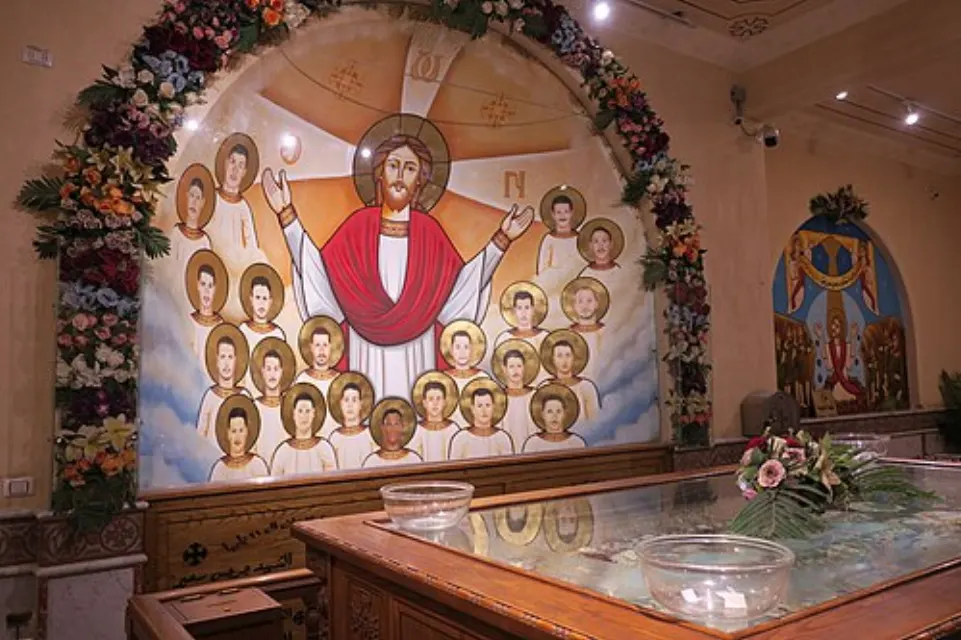
Overview
In late December 2014 and January 2015, twenty Coptic Orthodox men from Upper Egypt and one Ghanaian co-worker were seized in Sirte, Libya, where they had gone as migrant construction labourers to support families at home. Their captors gave them a chance to convert to Islam; every one of them refused. On 15 February 2015 the group was marched in orange jumpsuits onto a Mediterranean beach and beheaded on camera, in the moments just before their deaths, audio inserted into the video captures several of the men calling upon Jesus. The Ghanaian, Matthew Ayariga, is remembered for answering that his God was the God of the Copts. Within a week Pope Tawadros II canonized them, one of the fastest recognitions in Christian history. Their bodies were recovered in 2017 and returned to the village of Al-Our in Minya, where a great church now stands over their relics. The Coptic Church, the Catholic Church, several Lutheran bodies and the Anglican Communion all honour them as modern martyrs.
The Complete Life
Early Life
The twenty Coptic men came overwhelmingly from poor villages of Minya Governorate in Upper Egypt, places like Al-Our, Fayoum and Beni Suef, where Sunday liturgy and the calendar of martyrs shape ordinary life. Born between roughly 1978 and 1990, they grew up under economic hardship that pushed millions of Egyptians abroad; most were masons, labourers and tradesmen with little schooling. They crossed into Libya in 2013 and 2014 because work there paid better than home, joining thousands of compatriots in Sirte, a city then sliding under the control of Islamic State militants. Among them were close friends and at least two sets of neighbours; Samuel and Bishoy Asta were brothers. Matthew Ayariga of Ghana worked beside them. None of the twenty-one set out to be a witness; they set out to earn a living, and the world's violence made them confessors.
Captivity
The men were taken in coordinated raids at the end of December 2014 and in January 2015 as Islamic State fighters rounded up Egyptian Christians in Sirte. An eyewitness account and the captors' own film show that they were held together, pressured over weeks to convert to Islam and offered their lives as the price. The group refused, and the Copts prayed the Jesus Prayer with a rope of knots one of them carried. Their families learned of the seizure by phone and begged the Egyptian church and state to intervene, but the hostages were moved and hidden beyond reach. A deacon of the group, Matthew Ayariga, who had first been detained separately, told his captors that he shared the God of his fellow prisoners. This period of quiet refusal, largely hidden from the world, is the heart of their witness: ordinary men choosing Christ while shackled in a cellar rather than speaking a formula that would spare them.
Martyrdom
On 15 February 2015 the group issued a propaganda film titled 'A Message Signed with Blood to the Nation of the Cross', in which the twenty-one, dressed in orange jumpsuits, are marched along the Libyan coast behind a leader clad in black. Each was forced to his knees and beheaded. The film was meant as terror; it became instead an icon. Viewers worldwide heard the men calling on the name of Jesus at the moment of death, and Coptic communities recognized in them the ancient line of confessors from the Roman persecutions. The massacre provoked Egyptian air strikes against Islamic State positions in Derna and a wave of mourning across the Christian world. In the villages of Minya, homes of the dead became places of pilgrimage within days, and families spoke of their sons with the liturgical language normally reserved for saints of many centuries past.
Recovery and Burial
The martyrs' bodies were thrown into a mass grave and remained lost for more than two years while fighting continued around Sirte. In October 2017, after Libyan forces retook the city, the remains were located and exhumed under forensic supervision, then flown home to Egypt. Their arrival was met with full state honours, and they were laid to rest at Al-Our, in the church built for the Martyrs of the Faith and Homeland — thirteen of the men came from that very village — a great new building commissioned to hold their relics. Pilgrims now travel there throughout the year, especially around the February feast. A reliquary containing remains of the martyrs has also been sent abroad, including to Rome, where in 2023 their relics were venerated in St Peter's Basilica beside the chair of Peter, a striking image of old and new martyrdom together.
Canonization and Cult
Pope Tawadros II canonized the twenty-one on 21 February 2015, only six days after their death, acting with the Holy Synod of the Coptic Orthodox Church in a service at Al-Our. The speed reflects both the clarity of their confession, documented on film, and the Coptic understanding that public martyrdom requires no process. Their feast was fixed on 15 February in the Gregorian calendar and 8 Meshir in the Coptic. The Catholic Church followed: Pope Francis mentioned them as martyrs of today, and in May 2023 the Dicastery for the Causes of Saints inscribed the twenty-one in the Roman Martyrology for the same date, the first martyrs of Islamic State so honoured. Lutheran and Anglican bodies also commemorate them. Their icon, showing the twenty-one in white robes with Ayariga beside them, has spread through churches of every tradition.
Legacy
The twenty-one have become the emblem of contemporary Christian martyrdom, invoked at gatherings from the Global South to Rome and compared with the martyrs of the early Church. Their story reshaped Coptic self-understanding, joining the 2011 Alexandria bombing and the Maspero massacre in a recent roll of Egyptian confessors. Books, documentaries and an animated film carried their names abroad, and the phrase 'the martyrs of the beach' entered common speech. For migrant workers everywhere they stand as patrons of those who leave home for bread and meet the cross instead. Their families' forgiveness of the killers, repeatedly expressed in interviews, is cited as a Christian answer to terror. At Al-Our the completed church draws pilgrims of many churches, and each February fifteen the Coptic liturgy reads their names as it reads the names of martyrs under Diocletian, ancient and modern in one breath.
Timeline
- 27 Dec 2014
Coptic construction workers are kidnapped by the Islamic State in Sirte, Libya
§ Introduction
- Jan 2015
Further members of the group are seized in Sirte in January
§ Introduction
- 12 Feb 2015
Islamic State releases a video and photos reporting the twenty-one workers killed for their faith
§ Introduction
- 15 Feb 2015
The captives are beheaded on a Mediterranean beach in a video titled 'A Message Signed with Blood to the Nation of the Cross'
§ Execution
- 16 Feb 2015
At dawn the Egyptian military carries out airstrikes on Islamic State facilities in Libya
§ Aftermath
- 21 Feb 2015
Pope Tawadros II of Alexandria canonizes the twenty-one as saints, seven days after their deaths
§ Veneration
- 15 May 2018
Remains of the twenty Egyptians are returned to the shrine church built for them at Al-Our in Minya
§ Return of the remains
- 2019
The Libyan government agrees to transfer Matthew Ayariga's body to Egypt
§ Return of the remains
- 29 Sep 2020
Ayariga's remains are received in Egypt by the Al-Our shrine church and laid to rest with his companions
§ 21st martyr
- 11 May 2023
Pope Francis announces the twenty-one will be added to the Roman Martyrology
§ Veneration
- 15 Feb 2024
An ecumenical prayer service at Saint Peter's Basilica marks the martyrs' first Catholic commemoration
§ Veneration
In Their Own Words
I am a Christian and I am like them
The Record
- Patron of
- Egypt·Libya·Ghana·Migrant workers·Persecuted Christians
- Symbols
- Crown of martyrdom·Orange jumpsuits·Martyr's palm·Crucifix
- Canonization
- Canonized 21 February 2015 by Pope Tawadros II of Alexandria at Al-Our, Egypt; inscribed in the Roman Martyrology by Pope Francis in 2023
Prayer
Profile text adapted from the Wikipedia article, licensed CC BY-SA 4.0.
Pray with this saint every day
Save Sts. the 21 Coptic Martyrs of Libya to your favorites, read the full profile, and get feast-day reminders in the Saints app.
Get the Saints AppFree on the App Store for iPhone and iPad