
martyred 1597·Feast February 6
Sts. Paul Miki and Companions (the 26 Martyrs of Japan)
Martyrs (Franciscan missionaries, Japanese Jesuits, and lay Terziaries)
Overview
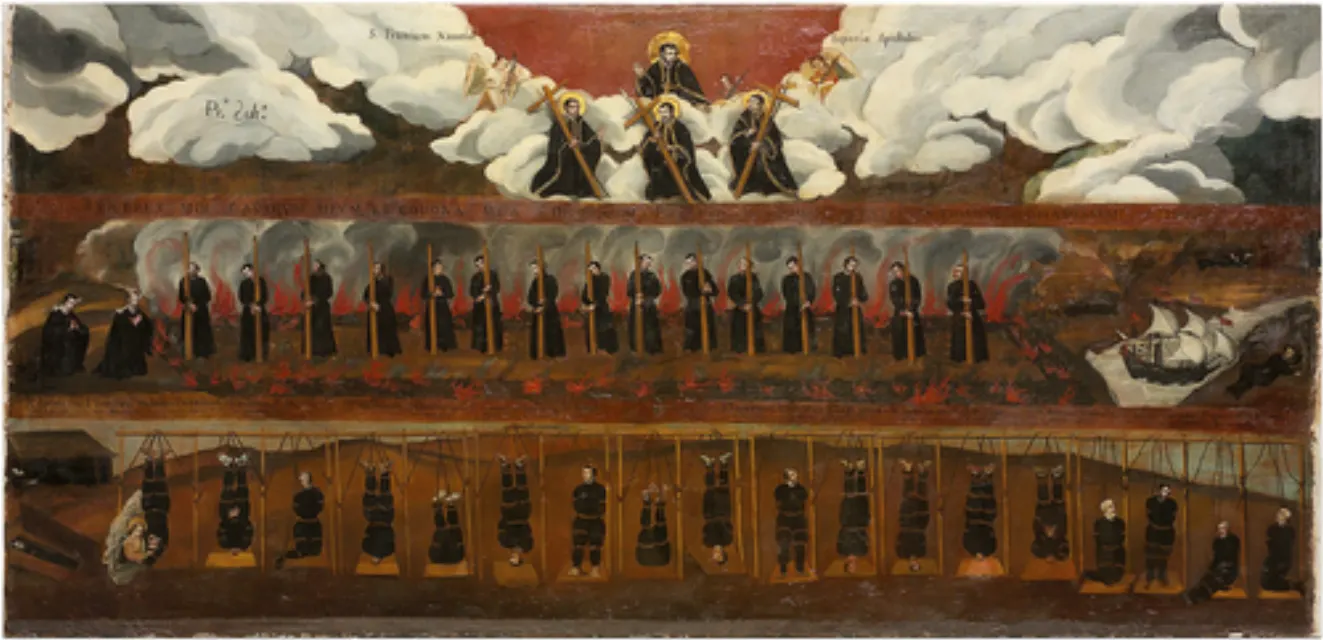
When Francis Xavier and his companions landed at Kagoshima in 1549, few could have predicted how quickly the Gospel would take root in Japan; by the close of the sixteenth century perhaps three hundred thousand Catholics lived there. That success bred suspicion. Toyotomi Hideyoshi, the regent who had first tolerated the missionaries, ordered all Christians expelled in 1587, and after the San Felipe incident of 1596 his patience ended altogether. In January 1597 soldiers arrested twenty-six Catholics in Kyoto: six Franciscan friars from Spain, New Spain and Portuguese India, three Japanese Jesuits including the preacher Paul Miki, and seventeen Japanese Franciscan tertiaries, among them three altar boys. The prisoners were roped together and marched for weeks through town and countryside behind a cart proclaiming their crime, defying the ban on preaching the faith. Crowds stoned them, stuffed weeds into their mouths, and their left ears were cut away. On 5 February 1597, on a hill above Nagasaki, the twenty-six were raised on crosses and finished with lances. Far from extinguishing the Church, the executions began a long age of blood; Catholicism survived underground for two and a half centuries until missionaries returned and found the hidden Christians still keeping the faith.
The Complete Life
Background
When Francis Xavier and his companions, Cosme de Torres and Juan Fernández, landed at Kagoshima on 15 August 1549, few could have predicted how quickly the gospel would take root in Japan; by the close of the sixteenth century perhaps three hundred thousand Catholics lived there. That success bred suspicion. The mission was entangled in competition between missionary orders and in the rivalry between Portugal and Spain, while the country's governing factions saw in the foreign religion a threat to their control of a recently unified Japan. Toyotomi Hideyoshi, the regent who had at first tolerated the missionaries, ordered all Christian priests expelled in 1587, though the order was only patchily enforced. After the San Felipe incident of 1596 — a Spanish galleon whose pilot's boast cost the Christians their last credit — his patience ended altogether, and he determined to make an example.
§ Early Christianity in Japan
Arrest and March to Nagasaki
In January 1597 soldiers arrested twenty-six Catholics in Kyoto: six Franciscan friars from Spain, New Spain and Portuguese India, among them the friars who had staffed the new convents and hospitals; three Japanese Jesuits, including the preacher Paul Miki, a nobleman's son and the most gifted Catholic speaker of his generation; and seventeen Japanese Franciscan tertiaries, among them three altar boys. The prisoners were roped together and marched for weeks through town and countryside behind a cart proclaiming their crime — preaching the banned faith. Crowds stoned them and stuffed weeds into their mouths, and their left ears were cut away at the start of the march. They prayed and sang as they went, and the spectacle intended to terrify the faithful instead edified them.
§ Martyrdom
Martyrdom
On 5 February 1597, on a hill above Nagasaki, the twenty-six were raised on crosses and finished with lances. Paul Miki, from his cross, preached to the crowd, forgave his executioners, and declared that he had not come from the Portuguese but was Japanese, and died for teaching the law of God that he had obeyed all his life. The executions were intended to end Christianity in Japan; instead the blood of the martyrs became the seed of a church that survived every subsequent persecution. The twenty-six were beatified by Pope Urban VIII on 14 September 1627 and canonized by Pope Pius IX on 8 June 1862. In 1962, for the centenary, a memorial monument and museum were raised at Nagasaki; in 1969 the martyrs were added to the General Roman Calendar, their feast on 6 February.
§ Introduction
Legacy
The 26 Martyrs of Japan are the emblematic martyrs of the Japanese church, its patrons together with the later blesseds and martyrs of the great persecution. Their hill at Nagasaki, Nishizaka, has become the church's holy ground in Japan: the memorial built there draws pilgrims from across the Catholic world, and every 5 February their memory is kept there with procession and Mass. Their story brackets the whole history of Japanese Catholicism — from Xavier's first landing in 1549, through the persecutions that drove the faith underground by 1630, to the astonishing discovery in 1865 of the hidden Christians at Nagasaki who had kept the faith for seven generations without a priest. Paul Miki and his companions are honored as patrons of Japan and of persecuted Christians everywhere.
§ Introduction
Timeline
- 15 Aug 1549
Francis Xavier, Cosme de Torres and Juan Fernández arrive at Kagoshima from Portugal
§ Early Christianity in Japan
- 29 Sep 1549
Xavier visits the daimyō Shimazu Takahisa and receives permission for the first Catholic mission in Japan
§ Early Christianity in Japan
- 1587
Toyotomi Hideyoshi orders all Christians expelled from Japan
§ Early Christianity in Japan
- 1596
San Felipe incident hardens official hostility toward Catholics
§ Martyrdom
- Jan 1597
Twenty-six Catholics, friars, Jesuits and tertiaries, are arrested in Kyoto on Hideyoshi's orders
§ Martyrdom
- 5 Feb 1597
The twenty-six are crucified, lanced and martyred on a hill overlooking Nagasaki
§ Introduction
- 10 Sep 1622
Fifty-five Catholics martyred at Nagasaki in the Great Genna Martyrdom; Catholicism officially outlawed
§ Martyrdom
- 14 Sep 1627
The twenty-six are beatified by Pope Urban VIII
§ List of martyrs
- 8 Jun 1862
Canonized by Pope Pius IX
§ Recognition
- 1959
The Anglican Nippon Sei Ko Kai adds an annual commemoration of all the martyrs of Japan to its calendar
§ Recognition
- 1969
Entered the General Roman Calendar for the first time, commemorated as Paul Miki and Companions
§ Recognition
The Record
- Patron of
- Japan·Persecuted Christians
- Symbols
- Martyr's palm·Cross
- Canonization
- Beatified 14 September 1627 by Pope Urban VIII; canonized 8 June 1862 by Pope Pius IX
Prayer
Bibliography
Show 12 sources
- ↑ Astrain, Antonio. "St. Francis Xavier." The Catholic Encyclopedia Vol. 6. New York: Robert Appleton Company, 1909. 12 February 2019
- ↑ " "Site of the Martyrdom of the 26 Saints of Japan", Visit Nagasaki" . Archived from the original on 2019-02-07 . Retrieved 2019-02-05 .
- ↑ Solly, Meilan (September 10, 2024). "Why Japan's Shogun Executed Dozens of Christians During the Great Genna Martyrdom of 1622" . Smithsonian Magazine .
- ↑ Kennedy, Thomas. "Nagasaki." The Catholic Encyclopedia Vol. 10. New York: Robert Appleton Company, 1911. 6 May 2018
- ↑ Lavrin, Asunción (July 2003). "Spanish American Saints and the Rhetoric of Identity, 1600-1800. By Ronald J. Morgan. Tucson: The University of Arizona Press, 2002. Pp. x, 238. Illustrations. Notes. Works Cited. Index. $45.00 cloth" . The
- ↑ Conover, Cornelius; Conover, Cory (2011). "Saintly Biography and the Cult of San Felipe de Jesús in Mexico City, 1597-1697" . The Americas . 67 (4): 441– 466. ISSN 0003-1615 .
- ↑ "Saint of the Day: St. Paul Miki and Companions" . 6 February 2022. Archived from the original on August 14, 2022.
- ↑ "Martyrs List" . Twenty-Six Martyrs Museum. Archived from the original on 2010-02-14 . Retrieved 2010-01-10 .
- ↑ Delplace, Louis. "Japanese Martyrs." The Catholic Encyclopedia Vol. 9. New York: Robert Appleton Company, 1910. 29 March 2019 This article incorporates text from this source, which is in the public domain .
- ↑ Heckmann, Ferdinand. "Sts. Peter Baptist and Twenty-Five Companions." The Catholic Encyclopedia Vol. 11. New York: Robert Appleton Company, 1911. 6 May 2018
- ↑ In the 1962 typical edition of the Roman Missal Archived 2008-08-28 at the Wayback Machine , page [143], the text goes directly from the Mass of St. Francis de Sales (January 29) to that of St. Margaret of Cortona (February 22).
- ↑ The Daily Missal and Liturgical Manual . London: Baronius Press. 2008. pp. 1722– 1723. ISBN 978-0-9545631-2-7 .
Profile text adapted from the Wikipedia article, licensed CC BY-SA 4.0.
Pray with this saint every day
Save Sts. Paul Miki and Companions (the 26 Martyrs of Japan) to your favorites, read the full profile, and get feast-day reminders in the Saints app.
Get the Saints AppFree on the App Store for iPhone and iPad