
martyred c. 290·Feast November 7
Sts. Hieron and Companions (the 33 Martyrs of Melitene)
Martyrs of the Diocletianic Persecution
Overview
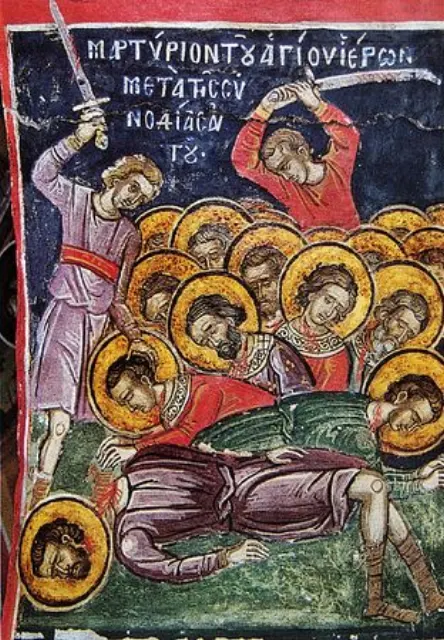
Around the year 290, during the persecution launched by the emperors Diocletian and Maximian, Roman detachments under an officer named Lysias moved through Cappadocia to stamp out Christianity and at the same time to conscript recruits for the army. In that sweep a group of thirty-three believers was taken to Melitene, in eastern Asia Minor, and put to death for refusing to sacrifice to the pagan gods. The best remembered of them is Hieron, a strong young farmer of Tyana who cared devotedly for his blind mother Stratonika. Hieron would not enroll in the imperial army, fearing it would compel him to renounce Christ, and he defended himself so vigorously that recruiters fled. Along with eighteen fellow believers he took shelter in a cave, but he was at length captured and suffered flogging and mutilation at Melitene before being beheaded alongside his companions. All but one of the group, a kinsman of Hieron named Victor, remained steadfast under torture. The martyrs are commemorated together in the Eastern Orthodox Church on November 7.
The Complete Life
The Persecution
The thirty-three martyrs of Melitene belong to the great persecution that Diocletian and his colleague Maximian unleashed at the close of the third century. Large military detachments were dispatched to Cappadocia with a double purpose: to suppress the spreading Christian faith and to gather recruits for the imperial army. For believers the two aims were one, since service in the army required obedience to the old gods. The most fully drawn figure among the martyrs is Hieron of Tyana. His mother Stratonika was a devout Christian who had gone blind, and her son cared for her with tenderness while growing strong in the faith himself. When recruiters came to enroll him, Hieron refused, fearing that the oath of a soldier would oblige him to sacrifice to idols and so betray Christ. He resisted the soldiers with such force, driving them off with a wooden tool, that they fled from him in fear. To escape seizure he then hid with eighteen other Christians in a cave, where a vision foretold the martyrdom awaiting him.
§ Introduction
Martyrdom at Melitene
Hieron was eventually arrested and taken with others to Melitene, where they were thrown into prison and tortured. The hagiographic accounts name thirty-two companions beside Hieron, among them Amonitus, Anicletus, Barachius, Callinicus, Hesychius, Longinus, Mamas, Nikon, Theodotus and many more whose names the Church has kept in alphabetical order. Under torture nearly all stood firm; the single recorded failure was Hieron's own kinsman Victor, who broke under pain and renounced his faith. Hieron himself suffered with particular cruelty: his hand was cut off, he was flogged and beaten repeatedly, and at last he was beheaded together with the rest of the company. The martyrs are said to have chanted the first verse of Psalm 118 throughout their suffering, blessing the Lord in the very hour of death. After the execution a man named Chrysanthus purchased Hieron's head, buried it reverently, and later raised a church over it; the severed hand was carried to Stratonika, who herself came to be honored as a saint and martyr.
§ Other Martyrs
Cult and Veneration
The thirty-three martyrs were honored as saints by the Eastern Orthodox Church long before formal canonization processes existed; their sanctity rests on the ancient tradition of their death at Melitene around the year 290. Their joint feast is kept on November 7. Under Emperor Justinian the remains were brought to light and placed in the church of Hagia Eirene, which gave the cult an imperial setting in Constantinople. The liturgical texts appointed for the feast, the apolytikion and kontakion in the fourth tone, are sung at Vespers and through the day's services, keeping the memory of the martyrs alive in Orthodox worship. The calendar entry preserves not only Hieron's story but the roll of the other thirty-two names, a reminder that the Church venerates the whole company rather than a single hero. Orthodox martyrologies also connect the company with the later cult of Hieron and with the blind Stratonika, whose grief became a title of holiness.
§ Hieron
Legacy
The 33 Martyrs of Melitene endure in the Orthodox calendar as a witness from the last and fiercest wave of pre-Constantinian persecution. Their story has a domestic tenderness rare in martyr acts: a son who would not leave his blind mother, a mother who received his severed hand, a cave of eighteen frightened believers sustained by a vision. It also records honestly that one of the company failed, since Victor's collapse stands in the account beside the constancy of the rest, and that honesty gives the triumph of the others its weight. The martyrs who would not kill for the empire, and would not let the empire kill their faith, remain a reference point for Christians who face pressure from state or society. Their feast on November 7 continues to be kept in Orthodox Churches, and the relics enshrined under Justinian testified for centuries to a small town's refusal to bow.
§ Hieron
Timeline
- 290
Persecution under Diocletian and Maximian reaches Cappadocia, with military detachments sent under Lysias
§ Introduction
- 290
Hieron, a farmer of Tyana, repeatedly refuses recruitment into the imperial army and drives the soldiers off
§ Hieron
- 290
Shares a hiding cave with eighteen fellow Christians and receives a vision foretelling his martyrdom
§ Hieron
- 290
Arrested and taken to Melitene, where the captives are tortured in prison; only Victor apostatizes
§ Hieron
- 290
After his hand is cut off and further torments, Hieron is beheaded with the other martyrs
§ Hieron
- 290
Chrysanthus purchases Hieron's head, buries it, and later builds a church in his honor
§ Hieron
The Record
- Symbols
- Psalm 118 recited under torture·Farmer's tool (Hieron)·Severed hand brought to his blind mother
- Canonization
- Pre-congregation; ancient cult in the Eastern Orthodox Church
Prayer
Bibliography
Show 5 sources
- ↑ "33 Martyrs of Melitene" . www.truechristianity.info . Retrieved 2025-03-15 .
- 1 2 3 "33 Holy Martyrs of Melitene" . www.oca.org . Retrieved 2025-03-14 .
- 1 2 "The 33 Holy Martyrs of Melitene" . Orthodox Times . Retrieved 2025-03-14 .
- ↑ "33 Holy Martyrs of Melitene" . www.oca.org . Retrieved 2024-11-20 .
- ↑ "33 Martyrs of Melitene" . www.truechristianity.info . Retrieved 2025-03-16 .
Profile text adapted from the Wikipedia article, licensed CC BY-SA 4.0.
Pray with this saint every day
Save Sts. Hieron and Companions (the 33 Martyrs of Melitene) to your favorites, read the full profile, and get feast-day reminders in the Saints app.
Get the Saints AppFree on the App Store for iPhone and iPad