
martyred c. 250·Feast July 30
Sts. Abdon and Sennen
Persian Noble Martyrs of Rome
Overview
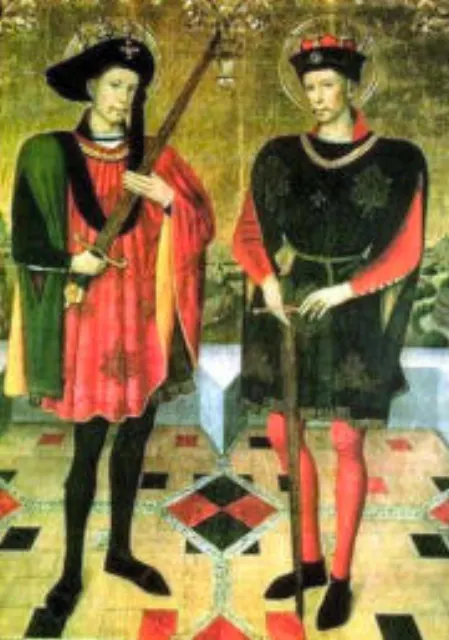
Abdon and Sennen, whose names appear in early calendars under many spellings, are honored as martyrs laid to rest on 30 July at the Pontian cemetery by the Portway outside Rome; beyond that burial notice, nothing about them can be verified historically. Their Acts, composed for the most part before the ninth century, tell an elaborate story: two Persian nobles carried off to Rome in a third-century military campaign, enslaved, converted to Christianity, and distinguished by their care in burying Christian dead. Brought before the emperor Decius and the Senate, they refused sacrifice to the Roman gods and were condemned to the beasts, which the Acts say refused to touch them, before being dismembered by gladiators in the Colosseum around the year 250. A subdeacon named Quirinus buried them, and Constantine later translated the relics to Pontianus. Scholars regard the Acts as largely legendary, and the twentieth-century revision of the calendar dropped their obligatory commemoration, yet their feast on 30 July is still kept, and their patronage of children, harvests, and several Spanish and Italian towns endures.
The Complete Life
What Can Be Known
Honesty is the first duty of any account of Abdon and Sennen, because the historical record about them is nearly empty. The Roman Martyrology's earliest notice states only that they witnessed with their blood and were interred on 30 July at the Pontian cemetery along the Portway; their names, in the variant forms Abdo, Abdus, Sennes, Sennis, and Zennen, appear in early martyrologies and calendars, which shows that their cult is old, being spread through Rome and beyond by the early Middle Ages. Who they were, where they came from, and how they died are questions the documents before the ninth century do not answer. Everything else that is commonly repeated about them comes from the Acts, a romance which the Bollandists and modern scholars agree weaves in a number of invented details about the cause, the setting, and the torments; and yet the romance itself became, for a thousand years, the means by which the two martyrs were loved.
§ Introduction
The Story of the Acts
The Acts make the two men Persian nobles, captured and carried to Rome during a third-century war between the empires. There they became slaves, embraced Christianity, and devoted themselves to burying the bodies of Christians whom the authorities left unburied, a work of mercy that brought them to public notice under Decius. Taken in chains before the emperor and the Senate, they refused to offer sacrifice, and were condemned to the beasts in the arena. The Acts, in the style of the genre, report that the lions and bears would not harm them, gladiators being sent in to dismember them instead, around the year 250. The body of the legend, in other words, follows a familiar template: foreign origin, pious slavery, burial of the dead, courtroom defiance, animals that refuse the kill. Its value is not as a report but as a meditation the medieval church read upon the martyrs, and as evidence of how their feast was celebrated in Rome and in the many European towns that later claimed them.
§ Veneration
The Relics
The Acts say that a subdeacon named Quirinus took the bodies and buried them, and that in the reign of Constantine they were moved to the Pontian burial ground on the Porto road. A fresco on a sixth-century sarcophagus, believed at the time of its discovery to contain their remains, shows the two figures receiving crowns from Christ, an early iconographic witness to their cult. The Middle Ages multiplied their bodies: Florence and Soissons, among others, claimed possession, and the Benedictine abbey of Sainte-Marie at Arles-sur-Tech in the French Pyrenees still keeps a tomb venerated as theirs, associated there with an annually renewed miraculous spring. The Bollandists, sifting the claims, concluded that the relics rest in the Basilica of San Marco Evangelista al Campidoglio in Rome, brought there in 1474. A lost church in Rome may once have borne their names, a sign of a local cult that once had a fixed home in the city of their death.
§ Veneration
Calendar and Cult
Abdon and Sennen were saints a thousand years before the word canonization acquired its modern meaning; they entered the calendars of Rome by ancient usage, and their rank in the Tridentine calendar was that of a Simple feast. In 1960 the classification of their celebration was reduced to a Commemoration, and the twentieth-century revision of the General Roman Calendar removed their obligatory observance worldwide, a decision that reflects the historical uncertainty of their Acts rather than any judgment against martyrdom itself. Local observance remains entirely legitimate: they may still be celebrated on their day unless a higher celebration claims it, and in the places of which they are patrons their feast has never lapsed. The Eastern churches, including the Eastern Orthodox, Oriental Orthodox, and the Church of the East, have likewise kept their memory, so that this obscure pair of Roman martyrs belongs, in a small way, to the common inheritance of all the apostolic churches.
§ Introduction
Legacy
Popular devotion gave Abdon and Sennen a second life far more vivid than the scholarly record. In Catalonia they are Sant Nin i Sant Non, in Valencia the Sants de la Pedra, the saints of stone, popularly reheard as the saints of hail, protectors of orchards and fruit trees against storms; in Calasparra in Murcia their fiestas are documented back to the sixteenth century and are still the town's great annual festival. They were invoked for children, for the burial of the dead, for coopers, and for the harvest, a portfolio of humble patronages that shows how completely the rural imagination made them its own. Churches under their dedication stand across the south of France and Spain, from Ariège to the Gers. Their story is a lesson in the two registers of hagiography: the historian's austere verdict that nothing can be verified, and the people's centuries-long insistence that two strangers who died refusing to deny Christ deserve their feast still.
§ Veneration
Timeline
- 250
Condemned before the Senate under Decius for refusing sacrifice, the two Persians are dismembered by gladiators in the Colosseum
§ Veneration
- 1474
Their relics are brought to the Basilica of San Marco Evangelista al Campidoglio in Rome, according to the Acta Sanctorum
§ Veneration
- 1960
The rank of their feast is changed from Simple to Commemoration in the General Roman Calendar of 1960
§ Introduction
The Record
- Patron of
- Children·Good harvests·Burying the dead·Coopers·Pescia, Italy·Calasparra, Spain·Sagunto, Spain·Sahagún, Spain
- Symbols
- Fur tunics·Sword·Phrygian caps·Two crowns·Den of lions and bears
- Canonization
- Pre-congregation (ancient cult; removed from the General Roman Calendar in the twentieth century, but liturgical commemoration remains permitted)
Prayer
Bibliography
Show 10 sources
- 1 2 3 4 "Saints of July 30: Abdon and Sennen" . St. Patrick Catholic Church Saint of the Day. 2009. Archived from the original on October 5, 2018 . Retrieved March 19, 2012 .
- 1 2 "Martyrologium Romanum" (Libreria Editrice Vaticana, 2001 ISBN 88-209-7210-7 )
- ↑ Holweck, F. G. , "A Biographical Dictionary of the Saints", St. Louis, Missouri: B. Herder Book Co., 1924.
- ↑ "Calendarium Romanum" (Libreria Editrice Vaticana, 1969), p. 132
- ↑ General Instruction of the Roman Missal Archived 2008-07-20 at the Wayback Machine , 355 c
- ↑ Wynne, John Joseph (1907). "Sts. Abdon and Sennen" . In Herbermann, Charles (ed.). Catholic Encyclopedia . Vol. 1. New York: Robert Appleton Company.
- ↑ "Fiestas Patronales de los Santos Mártires San Abdón y San Senén" . Región de Murcia . Retrieved March 19, 2012 .
- ↑ "Museo Temático-Museo del Arroz" (in Spanish). Cullera Turismo. Archived from the original on 2014-03-20 . Retrieved 2012-04-10 .
- ↑ "Ermitas de Sueca" (in Spanish). Ermitas de la Comunidad Valenciana. Archived from the original on 2018-04-26 . Retrieved 2014-07-01 .
- ↑ Norris Deck (1851). The calendar of the Anglican church .
Profile text adapted from the Wikipedia article, licensed CC BY-SA 4.0.
Pray with this saint every day
Save Sts. Abdon and Sennen to your favorites, read the full profile, and get feast-day reminders in the Saints app.
Get the Saints AppFree on the App Store for iPhone and iPad