
d. 4 March 306·Feast September 8
Sts. Adrian and Natalia of Nicomedia
Martyr and his Wife
Overview
Adrian, also known as Hadrian, was a twenty-eight-year-old Herculian Guard of the emperor Galerius and head of the praetorium at Nicomedia when, early in the fourth century, he was put in charge of the torturing of a group of Christians. He asked what recompense they looked for from their God, he heard them answer with Paul's words that eye has not seen nor ear heard what God has prepared for those who love him. Amazed at their courage, Adrian publicly confessed the faith — though not yet baptized — and was immediately imprisoned. His young wife Natalia, forbidden to visit, came to him dressed as a boy to ask his prayers in heaven, and was present at his execution: after refusing to renounce Christ before Galerius, and after a lion in the arena refused to attack him, Adrian was broken on an anvil and died on 4 March 306. Natalia cherished his memory and relics, and the pair became the chief military saints of the medieval North, second only to George.
The Complete Life
Early Life
Adrian and Natalia lived in Nicomedia, the eastern capital where Diocletian held court and where the Great Persecution opened in 303 with the burning of the city's church and the proclamation of the edicts from its walls. Adrian, twenty-eight years old, was head of the praetorium and a Herculian Guard of Galerius, the junior emperor who pressed the persecution hardest; he was thus an instrument of the very policy that would kill him. Natalia was his young wife, and the sources present her as a Christian already — the quiet believer inside the officer's household, whose faith her husband came to share only at the tribunal he was conducting. The date of their story is fixed by his death, 4 March 306, at Nicomedia. The city was full of soldiers and clerks of the persecution, and it was there that the palace church was burned down before the emperor's eyes on the very morning the edicts were posted, with a martyr eunuch executed for tearing the notice down.
§ Introduction
Conversion at the Tribunal
The acta tell of the conversion with narrative economy. Put in charge of the torturing of a group of Christians, Adrian asked what reward they looked for from their God. Their answer was Paul's own words: that no eye has seen, no ear has heard, nor has any heart of man imagined the things God readies for those who love him. So amazed was the young officer at their courage under torture that he publicly confessed himself a Christian — before baptism, before instruction, in the presence of his own court. He was immediately imprisoned and forbidden all visitors. It is one of the great conversion scenes of the martyr literature: the judge convinced by the accused. Baptism would normally have preceded such a confession by months of preparation; Adrian's word stands as the reminder that the Church has always counted the unbaptized confessor as belonging wholly to Christ. His memory is still honored in the calendars that carry his name.
§ Martyrdom
Natalia's Ministry
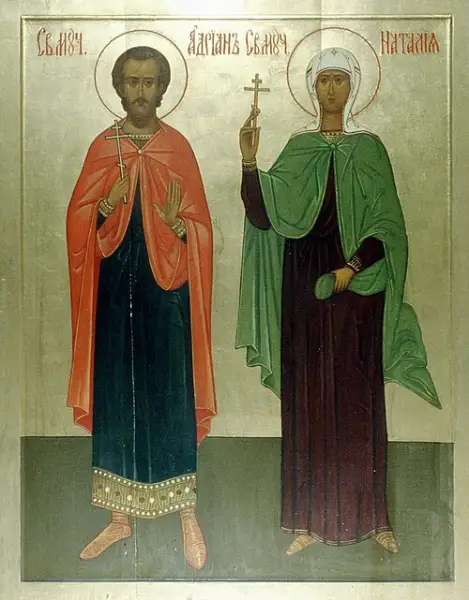
What follows belongs almost as much to Natalia as to Adrian. Forbidden visitors, she came to the prison dressed as a boy to sit beside her husband and ask for his prayers when he came to heaven — an inversion of every conventional petition, the wife asking the condemned man to intercede for her. She was present at his execution and, in the later tradition, rescued and cherished one of his severed hands. Her role made the pair a model of married sanctity: not two independent martyrs but a household in which one spouse's confession became the other's vocation, and the widow's fidelity completed what the husband's death began. Churches of the East and West came to invoke them together, and their joint feast on 8 September spread across the calendars of both. Eastern calendars honor her as equal to the martyrs, and icons of the pair — the soldier and the woman in widow's dress side by side — became one of the few standing images of married sanctity in a calendar crowded with virgins.
§ Introduction
Martyrdom
Brought before Galerius himself, Adrian was demanded to renounce his new faith; he refused and proclaimed Christ to the emperor. Ordered into the arena with a lion, he was left unharmed when the animal refused to attack him — the motif of Daniel's lions borrowed for a guardsman's trial. Enraged, the court ordered the execution that made him famous in art: his limbs broken on a blacksmith's anvil, a death of deliberate cruelty intended for an officer who had betrayed his class. He died on 4 March 306. Natalia survived him, refusing remarriage in the tradition of the Acta, and the later accounts bring her to the relics at Argyropolis in Thrace, near Constantinople, where she died in peace and was buried beside the martyr. The anvil, an executioner's tool chosen for a soldier, became his emblem in art and the source of his patronage of metalworkers and of those who suffer diseases of the body's members.
§ Introduction
Veneration
Adrian belongs to the pre-congregation martyrs, honored from the generation after the persecution itself. His relics were gathered at Argyropolis near Constantinople, a major shrine of the Byzantine world; other principal shrines rose at Geraardsbergen in Flanders and at the church of Sant'Adriano al Foro in Rome, which was adapted from the Senate house of old Rome. For many ages he ranked as Northern Europe's foremost military saint, with only Saint George above him, and he remains deeply honored in Flanders, Germany, and northern France. His calendar days are 8 September with Natalia and 1 December; the East keeps the pair among the great martyrs, and the Coptic Church venerates them as well. The double feast of 8 September, shared by husband and wife, reflects the translation of their relics together, and the Western martyrologies add the December observance from the old Roman books.His name entered the litanies of the North as naturally as George's own.
§ Introduction
Legacy
The couple's legacy runs along two lines. As military patron, Adrian rode with the armies and guilds of the medieval North: armed and anvil-marked, he appears on banners, bells, and town seals from Flanders to the Baltic, and Geraardsbergen's great relic shrine made him a destination of pilgrimage. As a married pair, he and Natalia became the standing example of holiness within marriage tested to the breaking point — the unbaptized confessing husband, the wife who visits in disguise, the relics handed between spouses. The odd modern patronage of those suffering eating disorders, attached to him through the anvil and the broken body, shows how a martyr's attributes keep generating new meanings for new sufferers. In an age when the Church asks again what martyrdom costs and who pays it, the guardsman who crossed the bench and the wife who kept his memory offer a pattern that has never lost its force.
§ Introduction
Timeline
- 4 Mar 306
Executed at Nicomedia with 23 fellow Christians; a storm quenches the executioners' fire and Natalia recovers one of his hands
§ Martyrdom
- 630
Sant'Adriano al Foro, a church in the Roman Forum, is founded and named in his honour
§ Feast day and patronage
- 1958
When the old church is demolished, his dedication passes to a new Roman church on the Villa Albani site
§ Feast day and patronage
In Their Own Words
Eye hath not seen, nor ear heard, neither has entered into the heart of man, the things which God hath prepared for them that love him.
The Record
- Patron of
- Martyrdom·Guards and soldiers·Those with eating disorders·Peacekeeping missions
- Symbols
- Depicted armed, with an anvil in his hands or at his feet
- Canonization
- Pre-congregation; ancient cult in both East and West
Prayer
Bibliography
Show 12 sources
- ↑ Jones, Terry. "Adrian of Nicomedia" . Patron Saints Index . Archived from the original on 1 January 2008 . Retrieved 2007-12-29 .
- 1 2 3 Kirsch, J.P. (1910). "Hadrian" . The Catholic Encyclopedia . Vol. 7. Robert Appleton Company . Retrieved 2007-12-29 .
- ↑ Holweck, F. G. (1924). A Biographical Dictionary of the Saints . St. Louis: B. Herder Book Co.
- ↑ "St. Natalia, Martyr", Antiochian Orthodox Christian Archdiocese
- ↑ 1 Corinthians 2:9
- ↑ "St. Adrian" . Catholic Online Saints & Angels . Archived from the original on 3 March 2008 . Retrieved 2008-03-04 .
- 1 2 3 4 "Saints Adrian and Natalia of Nicomedia and the 23 Martyrs With Them" . ORTHODOX CHRISTIANITY THEN AND NOW . Mystagogy Resource Center. 26 August 2015 . Retrieved 29 September 2026 .
- ↑ Father Lawrence Jagdfeld, O.F.M. (4 March 2025). "St. Adrian of Nicomedia" . Order of Friars Minor . Saint for a Minute . Retrieved 29 September 2026 .
- ↑ "Wooden statue of St Adrian" . Science Museum Group . © The Board of Trustees of the Science Museum . Retrieved 29 September 2026 .
- ↑ "August 26: Saints Adrian and Natalie" . Orthodox Metropolitanate of Hong Kong and South East Asia . © OMHKSEA. 13 August 2026 . Retrieved 29 September 2026 .
- ↑ "Martyr Adrian of Nicomedia", Orthodox Church in America
- ↑ Monks of Ramsgate. “Hadrian”. Book of Saints , 1921. CatholicSaints.Info. 22 May 2017 This article incorporates text from this source, which is in the public domain .
Profile text adapted from the Wikipedia article, licensed CC BY-SA 4.0.
Pray with this saint every day
Save Sts. Adrian and Natalia of Nicomedia to your favorites, read the full profile, and get feast-day reminders in the Saints app.
Get the Saints AppFree on the App Store for iPhone and iPad