
d. 315·Feast November 2
Sts. Agapius, Atticus, Carterius, Styriacus, Tobias, Eudoxius, Nictopolion and Companions
Martyrs of Sebaste
Overview
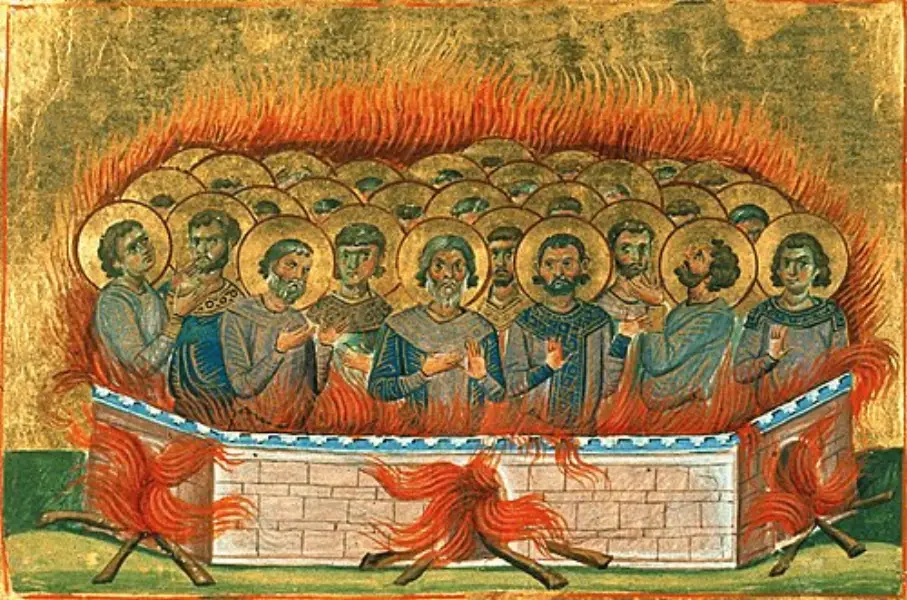
Agapius, Atticus, Carterius, Styriacus, Tobias, Eudoxius, Nictopolion — with their fellow martyrs — are honored as Christians put to death by fire at Sebaste — modern Sivas in Armenia Minor — in the year 315, during the reign of the emperor Licinius. They were soldiers, and they died as soldiers who would not obey the one command their conscience forbade: the sacrifice to the gods of the empire. The Latin notices know them under slightly different name-forms — Styriacus also as Styrax or Istucarius, Tobias also as Pactobius. Their cult is chiefly Byzantine: the Menologion of Basil II preserves their image, and the liturgical books of the East carry their commemoration, where the Menaion's notice keeping the memory of the Holy Martyrs Agapius and his Seven Companions puts the group's death by beheading on 24 March 304 — a divergent tradition that points to an earlier passion under Diocletian, later conflated with the Licinian burning. The Roman martyrologies keep them on 2 November.
The Complete Life
The Group and Its Names
The martyrs are known to us only as a group. The name-list — Agapius, Atticus, Carterius, Styriacus, Tobias, Eudoxius and Nictopolion, together with unnamed companions — has come down in variant spellings: Styriacus appears also as Styrax or Istucarius, and Tobias as Pactobius, forms that suggest the names travelled from a Greek or Syriac original through Latin copyists. All are identified as soldiers. Individually they are silent; collectively they are a witness to the way the persecutions of the early fourth century fell on the army, where refusal to sacrifice was read as mutiny.
§ Introduction
Martyrdom at Sebaste
The Latin notice, which follows Catholic Online's entry for St. Carterius, has the men put to death by fire at Sebaste in 315, under the rule of Licinius. Sebaste — Sivas today — had already seen the Forty Martyrs frozen on its lake a few years later, and the city's Christian memory clustered such deaths together. The Byzantine liturgical tradition, whose Book of Menaion keeps the Holy Martyrs Agapius and his Seven Companions, assigns instead a beheading on 24 March 304 — the Diocletianic persecution rather than the Licinian. It remains unsettled whether one group or two overlapping traditions are involved; both accounts survive.
§ Introduction
Cult
The martyrs are pre-congregation saints of both the Roman and the Byzantine calendars. The West keeps them on 2 November; the Menaion commemoration with its March date belongs to the Byzantine liturgical year. Their image is preserved in the Menologion of Basil II, the great illustrated synaxarium of about the year 1000 and a principal witness to their place in Byzantine devotion.
§ Introduction
Legacy
These martyrs matter today chiefly as evidence of the church of the army: men whose baptism put them at odds with their oath, and who resolved the conflict at the cost of their lives. Their double tradition, burning under Licinius and beheading under Diocletian, also shows how the calendars accumulated layers rather than discarding them — the church remembered both stories rather than choosing.
§ Introduction
Timeline
- 24 Mar 304
Menaion tradition records Agapius and his seven companions beheaded on this date
§ Introduction
- 315
Soldier martyrs burned at the stake at Sebaste in Armenia during the reign of Emperor Licinius
§ Introduction
The Record
- Patron of
- Soldiers
- Symbols
- Flames (martyrdom by fire)·Soldier's arms
- Canonization
- Pre-congregation; commemorated in the Byzantine Menaion
Prayer
Bibliography
Show 2 sources
- 1 2 "St. Carterius" . Catholic Online. 2010 . Retrieved January 22, 2010 .
- ↑ Raya, Archbishop Joseph (1969). Byzantine Daily Worship . Alleluia Press. p. 654.
Profile text adapted from the Wikipedia article, licensed CC BY-SA 4.0.
Pray with this saint every day
Save Sts. Agapius, Atticus, Carterius, Styriacus, Tobias, Eudoxius, Nictopolion and Companions to your favorites, read the full profile, and get feast-day reminders in the Saints app.
Get the Saints AppFree on the App Store for iPhone and iPad