
Early Christian era (Coptic tradition)·Feast 8 Hatour (Coptic calendar, with Mercurius on 25 Hatur traditions)
Sts. Ahrakas and Augani
Companions of Saint Mercurius
Overview
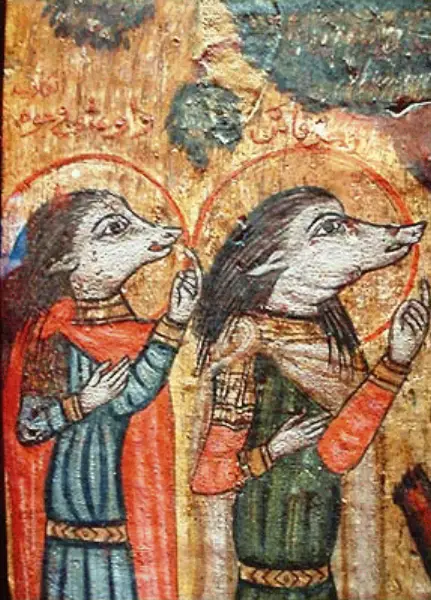
Ahrakas and Augani (also spelled Ahraqas and Oghani) are saints of the Egyptian Coptic Christian tradition, the companions and bodyguards of Saint Mercurius, the soldier-martyr of the third century. In Coptic iconography they are portrayed as cenocephalic — dog-headed — a survival of the ancient legend of the cynocephali, the dog-headed races said to dwell at the edges of the world. According to the legend, two cynocephali devoured the grandfather of Saint Mercurius and were on the point of devouring his father as well when an angel came and ringed them about with fire; overcome with repentance, they joined the father's company and afterward went with Mercurius into battle as his guard. The pair are known today chiefly from an eighteenth-century icon attributed to Ibrahim al-Nassikh in the Coptic Museum in Cairo, which shows them beside the horseman-saint. Their cult belongs to the imaginative world of the Coptic synaxary and its Armenian parallels — scholarship has traced the icon's imagery to Armenian prototypes — where the monstrous races of ancient ethnography were received into the company of the redeemed and given a place beside the martyrs.
The Complete Life
The Legend
The Coptic legend of Ahrakas and Augani begins in violence: two cynocephali — dog-headed men of the races ancient geographers placed at the world's edge — devoured the grandfather of Saint Mercurius and were about to devour his father too when an angel came and cast a ring of fire around them. Face to face with that divine power, the two repented, were received into the family's company, and became its protectors. The tale belongs to a large family of stories in late antique and medieval hagiography in which the monstrous races of pagan ethnography meet the Gospel and are converted: the alien becomes the guardian, the devourer the bodyguard.
§ Introduction
Companions of Mercurius
In the tradition the two accompanied Mercurius into battle, serving as his companions and bodyguards. Mercurius — Abu'l-Seifein, 'father of the two swords,' the Coptic soldier-martyr killed under Decius — was the most popular of the warrior saints of Egypt, and his iconography is among the richest in Coptic art. To give him two dog-headed guards was to surround the greatest of soldiers with the fiercest of companions: an image of Christ's lordship over even the strangest of creatures, and of the loyalty even the outlandish owe the martyr. The Arabic synaxary of the Coptic Church, published in René Basset's edition of the Jacobite synaxary, transmits the tradition.
§ Sources
Veneration and the Icon
Ahrakas and Augani are known today principally through an eighteenth-century icon attributed to Ibrahim al-Nassikh in the Coptic Museum in Cairo, which shows the two dog-headed saints flanking or attending Mercurius. The scholarship on the image is substantial: A. Piankoff studied the dog-headed saints of the Coptic tradition in two papers for the Bulletin de la Société d'Archéologie Copte, and O. F. A. Meinardus traced the Armenian origin of the cynocephali iconography in the Coptic Museum. The icon's lineage through Armenian art shows the legend traveling between the churches of the Christian East before settling in Cairo.
§ Introduction
Legacy
The two saints are a small but telling fragment of the Coptic imagination: proof that the tradition's idea of holiness was wide enough to include even the legendary races at the margin of the world. Their story echoes the ancient Christian theme announced in the earliest icons of the conversion of the nations — that Christ's redemption reaches the ends of the earth and beyond the boundary of the human. They remain a curiosity of museum catalogues and a reminder that hagiography, like the psalms it grew from, summons all creatures to praise.
§ Introduction
The Record
- Symbols
- Dog-headed (cynocephalic) figures·Soldier's arms as companions of Mercurius
- Canonization
- Pre-congregation; commemorated in the Coptic Orthodox tradition
Prayer
Bibliography
Show 3 sources
- ↑ A. Piankoff: Deux Saints à la tête du chien , Bulletin de la Société d’Archéologie Copte 12, 1947, pg 58
- ↑ Coptic Museum, Old Cairo.
- 1 2 Stefanović, Danijela (2013). "The "Christianisation" of Hermanubis" . Historia: Zeitschrift für Alte Geschichte . 62 (4): 512. doi : 10.25162/historia-2013-0022 . ISSN 0018-2311 . JSTOR 24434042 .
Profile text adapted from the Wikipedia article, licensed CC BY-SA 4.0.
Pray with this saint every day
Save Sts. Ahrakas and Augani to your favorites, read the full profile, and get feast-day reminders in the Saints app.
Get the Saints AppFree on the App Store for iPhone and iPad