
d. 303 or 304·Feast November 18
Sts. Alphaeus and Zacchaeus
Lector and Deacon, Martyrs of Caesarea
Overview
Alphaeus and Zacchaeus were two Palestinian Christians put to death at Caesarea in 303 or 304, recorded by the church historian Eusebius, who was himself present in the city during the persecution, in his Martyrs of Palestine. Zacchaeus, a deacon of Gadara, was so named — after the short-statured tax collector of the Gospel — for his own short stature and sweet nature; hauled in from the countryside with the choice of apostasy or death, he confessed his faith boldly before the judges, endured torture, and was imprisoned. Alphaeus, his cousin, was lector of the church of Caesarea, of a high-status family of Eleutheropolis; when Christians crowded into the city to perform the demanded sacrifices, he loudly and publicly denounced their apostasy, was hauled before the judges, refused to sacrifice, and made defiant statements of faith. The two were tortured together over days, repeatedly offered freedom for one act of worship, and refused to the end, winning what Eusebius called the crown of the holy martyrs — the only two of that round of arrests at Caesarea to die.
The Complete Life
Background
The story of Alphaeus and Zacchaeus reaches us from the best possible source: Eusebius, bishop of Caesarea, who witnessed the persecution in his own city and wrote the Martyrs of Palestine in two recensions, longer and shorter, both of which recount these martyrs, though with variations. The setting is Caesarea Maritima, the Roman capital of Palestine, in the first years of the fourth century. Diocletian, the emperor, had commanded that everyone in the empire worship the Roman gods and offer sacrifice, and the authorities in Caesarea were so zealous that, in Eusebius's shorter recension, they grabbed one Christian leader by the hands, walked him to the altar, and pressed the offering into his right hand, sending him off as though he had sacrificed; they even agreed to attest that two others had made offerings who had not. Against that background of coerced and fabricated conformity, genuine refusal stood out starkly.
§ Persecution of Christians in Caesarea
Two Confessors
Christians had been brought in by the authorities from the countryside round about, faced with a choice between apostasy and death. Among them stood Zacchaeus, a deacon of Gadara, named — Eusebius explains in the long recension — for the Gospel's Zacchaeus, on account of his small stature and sweet nature. Before the judges he confessed his faith boldly; he was tortured and cast into a prison cell. His cousin Alphaeus served as lector of the Caesarea church, belonging to a high-status family of his native Eleutheropolis, Bayt Jibrin in the Judean hills. When crowds of Christians from the city and its environs, forced to choose between their principles and death, were streaming in to offer the sacrifices, Alphaeus loudly and publicly denounced their apostasy — the act of a reader, whose office was precisely to say aloud what the Church believes. The judges hauled him in and commanded him to sacrifice; he refused, and voiced defiant statements of his faith.
§ Introduction
Martyrdom
Over a period of days Alphaeus and Zacchaeus were tortured side by side; time after time the chance to sacrifice to the gods and go free was put to them, and time after time they refused, whatever the pain. Eusebius, who saw the arrests and knew the men of his own church, records the outcome in a sentence of quiet pride: of the many herded in from the region to worship the Roman gods on pain of death, just these two won the crown of the holy martyrs. This is the historian's way of saying that the prisons were full of Christians but the scaffold held only the steadfast, and that the church of Caesarea knew the difference and kept the names. Eusebius wrote within sight of the prison; his two recensions differ in detail but agree on the substance, the witness of a man who was in the city when they died rather than the echo of a tale that had traveled.
§ Introduction
Commemoration
Alphaeus and Zacchaeus belong to the pre-congregation martyrs, commemorated on 18 November in the Western martyrologies. Their cult rests entirely on Eusebius's testimony, which for the martyrs of Palestine is the primary narrative source, and on the calendars that drew from it. They are not to be confused with the New Testament figures Alphaeus the father of apostles and Zacchaeus of Jericho — the coincidence of names is the historian's, not the hagiographer's, and the deacon's nickname shows how alive Gospel memory was among Palestinian Christians. What is commemorated is exact and small: two names, one date, one church, one historian who stood nearby and wrote it down before the memory could soften into legend. The Western martyrologies took the commemoration from his pages and copied rather than embroidered.
§ Introduction
Legacy
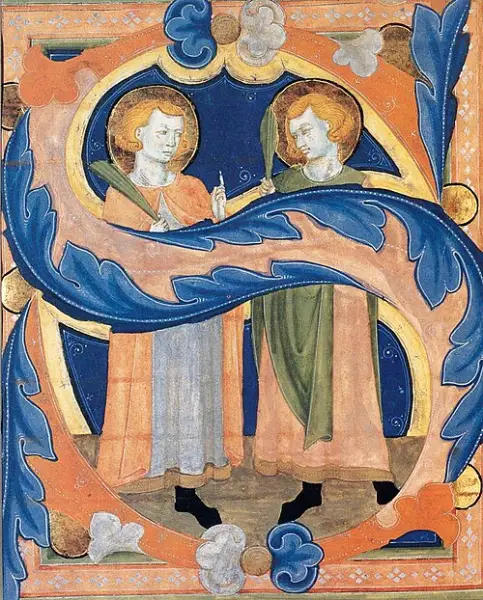
The legacy of Alphaeus and Zacchaeus is bound to the honesty of Eusebius's record. Because he stayed in Caesarea through the persecution and wrote both a long and a short account, historians can see the machinery of the great ordeal from inside: the fabricated sacrifices, the coerced offerings, the faces struck for speaking — and then the two men, cousins, reader and deacon, who would not. Fourteenth-century Italian painting kept their memory, with an initial-letter illumination of two martyr saints; and each November the Church remembers the little and the loud, the sweet deacon and the defiant lector, as one crown in two witnesses. For the rest, the record is the historian's own: the church of Caesarea learned of the two deaths from a member of its congregation, and has repeated his account ever since. Wherever his pages went, the two names went with them, cousin beside cousin.
§ Introduction
Timeline
- 303
Diocletian requires sacrifice to the Roman gods empire-wide; Caesarea's officials press Christians to comply or die
§ Persecution of Christians in Caesarea
- 303
Zaccheus, a deacon from Gadara, confesses boldly before the judges and, after torture, is jailed
§ Zaccheus
- 303
Alphaeus, lector of the Caesarea church from a leading Eleutheropolis family, openly rebukes the crowds apostatizing
§ Alphaeus
- 303
Tortured together over days and refusing every offer of freedom, the cousins are beheaded the same day; Eusebius dates their deaths 303 or 304
§ Martyrdoms
The Record
- Patron of
- Palestinian Christians·Lectors and deacons (by their offices)
- Symbols
- Palm of martyrdom·The lector's book
- Canonization
- Pre-congregation martyrs of the Diocletian persecution
Prayer
Bibliography
Show 4 sources
- ↑ Eusebius. " Martyrs of Palestine , short recension, I" . Retrieved 17 April 2013 .
- 1 2 3 4 Eusebius. " Martyrs of Palestine , long recension, III" . Retrieved 17 April 2013 .
- ↑ Butler, Rev.Alban. "The Lives of the Saints, 1866" . Retrieved 17 April 2013 .
- ↑ Bishop of Caesarea, Eusebius (2005), History of the Martyrs in Palestine: Discovered in a Very Ancient Syriac Manuscript , p. 5
Profile text adapted from the Wikipedia article, licensed CC BY-SA 4.0.
Pray with this saint every day
Save Sts. Alphaeus and Zacchaeus to your favorites, read the full profile, and get feast-day reminders in the Saints app.
Get the Saints AppFree on the App Store for iPhone and iPad