
died c. 251·Feast May 10
Sts. Alphius, Philadelphus and Cyrinus
Martyr Brothers
Overview
Alphius, Philadelphus and Cyrinus, in Italian Alfio, Filadelfo and Cirino, were a trio of brothers from Vaste, in the southern Italian diocese of Otranto, who met death as martyrs in the persecution of Decius around 251, together with their mother Benedicta. The details of their martyrdom are traditional, set down at a later date in the Benedictine Acta of Saint Alphius. According to the Acta, the brothers, ranging from nineteen to twenty-two years of age, and their mother were seized along with other Christians and brought to Pozzuoli, near Naples, where a member of the group, Onesimus, was put to death. The brothers were then carried on to Sicily and put to death at Lentini, where they rank among the patron saints. Alphius's tongue was torn out; Philadelphus died at the stake; Cyrinus was scalded to death in boiling oil. Of Benedicta's execution no detail is given. Their feast is kept on 10 May at Trecastagni in Sicily, where their cult is immense, and on Labor Day weekend by the Italian community of Lawrence, Massachusetts. The Sicilian town of San Fratello, the brothers' town, is named for them.
The Complete Life
Early Life
The three brothers came from Vaste, a town of the Salentine peninsula in the diocese of Otranto, the heel of Italy, where the Greek-speaking Christianity of the Byzantine tradition had taken early and deep root. Their mother was Benedicta, whose name suggests a Christian household of long standing, and the Acta give their ages at death as between nineteen and twenty-two, three sons of one house falling within four years of one another. The persecution of Decius, which broke upon the church in 249, was the first to require of all subjects of the empire, not merely of the accused, an act of conformity, a certificate of sacrifice to the gods; it was therefore the first persecution that made flight and hiding no protection, and whole families found themselves swept into the net. A widow of the Greek south with three grown sons would have had few places to hide and, as the tradition tells it, no wish to. The family that the Acta present, mother and sons confessing together, is the portrait the church drew of the household as the first and smallest community of martyrdom.
§ Introduction
Arrest and Journey
The Acta carry the family through a martyrdom's progress. Arrested with a company of other Christians, they were taken first to Pozzuoli, the volcanic city by Naples whose amphitheatre and whose memories of earlier executions made it a natural place of judgment; there Onesimus, one of their fellow prisoners, was put to death before them. The brothers were then shipped onward to Sicily, a journey of interrogation and display, and were executed at Lentini, the town inland from Syracuse whose patron saints they became. The division of the party, some dying at Pozzuoli and some in Sicily, is the kind of detail that suggests a real tradition of a translated company of martyrs, such as the church of the south possessed several. The ages of the brothers, and the presence of their mother through it all, gave the story its hold: three young men, of an age to fear everything, and a widow who had taught them not to.
§ Introduction
Martyrdom
The deaths, as the Acta give them, were differentiated with a literalness the medieval imagination required: Alphius, whose confession had been most public, had his tongue torn from his mouth, the punishment of the witness who would not stop preaching; Philadelphus was burned at the stake; Cyrinus was boiled alive in oil. Of Benedicta the Acts say only that she was martyred, the restraint perhaps a mark of respect, or the loss of a page. The threefold execution, each brother dying by his own torment in the sight of the others, was told in the south as the ultimate test of fraternal endurance: none of the three, seeing the others die, recanted. The tradition that the brothers were twins, or as some versions say identical, the autadelphoi of the Greek title, made the point sharper still: the same face three times, and each face constant. Such elaborations belong to the piety rather than the record, but the record of their cult is beyond dispute.
§ Introduction
Canonization
The three brothers belong to the Byzantine stratum of sanctity in southern Italy and Sicily, the layer of martyrs whose cult was fixed under the Greek monks and the Greek rite before the Latinization of the island. Their feast on 10 May is kept with extraordinary fullness at Trecastagni, on the slopes of Etna above Catania, where the annual festa is among the great popular devotions of Sicily, and at Lentini, their place of death, where they are the chief patrons. The town of San Fratello, in the Nebrodi mountains, bears their collective name, saintly brothers, and keeps their memory as its identity. In 1903 their relics, discovered at Lentini, gave the cult a material center. No formal canonization was ever needed; the Byzantine and then the Latin church of Sicily inherited these martyrs as founders of their local memory, and the calendars of both rites keep them.
§ Introduction
Legacy
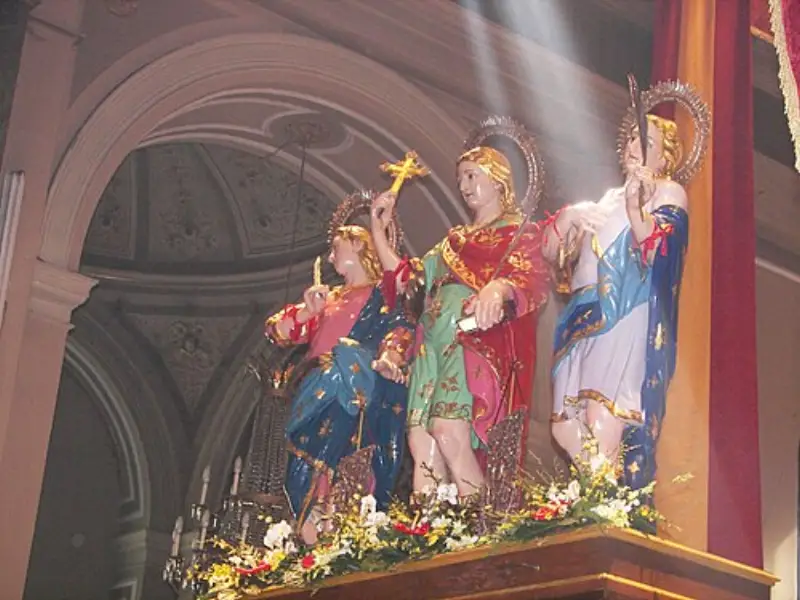
The cult of the three brothers is one of the most vivid survivals of Byzantine Christianity in the Italian south. At Trecastagni the May festa draws thousands, with processions, lights and the carrying of the statues of the three saints through the town, a celebration that has continued under every ruler of Sicily for centuries. Across the Atlantic, the immigrants of the Sicilian diaspora carried the cult to Lawrence, Massachusetts, where the Italian community keeps the brothers' feast on Labor Day weekend with one of the oldest Italian-American religious festivals in the United States, an entire neighborhood's year organized around three martyrs of the Decian persecution. The story they carry, of a mother and three sons, has proved to be one of the most portable in the calendar: wherever families have had to hold together under pressure, the brothers of Vaste have been invoked, and the tongue of Alphius, torn out for preaching, has remained the emblem of confession that cannot be silenced.
§ Introduction
Timeline
- 251
Arrested with their mother Benedicta and other Christians during the persecution of Emperor Decius
§ Introduction
- 251
Taken to Pozzuoli near Naples, where their fellow prisoner Onesimus is executed
§ Introduction
- 253
Martyred at Lentini in Sicily — Alphius' tongue torn out, Philadelphus burned at the stake, Cyrinus boiled in oil
§ Introduction
The Record
- Patron of
- Lentini and Trecastagni, Sicily·San Fratello·The Italian community of Lawrence, Massachusetts
- Symbols
- Three brothers together·Palm of martyrdom
- Canonization
- Pre-congregation; ancient Byzantine-rite cult in Sicily and the south
Prayer
Bibliography
Show 1 sources
Profile text adapted from the Wikipedia article, licensed CC BY-SA 4.0.
Pray with this saint every day
Save Sts. Alphius, Philadelphus and Cyrinus to your favorites, read the full profile, and get feast-day reminders in the Saints app.
Get the Saints AppFree on the App Store for iPhone and iPad