
died c. 304·Feast October 11 (Catholic); October 12 (Greek Orthodox)
Sts. Andronicus, Probus, and Tarachus
Martyrs of Tarsus in Cilicia
Overview
Andronicus, Probus, and Tarachus were martyrs of the Diocletian persecution, put to death about 304 in Cilicia in Asia Minor, and honored together in the calendars of East and West. According to the first version of their Acts, the three made an unlikely trio: Tarachus, a Roman of about sixty-five, a native of Claudiopolis in Isauria and a former soldier; Probus, a plebeian of Side in Pamphylia; and Andronicus, a patrician of a prominent family of Ephesus. Tried before the governor Numerian Maximus, they were horribly tortured in three successive cities of Cilicia — Tarsus, Mopsuestia, and Anazarbus — the record intending by sheer accumulation to show a constancy no cruelty could shake: Tarachus endured a stoning; Probus underwent the whip, red-hot irons against his feet, heated spits driven into his back and sides, and at the last the knife; Andronicus likewise died under the knife. Condemned then to the beasts, they were untouched by the animals in the amphitheatre, and were finally killed with the sword. Three witnesses of the martyrdom — Marcian, Felix, and Verus — retrieved the bodies, buried them, watched over them for the rest of their lives, and asked to be buried in the same vault at the end. Tarachus is honored in the Maronite Church as Mar Edna — 'the ear' — from his mutilation, and is invoked for ailments of the ear.
The Complete Life
Three Men of Asia Minor
The Acts give the three martyrs carefully differentiated origins, and the differences are part of the meaning. Tarachus was a Roman, a native of Claudiopolis in Isauria, the rough hill country of the Taurus, and a former soldier; his age at trial is given as about sixty-five, which made him the veteran of the three. Probus was a plebeian of Side, the port city of Pamphylia with its great theater on the Mediterranean. Andronicus was a patrician, sprung from a leading family of Ephesus, metropolis of the Asian province. Soldier and commoner and aristocrat, Isaurian and Pamphylian and Ephesian: the composition reads as deliberate, a small image of the whole society of Asia Minor confessing one faith — the older hagiographic device of the representative trio, which in this case the extant Acts apply with unusual specificity of place and rank. The differentiation of rank and city in the Acts is the older hagiographic device of the representative trio, applied here with unusual specificity of place.
Trial on Circuit
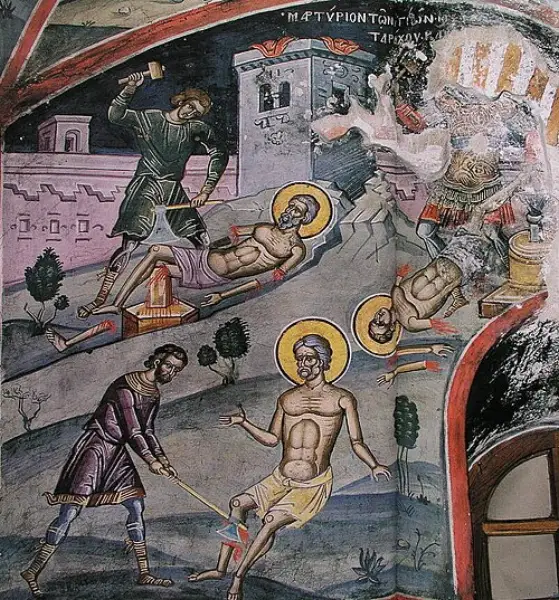
The three were tried by the governor Numerian Maximus, and the Acts describe a prosecution that moved with them from city to city. Thrice over, in differing cities of Cilicia — among them Tarsus, Mopsuestia, and Anazarbus — they were interrogated and savagely tortured, an arrangement that reflects the real practice of the Diocletian persecution's later years, when confessors who would not yield were sent on circuit, partly in hope that different judges and different torments would break them, partly as exhibition. In the traditional account, Tarachus endured stoning; Probus underwent whipping, burning of his feet with red-hot irons, piercing of his back and sides by heated spits, and at the last the knife; Andronicus too met death by dismemberment. Sentenced to the beasts, the three were set out in the amphitheatre; since the animals declined to touch them, the executioners finished them with the sword.
The Acts and Their Critics
Two versions of the Acts of Andronicus, Probus, and Tarachus survive, and the modern notice states flatly that both are medieval fictions. The first (BHG 1574) is printed in the Acta Sanctorum; the second (BHG 1575) is a revision by Simeon Metaphrastes, the tenth-century Constantinopolitan editor of the saints' lives, printed in the Patrologia Graeca. Thierry Ruinart, the great Maurist student of the acts of the martyrs, held the first version to be entirely authentic; Adolf von Harnack doubted the account's genuineness; and Hippolyte Delehaye, whose classification remains normative, put the martyrdom among the legends he called historical romances — narratives built around a real martyrdom whose original record had been lost. The feast, kept in the Roman Catholic Church on 11 October and in the Greek Orthodox Church on 12 October, is older than the argument: whatever the Acts' date, the church of Cilicia was honoring these men long before the critics took up the question.
Mar Edna of the Lebanon
The most durable popular cult of the three belongs to Tarachus alone, in the Maronite Church of Mount Lebanon. There he is venerated as Mar Edna — in Syriac, 'my lord Ear' — a name drawn from the tradition that Roman torturers severed his ears, and he is invoked as patron by those afflicted with ailments of the ear. The Mar Edna monastery at Aqoura, in the Lebanese mountains, and the church of Mar Edna at Ain Akrine keep his feast and his name, and his iconography in the western tradition likewise recalls that torture: Tarachus appears as an aged man clad in the robes of a Roman citizen and holding a spear, his companions carrying crosses or spears. A fresco of the three martyrs survives in the martyrion of Dionysiou Monastery on Mount Athos. The trio's afterlife thus runs from the amphitheatres of Cilicia to the villages of the Lebanese hill country — a reach the prosecutors at Tarsus did not imagine.
Timeline
- 239
Tarachus, a native of Claudiopolis in Isauria and a former Roman soldier, is born
§ Legend
- 304
The three are tried by Governor Numerian Maximus and tortured in Tarsus, Mopsuestia, and Anazarbus
§ Legend
- 304
Tarachus is stoned, Probus whipped, burned, and pierced with spits, and both he and Andronicus are cut up with knives
§ Martyrdom of Andronicus, Probus, and Tarachus
- 304
Condemned to wild beasts, the three are untouched by the animals and are then killed with the sword
§ Martyrdom of Andronicus, Probus, and Tarachus
- 304
Witnesses Marcian, Felix, and Verus retrieve and bury the martyrs' bodies, later asking to share their vault
§ Martyrdom of Andronicus, Probus, and Tarachus
The Record
- Patron of
- Those suffering ear ailments (Tarachus)·Aqoura and Ain Akrine, Lebanon
- Symbols
- Tarachus as an elderly Roman citizen with a spear; the others with crosses or spears·Palm of martyrdom
- Canonization
- Pre-congregation (ancient cult; martyrs of the Diocletian persecution)
Prayer
Profile text adapted from the Wikipedia article, licensed CC BY-SA 4.0.
Pray with this saint every day
Save Sts. Andronicus, Probus, and Tarachus to your favorites, read the full profile, and get feast-day reminders in the Saints app.
Get the Saints AppFree on the App Store for iPhone and iPad