
d. 1347·Feast April 14 (main); July 13 (Vilnius monastery commemoration)
Sts. Anthony, John, and Eustathius of Vilnius
Orthodox Martyrs of Vilnius
Overview
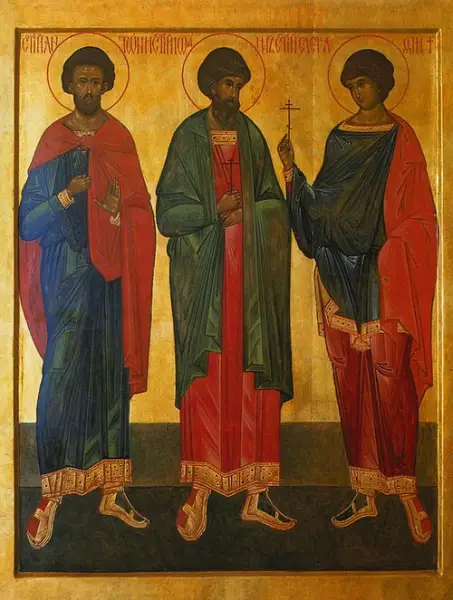
Anthony, John, and Eustathius, the Martyrs of Vilnius, were three Lithuanian courtiers of Grand Duke Algirdas who died for their Orthodox Christian faith in 1347. Originally named Kumetis, Nezilas and Krulis, the first two were brothers and the third their cousin. They were converted through the Orthodox milieu that the duke's first wife, Maria of Vitebsk, brought to Vilnius with her priest Nestor; at her request a church was built, and there Nestor baptized the three, giving them their Christian names. After Maria's death Algirdas returned to open support of paganism, and pagan priests began to persecute Christians. The three converts stood out: they refused to join pagan worship, were observed keeping Orthodox fasts, and did not cut their hair and beards in the pagan fashion. Hauled before Algirdas and commanded to take meat, they would not, for it was the season of the Great Fast. Anthony was hanged on 14 April 1347 on an oak sacred to the pagans; John was seized by a crowd and strangled, his body hung on the same oak on 24 April; and Eustathius was hanged on the same tree on 13 December 1347. The Monastery of the Holy Trinity was later built where they died.
The Complete Life
Early Life
The three were Lithuanians of the pagan court aristocracy — Kumetis, Nezilas and Krulis by birth, the first two brothers, the third their cousin — serving at the court of Algirdas, the pagan grand duke whose realm was the last pagan polity in Europe. Their route to Christianity ran through a dynastic marriage: Algirdas had wed the Orthodox princess Maria of Vitebsk, who brought with her an Orthodox priest, Nestor. At her request an Orthodox church was built in Vilnius, and there Nestor baptized the three courtiers, giving them the names Anthony, John, and Eustathius.
§ Life
Christians at a Pagan Court
After Maria's death, Algirdas again openly supported paganism, including the pagan priests who began persecuting Christians. The converts made no secret of themselves: they kept away from pagan rites, were observed keeping the Orthodox fasts, and left their hair and beards unshorn where the pagans shaved theirs — visible marks of a divided loyalty in a court where religion was politics. The Lithuanian nobles grew suspicious and interrogated them. The crisis came over food: when Algirdas in person commanded them to take meat, they would not, since the Lenten discipline of the Orthodox forbade it. The refusal was at once trivial and total — a matter of diet that touched the allegiance of the whole man.
§ Life
Martyrdom in 1347
For the refusal they were tortured and imprisoned. On 14 April 1347 Anthony died hanging from an oak the pagans held sacred — the execution deliberately staged as a sacrifice on holy ground. John was afterwards swarmed by a crowd and strangled, his body hung on the same oak on 24 April; Christians buried both bodies in the Church of Saint Nicholas in Vilnius. Eustathius, held longer, was sentenced and hanged on the same tree on 13 December 1347. On the spot of their deaths there later rose the Monastery of the Holy Trinity.
§ Life
Veneration
Their relics were soon declared incorrupt. In 1364 Patriarch Philotheus of Constantinople sent a cross containing relics of the martyrs to Saint Sergius of Radonezh — a gesture binding the Lithuanian martyrs into the heart of Russian monasticism within a generation of their deaths. Their remains were set in a reliquary of glass in the crypt chapel below the cathedral's altar at the Monastery of the Holy Spirit in Vilnius; taken to Moscow during the German invasion of 1915, returned in 1947, and moved back to the monastery in 1997, they now rest in the cathedral's main sanctuary and are displayed to pilgrims.
§ Veneration
Legacy
The three martyrs are patrons of Vilnius, the shared heritage of a city that has been pagan, Orthodox, Catholic and Jewish in turn. Their story, studied by John Meyendorff as a window on Byzantium and Lithuania in the fourteenth century, preserves the moment when Lithuania's conversion was still contested — when a fast refused could cost a life, and an oak sacred to Perunas became a gallows for Christ.
§ Introduction
Timeline
- 14 Apr 1347
Anthony was hanged on an oak tree held sacred by the pagans
§ Life
- 24 Apr 1347
John, strangled by a crowd, was hung on the same oak; Christians buried both bodies at the Church of Saint Nicholas
§ Life
- 13 Dec 1347
Eustathius, sentenced to death, was hanged on the same oak tree
§ Life
- 1364
Patriarch Philotheus of Constantinople sent a cross with the martyrs' relics to Saint Sergius of Radonezh
§ Veneration
- 1915
During the German invasion the relics were taken to Moscow
§ Veneration
- 1947
The relics were returned to Vilnius and placed again in the cathedral's crypt chapel
§ Veneration
- 1997
The relics came home to Vilnius's Monastery of the Holy Spirit
§ Veneration
The Record
- Patron of
- Vilnius
- Symbols
- Oak tree·Martyr's ropes·Uncorrupt relics in the Monastery of the Holy Spirit, Vilnius
- Canonization
- Venerated in the Eastern Orthodox Church; also commemorated by the Roman Catholic Church
Prayer
Bibliography
Show 4 sources
- ↑ "Lives of all saints commemorated on April 14" . www.oca.org . Retrieved 2025-03-15 .
- ↑ "Holy Martyrs Anthony, John, and Eustathius of Vilnius" . OrthoChristian.Com . Retrieved 2025-03-15 .
- 1 2 3 "Martyrs Anthony, John, and Eustathius of Vilnius" . www.oca.org . Retrieved 2025-03-15 .
- ↑ "Martyrs Anthony, John, and Eustathius of Vilnius" . www.oca.org . Retrieved 2025-11-16 .
Profile text adapted from the Wikipedia article, licensed CC BY-SA 4.0.
Pray with this saint every day
Save Sts. Anthony, John, and Eustathius of Vilnius to your favorites, read the full profile, and get feast-day reminders in the Saints app.
Get the Saints AppFree on the App Store for iPhone and iPad