
d. 313·Feast May 3 (Catholicism); June 10 (Orthodoxy)
Sts. Antonina and Alexander
Legendary Virgin and Martyr, and her Rescuer
Overview
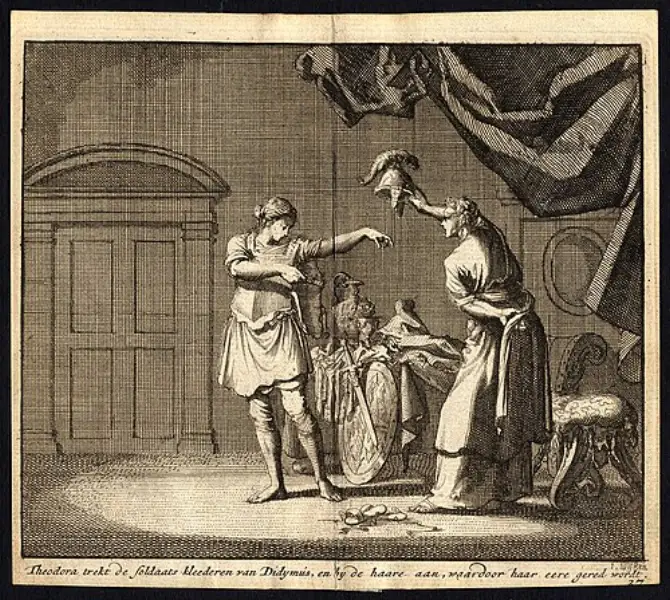
Antonina and Alexander, of Crodamon in Asia Minor, are Christian martyrs of the year 313 whose acta are frankly legendary — a twin of the better-known legend of Saints Theodora and Didymus of Alexandria, martyred in 304. In the tale, Antonina, a consecrated virgin, was condemned to a brothel, the penalty then prescribed for Christian women who refused to marry, and there a Christian soldier called Alexander came to her dressed as one of her customers. Rather than violate her, he changed garments with her, and Antonina got away in his armor. Alexander was discovered soon after; both he and Antonina were executed by being burned alive. The names themselves may have served as mnemonic devices that made the tale easier to repeat orally, and it is possible — perhaps even likely — that they were invented. Even if Theodora and Didymus were the originals, either legend could be the shadow of a real martyrdom since lost to the storytellers: the brothel penalty for virginity is historically real, and a rescue by substitution is the kind of thing a friend might attempt. The pair are commemorated on 3 May in the West and 10 June in the East.
The Complete Life
The Legend
The case is plain: the acta of Antonina and Alexander are legendary, and their tale is all but the same as Theodora and Didymus's. In that version, set at Alexandria in 304, the virgin Theodora refuses sacrifice before the prefect Eustratius, is condemned to a brothel, and is rescued by the soldier Didymus, who chases out the youths, exchanges clothes with her, and takes her place; Didymus is beheaded and his body burned; Ambrose adds that Theodora would not let her savior die alone and went to join him. Which pair came first — or whether both descend from a lost original — cannot be determined.
§ Legend
The Brothel Penalty and the Rescue
What gives the tale its grim verisimilitude is the legal background: condemnation to a brothel was an actual penalty for women who refused to wed, and the theme may reflect the institution of sacred prostitution once prevalent across the ancient Middle East, a practice remembered in Christian tradition with strong disapproval. Against that institution the legend sets the exchange of garments — the soldier's cloak for the virgin's — as its central image: the strong taking the place of the weak, and the weak walking free. It is the theology of the cross in a costume.
§ Legend
Cult
Antonina and Alexander are commemorated on 3 May in the Roman Catholic Church and 10 June in the Orthodox Church; the Theodora and Didymus version is kept by the Orthodox on 27 May and 5 April. Neither pair finds a place in the Roman Martyrology, the Catholic Church's official list of saints. The cult, such as it is, has lived in retellings more than in shrines.
§ References
Legacy
The legend's afterlife has been literary and musical: Corneille's 1645 tragedy Theodore, vierge et martyre, transferred to Antioch, failed after five performances; Robert Boyle's prose version, The Martyrdom of Theodora and of Didymus (1687), was read into the eighteenth century — Samuel Johnson praised it as the first work to dress religion in the ornaments of romance; and Handel's oratorio Theodora (1749), the composer's own favorite among his works, was based on the same story. A legend too doubtful for the martyrology has thus kept one of its clearest images of vicarious love in the church's imagination.
§ Adaptations
Timeline
- 313
Condemned to a brothel, the penalty for refusing to wed, at Crodamon in Asia Minor
§ Introduction
- 313
The Christian soldier Alexander visits her disguised as a customer and trades clothes so she can flee
§ Introduction
- 3 May 313
Alexander is soon discovered, and both are executed by being burned alive; the Catholic feast keeps this date
§ Introduction
The Record
- Symbols
- Virgin's veil·Soldier's garb exchanged·Flames of martyrdom
- Canonization
- Pre-congregation; not included in the Roman Martyrology (Theodora and Didymus tradition)
Prayer
Bibliography
Show 8 sources
- 1 2 "SS. Didymus and Theodora, Martyrs. April 28. Rev. Alban Butler. 1866. Volume IV: April. The Lives of the Saints" . www.bartleby.com . Retrieved 2018-03-17 .
- 1 2 "Virginmartyr Theodora of Alexandria" . oca.org . Retrieved 2018-03-17 .
- ↑ Monks of Ramsgate. "Theodora and Didymus". Book of Saints , 1921. CatholicSaints.Info. 12 November 2017 This article incorporates text from this source, which is in the public domain .
- ↑ Martyrologium Romanum (Libreria Editrice Vaticana, 2001, ISBN 88-209-7210-7
- ↑ Hunter, Michael; Davis, Edward B. (2000). The Works of Robert Boyle . London: Pickering & Chatto. pp. xiii.
- ↑ Tilden, Imogen (2012-08-27). "How we made: Peter Sellars and William Christie on Theodora" . the Guardian . Retrieved 2018-03-17 .
- ↑ "Alexander and Antonina the Martyrs", Greek Orthodox Archdiocese of America
- ↑ "Quarto die Maii" [ The Fourth Day of May ] . Martyrologium Romanum [ The Roman Martyrology ] . Gregory XIII, Pope. 1914 [1749]. p. 127. ISBN 9781497350298 . {{ cite book }} : ISBN / Date incompatibility ( help )
Profile text adapted from the Wikipedia article, licensed CC BY-SA 4.0.
Pray with this saint every day
Save Sts. Antonina and Alexander to your favorites, read the full profile, and get feast-day reminders in the Saints app.
Get the Saints AppFree on the App Store for iPhone and iPad