
died c. 303·Feast March 8 (December 14 in the Orthodox Church)
Sts. Apollonius and Philemon
Martyrs of Alexandria
Overview
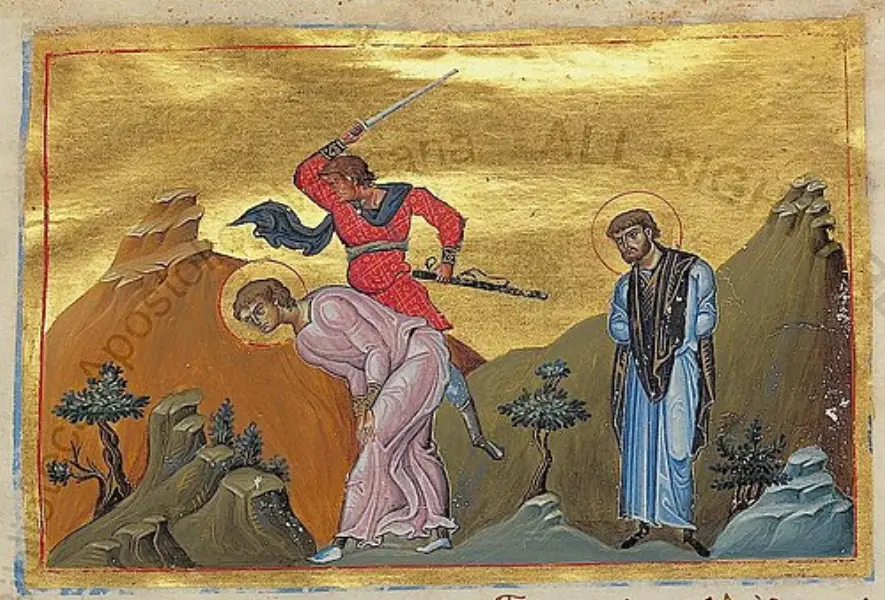
Apollonius, a deacon, and Philemon, his convert, were Christian martyrs of the persecution of Diocletian, put to death around 303 at Alexandria in Egypt. Philemon had made his name at Antinoöpolis, a city of middle Egypt, as a famous flute player, a mime and an actor — a professional entertainer, in other words, and by the standards of the preachers of the age a man of a suspect trade. The acts tell their story in a single episode: when the sacrifice to Jupiter was demanded of the deacon Apollonius, Philemon put on his clothes, intending, disguised as his friend, to perform the sacrifice in his stead and so save him from prison and death. But at the moment of the public sacrifice Philemon was recognized, and, brought to the point of choice, he declared himself a Christian and refused. The two were taken from Antinoë to Alexandria, where they died with many others who had accepted the faith: bound hand and foot, they were cast into the sea. Their feast is kept on 8 March in the West, and Philemon is the patron saint of dancers; the Orthodox church commemorates the pair on 14 December.
The Complete Life
The Two Men
The acts give the pair a sharply drawn professional contrast. Apollonius was a deacon of the church, presumably of Antinoöpolis, the Greek city Hadrian had built on the Nile in memory of his drowned favorite, a place of theaters and temples where the old cults and the new imperial demands met. Philemon was an entertainer, a famous flute player, mime and actor, one of the professionals of the stage whose trade the preachers of the age condemned and whose art the whole population enjoyed. How the two came to be friends the acts do not say; the connection presupposes Philemon's acquaintance with the Christian community and some bond of affection or of curiosity already formed, and later retellings have made Philemon Apollonius' convert, which the relationship implies. The story that follows turns on that bond, and on the instinct of a performer, accustomed to costume and impersonation, to solve a crisis by assuming a part: the entertainer would play the deacon, and play him at the most dangerous performance in the world.
§ Introduction
The Disguise and the Confession
When the edict of Diocletian demanded that the Christians sacrifice, Apollonius the deacon was marked for arrest and the altar. Philemon proposed to save him by substitution: he put on the deacon's clothes and went in his place to perform the sacrifice to Jupiter, trusting that the disguised layman, going through the motions, would satisfy the requirement and free his friend. The plan failed at the moment of its execution: Philemon was recognized, some versions say by his voice, the instrument of his profession, and the false deacon stood exposed before the altar he had come to deceive. Brought to the point of public choice, he found that he could not go through with the part: he declared himself a Christian, refused the sacrifice, and so converted the rescue of another man into his own confession. The acts, in this great reversal, show the difference between playing a Christian and being one; the actor who had put on the deacon's clothes discovered, in them, that he had put on the deacon's faith.
§ Narrative
Martyrdom at Alexandria
The two were brought from Antinoë down the river to Alexandria, the metropolis of Egypt, where the persecution raged with particular fury, and there they died among the many others who had come to believe in Christ, the phrase of the acts that quietly records the missionary effect of the trials. The manner of their death was drowning: bound hand and foot and cast into the sea, a mode the Alexandrian authorities used for batches of prisoners, as the contemporary letter of the churches of Vienne and Lyons records for another province and as Eusebius records for Egypt. The sea-martyrdom has given the pair their iconography and their poetry: the entertainer and the deacon, bound together, given to the water, around 303. The double death closes the story of the substitution: the man who tried to take the deacon's place at the altar took it at the end entirely, and the two who had exchanged clothes went into death together, indistinguishable to their executioners.
§ Introduction
Veneration
The cult of Apollonius and Philemon is old in both halves of the church. The western martyrologies keep their feast on 8 March, and the Orthodox church commemorates them on 14 December, the usual divergence of calendars for the martyrs of Egypt. Philemon in particular acquired a patronage as unexpected as it is durable: he is the patron saint of dancers, and by extension of the theatrical profession, the church having decided, in the case of the actor-martyr, to honor in heaven the trade it had preached against on earth. The choice made him a favorite figure of the Christian stage in every later century, when players needed a heavenly advocate and found one who had died for the faith in a deacon's borrowed clothes. The Ramsgate Benedictines' Book of Saints carries the pair among the martyrs of the great persecution, and the historians of the Egyptian church count them among the Alexandrian dead.
§ Introduction
Legacy
The pair's legacy runs chiefly through the arts. Philemon the dancer's patron made it possible for the theatrical professions to have a saint of their own, and their guilds and devotees have remembered him, especially wherever Christian performers have needed a warrant for their art. The story itself has proved one of the most retellable of the acts: in 1618 the Jesuit dramatist Jacob Bidermann made it the subject of his play Philemon Martyr, using the actor's conversion to argue, against the polemic of the age, that acting might serve as a possible path to moral and spiritual renewal, a defense of the theater mounted on the bones of an actor-martyr. In the twentieth century the British painter Albert Houthuesen returned to Philemon repeatedly, one of the minor obsessions of modern religious art. The tale endures because its irony is permanent: the costume became the conscience.
§ Legacy
Timeline
- 303
During the Diocletianic persecution, Philemon dons deacon Apollonius's clothes to offer the demanded sacrifice in his place
§ Narrative
- 303
Recognized just before the public sacrifice, Philemon declares himself a Christian and refuses to offer it
§ Narrative
- 303
The two are brought from Antinoë to Alexandria
§ Narrative
- 303
Bound hand and foot, the martyrs are cast into the sea alongside many other new believers
§ Narrative
The Record
- Patron of
- Dancers·Actors and entertainers·Flautists
- Symbols
- Flute·The sea
- Canonization
- Pre-congregation; ancient cult
Prayer
Bibliography
Show 7 sources
- 1 2 Monks of Ramsgate. "Philemon and Apollonius". Book of Saints 1921. CatholicSaints.Info. 29 December 2016 This article incorporates text from this source, which is in the public domain .
- ↑ Rollason, Nikki. Gifts of Clothing in Late Antique Literature Routledge, 2016, p. 139 ISBN 9781317128205
- ↑ Butler, Alban. "Saints Apollonius, Philemon, etc., Martyrs". Lives of the Fathers, Martyrs, and Principal Saints 1866. CatholicSaints.Info. 29 December 2016 This article incorporates text from this source, which is in the public domain .
- ↑ "Martyrs Philemon, Apollonios, Arrian, and Theonas of Alexandria", Orthodox Church in America
- ↑ Herdt, Jennifer A., Putting On Virtue: The Legacy of the Splendid Vices University of Chicago Press, 2012, p. 157 ISBN 9780226327198
- ↑ Neo-Latin Drama in Early Modern Europe (Jan Bloemendal, Howard Norland, eds.) BRILL, 2013, p. 277 ISBN 9789004257467
- ↑ Nathanson, Richard (2008). Walk to the Moon: The Story of Albert Houthuesen . The Putney Press. pp. 64, 171, 239. ISBN 978-0951621929 .
Profile text adapted from the Wikipedia article, licensed CC BY-SA 4.0.
Pray with this saint every day
Save Sts. Apollonius and Philemon to your favorites, read the full profile, and get feast-day reminders in the Saints app.
Get the Saints AppFree on the App Store for iPhone and iPad