
early 4th century·Feast October 29 (with Domnina and Theonilla)
Sts. Asterius, Claudius and Neon
Martyr Brothers of Aegeae
Overview
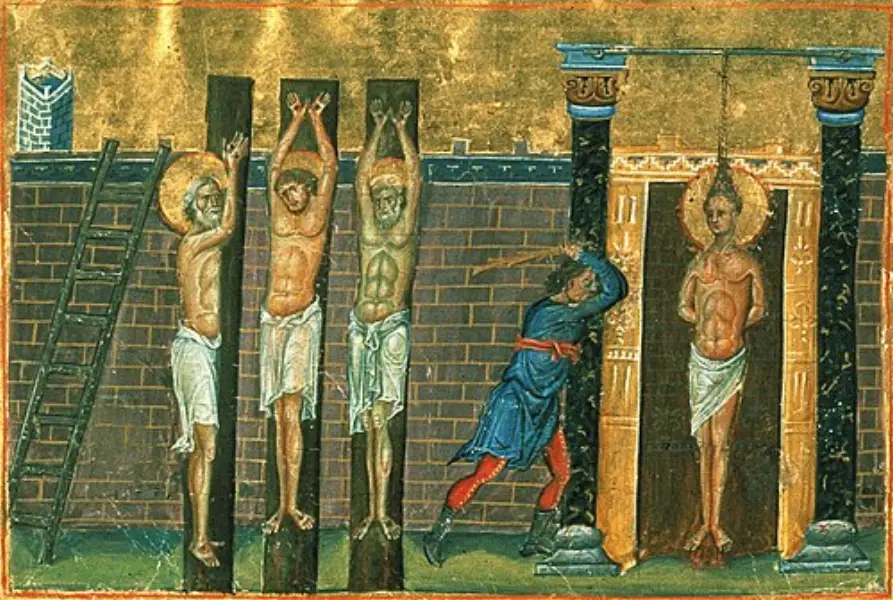
Asterius, Claudius and Neon were three brothers who suffered martyrdom in the persecutions of Diocletian. Together with two women, Domnina and the widow Theonilla, they were handed over to Lysias, the proconsul of Cilicia, at the city of Aegeae on the Cilician coast. Alban Butler's account preserves the tradition: the brothers were denounced to the magistrate of Aegeae by their own mother-in-law, whose principal view, he observes, was to possess herself of their estate. Held with the two women, arrested for the same offense of Christianity, they were presented to Lysias one by one when the proconsul convened his tribunal, and offered honors and rewards if they would sacrifice to the Roman gods, with torture and death if they refused. Speaking for the brothers, Claudius not only would not comply but hurled blasphemy at the gods of the state; torture was applied to every brother, no one retracted, and crucifixion was the sentence the proconsul passed on them. Domnina and Theonilla, refusing likewise, were tortured to death. So strict were the precautions taken over the five bodies that the Christians could not obtain possession of the relics. Their commemoration, with the women, is kept in the Byzantine calendar, where the Menologion of Basil II preserves the scene of their martyrdom.
The Complete Life
The Family and the Betrayal
The three brothers belonged to Aegeae, the port city of Cilicia in Asia Minor known for the martyrdom of several Christians of the Diocletianic persecution. Of their parentage and trade nothing is recorded; what the tradition preserves is the household into which they had married, for it was their mother-in-law who denounced them to the magistrate. Butler, transmitting the older Greek acts, notes her motive with a dryness the eighteenth century shared with the fourth: what she chiefly wanted was to get her hands on the brothers' property. The detail earns its place in the record, for it shows the mechanism of the great persecution as it actually worked: the edicts gave private malice a legal instrument, and the greed of a relative could do what the zeal of a proconsul might have lacked the leisure to attempt. The brothers, married men of property, were arrested with two women of the city, Domnina and Theonilla, a widow, held for the same offense; and the five awaited the visit of the proconsul whose circuit would bring the tribunal to their coast.
§ Introduction
The Tribunal of Lysias
The city received a visit from Lysias, proconsul of Cilicia, who then opened his tribunal and summoned the Christians the officers had handed over to the city magistrate. The procedure was the standard one of the persecution: presentation, invitation, threat. The prisoners were offered honors and rewards if they would sacrifice to the Roman gods, whose favor the state credited with its success as a world power, and promised torture and death if they refused; the governors' humor, as Butler observes, determined how harshly the edicts fell in any place. Claudius answered on his brothers' behalf, and his reply went beyond refusal into blasphemy against the state gods — the acta's word for his contemptuous speech about the divinities whose cult was demanded; the eldest brother's confession set the tone for all the rest. Each of the three was tortured in turn, and each refused to recant. The proconsul then ordered them crucified, the death of slaves and rebels, chosen here, as so often in Cilicia, for its shame; and Domnina and Theonilla, after their own refusal and torture, died with them.
§ Butler's account
Death and the Relics Denied
The five died at Aegeae, the brothers on crosses, the women under torture, and the authorities added to the sentence a bureaucratic cruelty that the acts describe exactly: guards were set over the dead bodies so that the Christians would be unable to obtain the relics. Gathering in its dead was, for the fourth-century church, the holding of its most precious possession, and the state knew it; to deny the martyrs their graves was to attempt a second execution, the killing of the memory. It failed, as it always failed: the acts themselves, with names, words and manner of death, are the relics the church preserved, and the commemoration of the five, Asterius, Claudius, Neon, Domnina and Theonilla, entered the Byzantine calendar, where the Menologion of Basil II, the great illuminated calendar of the tenth century, gives the martyrdom its image, the brothers and the women beneath the crosses of Cilicia.
§ Introduction
Veneration
The five martyrs of Aegeae belong to the pre-congregation company of the Byzantine martyrologies, honored by the recording of their passion and the keeping of their feast, which the Greek synaxaries assign in the autumn cycle; the Menologion of Basil II's illumination fixes their iconography for the Orthodox tradition, and the Western martyrologies, through Butler and the Bollandists who edited the same acts, carry the names as well. The collective commemoration, three brothers and two women, preserves the shape of the original arrest, a household group seized together, and it reflects the persecution's actual sociology: the church of Cilicia died in family clusters and village groups, not as isolated heroes. No formal process ever sat; the passio was the canonization, and the church that read it each year at the feast renewed its consent.
§ Introduction
Legacy
The trio's legacy lies chiefly in the episode of the betrayal, which has given the tradition one of its clearest pictures of the persecution's domestic face: the mother-in-law whose greed used the edict as a writ of dispossession. Preachers of every century have found in her the type of the faithless household, and in the brothers the type of the heirs who kept the better inheritance. For the churches of the old Cilician coast, whose ancient sites lie in modern Turkey, the martyrs of Aegeae are part of the lost Christian patrimony of Asia Minor, remembered in the liturgy long after the cities that kept their tombs had changed their faith. And in the general calendar of the saints they stand as witnesses to the fact that the great persecution was carried out as much by informers as by magistrates, and that the church's dead include those killed by the greed of their own kin.
Timeline
- 303
During Diocletian's persecution, the brothers were denounced at Aegeae by their mother-in-law
§ Butler's account
- 303
They were arrested with Domnina and Theonilla, all held for refusing the Roman cult
§ Butler's account
- 303
Before Lysias, proconsul of Cilicia, they were offered rewards to sacrifice to the gods
§ Butler's account
- 303
Each brother was tortured and, refusing to recant, was ordered crucified
§ Butler's account
- 303
Domnina and Theonilla died under torture; guards kept Christians from the bodies
§ Butler's account
The Record
- Patron of
- Victims of family betrayal·Those disinherited for the faith
- Symbols
- Three crosses·Palm of martyrdom
- Canonization
- Pre-congregation; ancient Byzantine cult
Prayer
Bibliography
Show 2 sources
- ↑ St. Asterius and Companions Catholic Online
- 1 2 Butler 1815 , pp. 318ff.
Profile text adapted from the Wikipedia article, licensed CC BY-SA 4.0.
Pray with this saint every day
Save Sts. Asterius, Claudius and Neon to your favorites, read the full profile, and get feast-day reminders in the Saints app.
Get the Saints AppFree on the App Store for iPhone and iPad