
986/987 – 1015·Feast July 24
Sts. Boris and Gleb
First canonized saints of Kievan Rus, passion-bearer princes
Overview
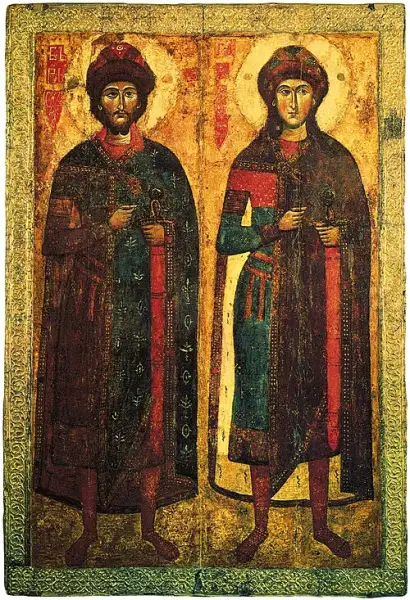
Boris and Gleb, in baptism Roman and David, were younger sons of Vladimir the Great of Kiev and the first saints to be canonized in Kievan Rus' after the country's conversion. Born around 986 and 987 into the Rurikid house, they were favorites of their father: Boris, married and adult, governed Rostov from about 1010 and was probably regarded as heir to the Kievan throne, while the underage Gleb held the eastern frontier town of Murom from about 1013. When Vladimir died in 1015 a succession crisis broke out. The Primary Chronicle lays the brothers' murders at the door of Sviatopolk the Accursed. Boris refused to lift his hand against an elder brother who had taken the throne, and was stabbed in his tent at Alta together with his Hungarian servant George, Varangians finishing him with a sword. Gleb, summoned on the pretext that their father still lived, was killed on the road by his own cook Torchin, who cut his throat as he prayed. Because they met violent death without resisting evil with violence, Rus' came to call them Strastoterptsy, Passion-Bearers. Glorified by the church in 1071 and again by Rome in 1724, they rest in the tradition of the Church of St Basil at Vyshhorod, where a monument to them was raised in 2011.
The Complete Life
Favored Sons of Vladimir
The two princes grew up in the household of Vladimir the Great, the ruler who had brought Christianity to Kievan Rus', and the pair of eleventh-century Lives devoted to them, credited to Nestor the Hagiographer and to Jacob the Monk, agree that their father preferred them to his numerous other children. Their Christian names in baptism were Roman for Boris and David for Gleb. The question of their mother is tangled: the Primary Chronicle calls her a Bulgarian woman, though this was most likely untrue, since their mother is otherwise identified as Anna Porphyrogenita, daughter of the Byzantine emperor Romanos II and of Theophano, a Laconian Greek princess of Armenian descent whose line ran back to the Mamikonian dynasty. Boris was the elder, born around 986, Gleb perhaps a year later. Both were set early to the business of ruling a scattered realm. Boris received Rostov, a northern town of the Finnish and Slavic frontier, about 1010, married, and by his father's death was probably looked upon as heir apparent in Kiev. Gleb, still a minor, was given Murom, the easternmost town of the principality, another outpost where a Rurikid prince governed peoples only partly settled in the faith. Between them the brothers held the two edges of their father's land while the succession, and their lives, hung on the health of an aging conqueror.
§ History
Rostov and Murom
The princes' vocation was not monastic but dynastic: they were Christian rulers of frontier towns in a newly baptized country. Boris governed Rostov from about 1010 to 1015, exercising the authority of a grown man, married and at the head of troops; the sources that describe him as probably the heir apparent imply that Vladimir was preparing him for the Kievan throne itself. Gleb's appointment to Murom, dated to about 1013, was of a different character, for he was still a minor and the town lay at the far eastern edge of the realm, among peoples whose incorporation into Rus' was recent. To hold such places a prince needed soldiers, judges and priests, and the Lives present the brothers as young men formed by the Christianity their father had imposed, attentive to prayer even on campaign. Boris in particular is shown returning with the Rus' army to the Alta when news of his father's death reaches him, a soldier at the moment his soldiering becomes morally useless. Whatever the exact division of their duties, both brothers stood in 1015 at the point where their father's empire would either pass quietly to a successor or tear itself apart, and their offices placed them, rather than any choice of their own, directly in the path of the coming crisis.
§ History
Non-Resistance and the Passion-Bearers
What made Boris and Gleb saints rather than mere casualties was the manner of their deaths, and the tradition built upon it a whole theology of suffering. Boris, learning at Alta of Vladimir's death and of Sviatopolk's seizure of the throne, was urged by his own men to make himself prince in Kiev instead; he answered that it was not for him to raise his hand against his elder brother, and that with their father gone Sviatopolk should take the father's place in his heart. That sentence, refusing civil war in the name of filial piety, became the hinge of the cult. Gleb showed the same spirit: deceived into traveling to a father already dead, warned by the brother Yaroslav of the treachery awaiting him, he was at prayer to his dead brother and to God when his own cook Torchin cut his throat with a kitchen knife. Because neither resisted evil with violence, Rus' gave them the title Strastoterptsy, Passion-Bearers, a category the church reserved for those who accept suffering in imitation of Christ rather than being killed for the faith as such. The Lives fill their last hours with telling scenes, among them a sister's warning of Sviatopolk's murderous plans, and hagiographers have admired the works as literary masterpieces that weave numerous traditions together, though historians insist the facts of the deaths cannot simply be read out of such artful pages.
§ History
Murders of 1015
The end came within weeks of Vladimir's death in 1015, during the succession crisis that ran to 1019. The Primary Chronicle blames Sviatopolk, later called the Accursed, for plotting the assassinations, and the outline it gives is stark. Boris was at Alta with the army when the news reached him; counseled to seize the throne for himself, he declined, and Sviatopolk sent Putsha and the boyars of Vyshegorod to destroy him. Boris and his Hungarian manservant George were stabbed while asleep in a tent, yet the prince was found still breathing in the bodybag that carried him toward Kiev, and Varangians ended his life with a sword. Gleb was dispatched for on the pretext that their father still lived and hurried to a deathbed that was already empty; warned too late by Yaroslav, he was killed mid-prayer by his own cook. Foreign sources complicate the chronicle's verdict: several unbiased ones suggest Boris had actually succeeded his father in Kiev rather than waiting in Rostov, and the Norse Eymund's saga tells of Varangians hired by Yaroslav the Wise to kill a brother named Burizleif, leading some historians to accuse Yaroslav rather than Sviatopolk, while others read Burizleif as a corruption of Boleslaw of Poland, Sviatopolk's ally. The uncertainty has never touched the cult itself.
§ History
The First Saints of Rus'
The brothers received the crown of martyrdom in 1015, and within two generations the church had acted formally. the Orthodox church in Rus' glorified the brothers in 1071, the work of canonization falling to the Metropolis of Kiev and all Rus', and they were the earliest saints raised to the calendar of Kievan Rus' following the land's conversion, native sons rather than imported Byzantine or Scandinavian holiness. They were interred in the cathedral at Vyshhorod, which was reconsecrated in their name, and their relics had rested before that in the Church of St Basil in the same town, a church later destroyed. The cult crossed confessional lines with unusual ease: the Catholic Church canonized the brothers in 1724, during the pontificate of Benedict XIII, so that they stand in both calendars. Relic translations marked the stages of the veneration, with ceremonies commemorated on 20 May for the years 1024 and 1072 and on 2 May for 1115, and in 1095 portions of the two brothers' relics reached Sazava Monastery in the Duchy of Bohemia, where they were inserted into one of the altars, carrying the passion-bearer princes' fame westward into Slavic lands that knew their story well.
§ Veneration
Passion-Bearers of Two Churches
The legacy of Boris and Gleb runs through the whole of East Slavic Christianity. They were venerated in Eastern Orthodoxy and in the Catholic Church alike, and their chief shrine remained Vyshhorod, where the cathedral stood over their tombs; a monument to the brothers by the sculptors Boris Krylov and Oles Sydoruk was erected there in 2011. Many other Russian churches were named for them in the centuries after their glorification. Their calendar is unusually rich for a single pair of saints: the main commemoration of the martyrdom is kept on July 24 in the Orthodox reckoning, August 6 on the Gregorian calendar, with the translation of relics on May 3, and the martyrologies also note 15 July for the martyrdom of Boris and 5 September for that of Gleb. Synaxes gather them into local calendars across the old Rus' lands, on 23 May with all the saints of Rostov and Yaroslavl, 23 June with those of Vladimir, 10 July with Ryazan, 15 July with Kiev, 22 September with Tula and Poltava, and on a movable Sunday before 28 July with the saints of Smolensk. Iconography shows them as two young princes holding swords or spears, or bearing the cross of martyrs, and a striking Russian tradition even numbers them among the patrons of railway troops, soldiers like the princes themselves.
§ Veneration
Timeline
- 986
Boris Vladimirovich, son of Vladimir the Great, was born.
§ History
- 987
Gleb Vladimirovich, the younger brother, was born.
§ History
- 1010
Boris, married and probably regarded as heir apparent, began his reign over the town of Rostov.
§ History
- 1013
Gleb, still a minor, began his reign over Murom, the easternmost town of the realm.
§ History
- 1015
On their father's death, Boris refused to oppose Sviatopolk and was stabbed in his tent at Alta, his servant George dying with him.
§ History
- 1015
Gleb, summoned on the false report that his father lived, was killed on the road by his own cook, Torchin, while at prayer.
§ History
- 1024
A first translation of the brothers' relics, commemorated liturgically on 20 May.
§ Feast Day
- 1071
The Orthodox church in Rus' glorified Boris and Gleb, the first saints canonized in Kievan Rus'.
§ Veneration
- 1072
A further translation of the relics, kept in the calendar together with that of 1024.
§ Feast Day
- 1095
Portions of the two saints' relics reached Sazava Monastery in Bohemia, where they were set into an altar.
§ Veneration
- 1115
A translation of the relics commemorated on 2 May, a feast shared with Boris I of Bulgaria.
§ Feast Day
- 1724
The Catholic Church canonized the brothers during the papacy of Benedict XIII.
§ Veneration
- 2011
A monument to Boris and Gleb, by Boris Krylov and Oles Sydoruk, was erected at Vyshhorod in Ukraine.
§ Veneration
In Their Own Words
Be it not for me to raise my hand against my elder brother. Now that my father has passed away, let him take the place of my father in my heart.
The Record
- Patron of
- Russian Railway Troops
- Symbols
- Two young princes holding swords or spears·The cross of martyrs
- Canonization
- Glorified by the Orthodox church in Rus' in 1071 by the Metropolis of Kiev and all Rus'; canonized by the Catholic Church in 1724 by Pope Benedict XIII
Prayer
Bibliography
Show 7 sources
- Voytovich, Leontii (1992). Genealogiya dinastiy Rurikovichev i Gediminovichev. Kyiv: Yunivers-93. p. 24.
- "Princes Boris and Gleb", Orthodox America. Archived from the original on 2008-10-07. Retrieved 2005-01-20.
- Hackel, Sergei. "Two Soldiers of Christ: Boris and Gleb". Cathedral Newsletter, Russian Orthodox Cathedral, London, November 1994.
- "Martyrs and Passion-Bearers Boris and Gleb". Orthodox Church in America.
- Cross, Samuel H.; Morgilevski, H. V.; Conant, K. J. "The Earliest Mediaeval Churches of Kiev". Speculum, Vol. 11, No. 4 (Oct., 1936), 489.
- "History". Sazava monastery. Retrieved 31 December 2023.
- "BORIS I GLEB". www.pravenc.ru. Retrieved 2023-01-16.
Profile text adapted from the Wikipedia article, licensed CC BY-SA 4.0.
Pray with this saint every day
Save Sts. Boris and Gleb to your favorites, read the full profile, and get feast-day reminders in the Saints app.
Get the Saints AppFree on the App Store for iPhone and iPad