
died 31 May c. 304·Feast May 31
Sts. Cantius, Cantianus, and Cantianilla
Roman sibling martyrs beheaded at Aquae Gradatae
Overview
Cantius, Cantianus, and Cantianilla were Roman Christians put to death, according to the tradition, on 31 May 304 and honoured as martyrs by both the Eastern Orthodox and the Roman Catholic Church, whose feast is kept on that day. A late legend makes them orphaned siblings of a noble Roman house, the Anicii, related to the Emperor Carinus: Cantius and Cantianus the brothers, Cantianilla their only sister. Their tutor and guardian was Protus, the Christian who converted the three. When Diocletian unleashed his persecution, the four are said to have left Rome, sold their home, and given most of the proceeds to the poor before travelling to their estate near Aquileia, where they hoped to visit the imprisoned priest Saint Chrysogonus. They were seized at Aquae Gradatae — the modern San Canzian d'Isonzo — and beheaded after refusing sacrifice to the Roman gods. Zoelus, a priest, laid their bodies to rest where they had died. Saint Maximus of Turin later preached a panegyric in their honour, and Venantius Fortunatus, drawing on contemporary documents, testifies that they were brothers by blood, martyred together not far from Aquileia as they departed in a chariot. Their ancient cult spread through Lombardy, France, and Germany, and an early Christian basilica and tomb discovered at San Canzian held the remains of three individuals.
The Complete Life
Children of the Anicii
The story of the three martyrs has come down to us chiefly through a late legend, and it begins in the highest ranks of Roman society. Cantius, Cantianus, and Cantianilla are presented as orphaned siblings of a noble Roman family, the Anicii, one of the great houses of the late empire, and as relatives of the Emperor Carinus. Cantius and Cantianus were the brothers; Cantianilla was their only sister, the one sister among the three. Into this household of privilege came Protus, their tutor and guardian, and with him the faith that would remake the family: it was Protus, a Christian, who converted the three siblings. The legend thus frames the martyrs twice over — as children of an ancient lineage and as children of a new one. Orphaned young, formed by a Christian teacher, and bound to one another by blood and by belief, the three grew into the crisis of Diocletian's persecution not as isolated confessors but as a household. The setting matters to how the story was received: that heirs of the Anicii, connected to the imperial throne itself, should choose poverty and death over conformity gave later generations of Christians a portrait of youthful nobility placed wholly at the service of Christ. Their youth became a fixture of their cult, which made them patrons of children and of Catholic youth.
§ Narrative
Selling All, Giving to the Poor
When Diocletian began to persecute the Christians, the response of the four was not flight into hiding but an act of evangelical renunciation. According to the legend, they left Rome and sold their home, distributing most of the proceeds to the poor before they set out. It is a deliberately gospel-shaped gesture — the sale of possessions and almsgiving that Christ asked of the rich — performed by three young aristocrats and their teacher at the very moment the faith they had embraced was made criminal. Their destination was an estate at Aquileia, in the north-east of Italy, and their purpose there was one of charity and fellowship in suffering: they had come to visit the holy priest Saint Chrysogonus, who lay in prison. The journey thus joined the works of mercy to the confession of faith: having given away their goods, they sought out a confessor in chains. The choice was costly. On the road, at a place called Aquae Gradatae — today San Canzian d'Isonzo, near the head of the Adriatic — they were captured. The tradition reports that they were travelling in a chariot, a detail that Venantius Fortunatus, who could draw on documents close to the events, preserves as genuinely ancient. What had begun as an act of solidarity with a prisoner ended with the travellers themselves numbered among the prisoners of the empire.
§ Narrative
Martyrdom at Aquae Gradatae
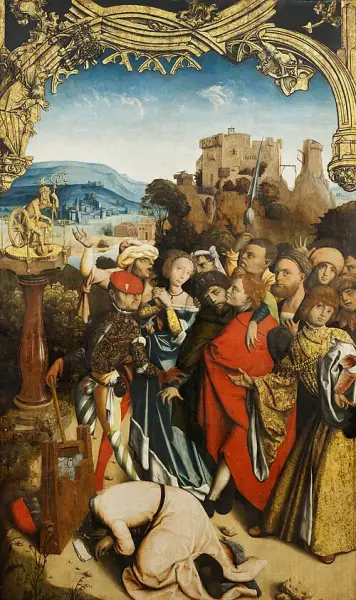
The end came swiftly at Aquae Gradatae. Brought before the authorities, the three siblings were ordered to offer sacrifice to the Roman idols — the standard test applied to Christians under the persecution, and the one act their faith forbade. They refused. For that refusal they were beheaded, the brothers and their sister together, and the place of their death became the place of their burial, for a priest named Zoelus gathered their bodies and laid them in the earth at the site. The manner of their killing fixed their iconography for centuries of Christian art: they are shown as two youths and a girl, sometimes fleeing in a chariot, bearing the sword and the palm of martyrdom, or depicted at the moment of execution before an idol. The Krainburger Altar of 1510 preserves a full scene of their martyrdom, a late but eloquent witness to how deeply the image had settled in the Christian imagination. What the reliable ancient testimony actually records is spare and certain: Venantius Fortunatus states that the three were siblings born of the same parents and suffered martyrdom side by side close to Aquileia, on the road out of the city, travelling by chariot. The core of the story — siblings, a shared death, a road out of Aquileia — stands on evidence close to the events themselves, whatever embellishments the later legend added around it.
§ Narrative
An Ancient Cult
No decree of a congregation marks these martyrs as saints; their veneration is older than any such machinery, and both the Eastern Orthodox and the Roman Catholic Church keep their feast on 31 May. The cult formed around the grave at Aquae Gradatae almost immediately after the deaths. Zoelus, the priest who buried the bodies, gave the site its first anchor, and from that grave a tradition of local devotion grew that soon travelled far beyond the region, spreading in early times through Lombardy, France, and Germany. Literary witness followed. Saint Maximus of Turin subsequently preached a panegyric in their honour, giving the martyrs a place in the early homiletic tradition. Venantius Fortunatus mentioned them as well, and his testimony carries particular weight: he could draw from coeval documents, and it confines itself to what those documents supported — that the three were brothers by blood and were martyred together near Aquileia. In more recent times an early Christian basilica and tomb were discovered at San Canzian d'Isonzo, containing the remains of three individuals, an archaeological echo of the tradition that had been carried by liturgy and preaching for more than a millennium and a half.
§ Veneration
Patrons of the Young
The memory of the three siblings has settled most durably around their youth. The churches that venerate them have made them patrons of children and of Roman Catholic youth, an office that follows naturally from the legend of two young brothers and their only sister — orphaned aristocrats, taught the faith by their tutor, and killed rather than sacrifice to idols. Their major shrine remains San Canzian d'Isonzo, the town at the site of ancient Aquae Gradatae that carries their Italian name, where the discovered early Christian basilica and tomb, holding the remains of three individuals, gave physical substance to the tradition. The diffusion of the cult across Lombardy, France, and Germany in the earliest centuries testifies to how widely the story of youthful constancy resonated. Art carried it further still: the attributes listed for the saints — the two youths, the girl, the tutor Protus with his staff and faggot, the chariot, the idol, the sword, and the palms — amount to a compressed retelling of the whole legend, and the Krainburger Altar of 1510 shows the martyrdom itself as a finished dramatic scene. For the Church's young, the siblings remain what the late legend made them: proof that age sets no minimum for the courage of faith.
§ Veneration
Timeline
- 304
According to the legend, when Diocletian's persecution began, the siblings and Protus left Rome after selling their house and aiding the poor.
§ Narrative
- 304
They reached their Aquileia estate, having travelled there to visit the imprisoned priest Chrysogonus, before being seized at Aquae Gradatae.
§ Narrative
- 304
Zoelus, a priest, buried the martyrs' bodies at the place where they were put to death.
§ Veneration
- 31 May 304
The three siblings were beheaded after refusing to sacrifice to Roman idols.
§ Narrative
- 1510
The Krainburger Altar portrayed the martyrdom of the three saints.
§ Introduction
The Record
- Patron of
- Children·Roman Catholic youth
- Symbols
- Two youths and a girl fleeing in a chariot·Sword and palms·Beheaded before an idol·Protus as a tutor with a staff and faggot
- Canonization
- Pre-congregation; venerated since antiquity by the Eastern Orthodox and Roman Catholic churches
Prayer
Bibliography
Show 7 sources
- "Latin Saints of the Orthodox Patriarchate of Rome". www.orthodoxengland.org.uk.
- "Cantianus, Saint". McClintock and Strong Biblical Cyclopedia.
- "Record". The Cult of Saints, csla.history.ox.ac.uk.
- "Sts. Cantius, Cantianus, Cantianilla, and Protus". FaithND.
- "Book of Saints - Cantius, Cantianus, Cantianilla, and Protus". CatholicSaints.Info.
- "St Cantianilla". The British Museum.
- "Santi Canzio, Canziano e Canzianilla".
Profile text adapted from the Wikipedia article, licensed CC BY-SA 4.0.
Pray with this saint every day
Save Sts. Cantius, Cantianus, and Cantianilla to your favorites, read the full profile, and get feast-day reminders in the Saints app.
Get the Saints AppFree on the App Store for iPhone and iPad