
died c. 295·Feast August 7
Sts. Carpophorus, Exanthus, Cassius, Severinus, Secundus and Licinius
Soldier Martyrs of Como under Maximian
Overview
Carpophorus, Exanthus, Cassius, Severinus, Secundus and Licinius were, according to tradition, Christian soldiers put to death for the faith at Como in about 295, under Maximian. Two versions of essentially the same legend are told of them. In the first, Carpophorus and Exanthus were Roman soldiers of the famed Theban Legion who deserted during Maximian's persecution of Christians and, once caught, were put to death at Como together with Fidelis. In the second, Fidelis was an army officer guarding Christian prisoners at Milan, among them Saint Alexander of Bergamo; he procured the freedom of five of them, and with Carpophorus and Exanthus the little band set out for the Alps, only to be executed at Como. Tradition sets the site of the martyrdom by Samolaco, on the lake's northern shore. Their feast is kept on August 7, and the church of San Carpoforo in Como, traditionally raised upon a converted temple of Mercury, was erected to receive the bones of Carpophorus and his brother martyrs of the city. Carpophorus alone was often honored jointly with Fidelis of Como, and both with the soldier saints Felinus and Gratian at Arona on March 13.
The Complete Life
Soldiers of the Theban Legion
The six martyrs whose names are bound together at Como, Carpophorus, Exanthus, Cassius, Severinus, Secundus and Licinius, belong wholly to the world of late Roman military hagiography. They died, by tradition, around the year 295, in the reign of Maximian, and nothing individual survives of any of them: no birthplace, no family, no words. What survives is the pattern of their deaths, told in two versions that are essentially one legend retold. The first version makes Carpophorus and Exanthus Roman soldiers of the Theban Legion, the celebrated body of Christian troops whose supposed massacre for refusing to sacrifice generated an enormous martyrology across the Alpine provinces. In this telling they deserted during Maximian's persecution of Christians, were caught, and were executed at Como. Their companions Cassius, Severinus, Secundus and Licinius are joined to them in the same cult, sharing their feast and their shrine. The second version shifts the scene to Milan and to the figure of Fidelis, an army officer set to guard Christian prisoners, among them Saint Alexander of Bergamo. Fidelis contrived the release of five of these captives and, together with Carpophorus and Exanthus, led the freed men toward the Alps and the safety of the mountains. The escape failed: the whole group was apprehended and put to death at Como. The tradition fixes the site of the martyrdom on the north side of Lake Como, near modern Samolaco, where the Alpine foothills close in on the water. In both legends the same elements recur, soldiers, desertion or liberation, flight toward the mountains, and death at Como, which is why scholars treat them as a single story retold.
§ Legends
The Shrine by the Lake
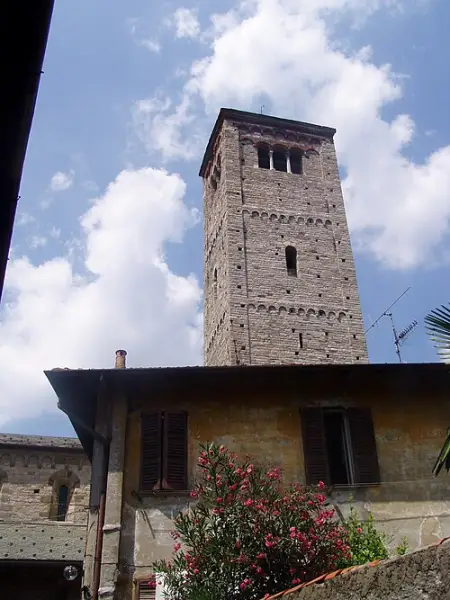
The cult of the six martyrs has been anchored at Como for the whole of the Christian memory of the city. Its center is the church of San Carpoforo, which tradition holds was raised upon a converted temple of Mercury so as to receive the relics of Carpophorus and his fellow martyrs of Como. The reuse of a pagan temple's site is a detail typical of the region's early Christian topography, a physical claim that the new faith had displaced the old at its own sacred places. Around that shrine grew a calendar of devotion. The six are honored on August 7, the day the city keeps their passion. Beyond Como, their cult entwined with that of Fidelis of Como, whose own legend the two martyrdom accounts share; Fidelis is venerated in association with these saints, and the several versions of the story are plainly branches of one tradition. A further extension carried Carpophorus to Arona, on Lake Maggiore, where Carpophorus and Fidelis kept a shared festival with two further warriors of the calendar, Felinus and Gratian, on 13 March. That double date, August at Como and March at Arona, marks how the same martyrs could be woven into the calendars of neighboring sees. In art and devotion the six are represented in military attire, the iconographic shorthand that marks them as soldier martyrs. For the modern reader they stand as witnesses to the way the early Church sanctified obedience to God over obedience to command, and to how a local shrine by an Italian lake preserved, through legend, the memory of men who chose death rather than deny their faith.
§ Legends
The Record
- Patron of
- Como, Italy
- Symbols
- Military attire
- Canonization
- Pre-congregation; ancient soldier-martyr cult at Como
Prayer
Bibliography
Show 3 sources
- Monks of Ramsgate. "Carpophorus, Exanthus, Cassius, Severinus, Secundus and Licinius". Book of Saints, 1921. CatholicSaints.Info, 28 September 2012.
- Alban Butler, Peter Doyle, Butler's Lives of the Saints (Liturgical Press, 1996), 196.
- Santi Graziano e Felino, Carpoforo e Fedele.
Profile text adapted from the Wikipedia article, licensed CC BY-SA 4.0.
Pray with this saint every day
Save Sts. Carpophorus, Exanthus, Cassius, Severinus, Secundus and Licinius to your favorites, read the full profile, and get feast-day reminders in the Saints app.
Get the Saints AppFree on the App Store for iPhone and iPad