
died 302·Feast January 9
Sts. Celsus and Marcionilla
Mother and Child Martyrs of Antioch
Overview
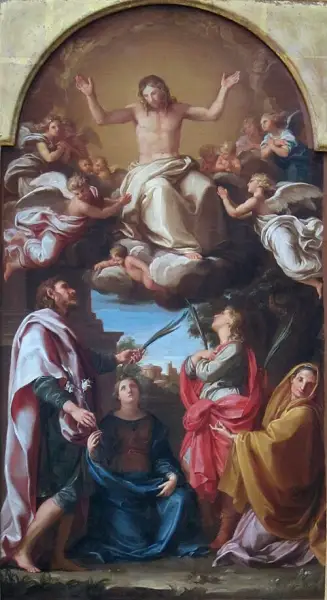
Celsus and Marcionilla are honoured as early Christian martyrs who suffered at Antioch during the Diocletianic Persecution. Marcionilla was a matron, a woman of standing, and Celsus was her little son; mother and child went to their deaths together. They were not alone: the record names Anastasius, Anthony, Julian and others as companions in the same martyrdom, a group that links them to the wider circle of Antiochene saints remembered from the last and fiercest of the Roman persecutions. Their deaths fell in the year 302, on the eve of the peace the Church would receive after 311. Both the Roman Catholic Church and the Eastern Orthodox Church venerate them, the former keeping their feast on 9 January and the latter on 8 January. In the eighteenth century Pompeo Batoni gave the pair a place in art, painting Christ with Saints Julian and Basilissa, Celsus and Marcionilla between 1736 and 1738, an indication that their cult was still living in the Roman devotion of that era.
The Complete Life
A Matron and Her Little Son
The record of Celsus and Marcionilla is brief, but its very brevity points to what mattered most to those who preserved their memory. Marcionilla is described as a matron, a married woman of property and position in the city of Antioch, and Celsus was her little son. In the Roman world of the early fourth century a matron who embraced Christianity did so at real cost, since the faith demanded public allegiance to a Lord other than the emperor, and a mother who brought her child into that allegiance cost him something as well. The sources do not record the stage at which the household came to faith, whether through Marcionilla's own conviction or through the preaching of others in Antioch, one of the great early centres of Christianity. What they do record is that when the hour of testing came, mother and child stood together, and that Celsus was counted a martyr in his own right rather than merely a victim of his mother's decision. The church that honoured them understood that confessors came in every age and condition: the woman of standing and the little boy at her side were both capable of the witness that the age demanded, and both received the martyr's crown.
§ Celsus and Marcionilla
Martyrdom at Antioch
Celsus and Marcionilla met their deaths at Antioch in the year 302, during the Diocletianic Persecution, the last and most systematic attempt of the Roman state to destroy the Christian Church. They did not die alone. The tradition names Anastasius, Anthony, Julian and others as their companions in the same suffering, a company of martyrs rather than isolated victims. The presence of Julian among them is significant for the later history of the cult, since Julian and his wife Basilissa were themselves honoured saints at Antioch, and the group came to be commemorated together in art and devotion. For the Christians who kept the memory of these deaths, the year mattered: 302 fell within the opening years of the persecution, when the imperial machine was first turned against the faithful, and the martyrs of that season were remembered as those who bled while the trial was still new. Antioch, where the disciples were first called Christians, had already given the Church a long roll of witnesses, and Celsus and Marcionilla took their place in that roll as the mother and the child who did not withdraw when the moment of confession arrived. Their execution was the world's answer to their faith; their veneration was the Church's answer to their execution.
§ Celsus and Marcionilla
Feast, Churches and Canvas
The cult of Celsus and Marcionilla has never been widespread, but it has proved remarkably durable, and it remains alive in both the great traditions of historic Christianity. The Roman Catholic Church keeps their feast on 9 January, while the Eastern Orthodox Church commemorates them on 8 January, the slight difference in date reflecting the separate liturgical traditions that grew up around the same martyrs. Modern standard references such as the Patron Saint Index continue to carry entries for both saints, keeping their names in circulation among those who look up the patrons of particular causes. The pair also found an unexpected place in the fine arts of the eighteenth century: between 1736 and 1738 the Roman painter Pompeo Batoni produced his Christ with Saints Julian and Basilissa, Celsus and Marcionilla, placing the Antiochene mother and child in the company of the better-known married saints Julian and Basilissa. A painting of this kind, executed for a religious setting in Batoni's Rome, tells us that in the eighteenth century these martyrs were still invoked and still depicted, not merely consulted by antiquarians. Their inclusion alongside Julian and Basilissa matches the ancient tradition that the two couples of martyrs, so to speak, suffered in the same persecution and were honoured in the same city.
§ Celsus and Marcionilla
The Record
- Symbols
- Palm of martyrdom·Child in a mother's arms
- Canonization
- Pre-congregation; venerated in the Roman Catholic and Eastern Orthodox churches.
Prayer
Bibliography
Show 3 sources
- "Saint Marcionilla", Patron Saint Index
- "Saint Celsus", Patron Saint Index
- Saints Julian, Basilissa, Marcianilla, and Celsus at the Christian Iconography web site
Profile text adapted from the Wikipedia article, licensed CC BY-SA 4.0.
Pray with this saint every day
Save Sts. Celsus and Marcionilla to your favorites, read the full profile, and get feast-day reminders in the Saints app.
Get the Saints AppFree on the App Store for iPhone and iPad