
died c. 304·Feast August 13
Sts. Centola and Helen
Virgin Martyrs of Burgos under Diocletian
Overview
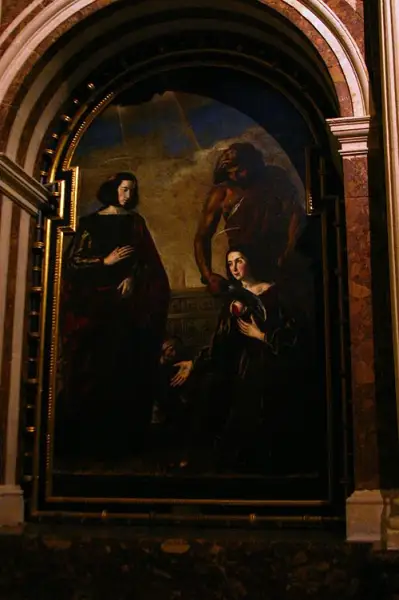
Centola and Helen, known in Spanish as Santa Centola y Santa Elena, are honoured in Christian tradition as two women martyred at Burgos in 304, during the persecution of Christians ordered by the emperor Diocletian. According to that tradition they were virgins who died for their faith, and their deaths placed them among the great host of Spanish martyrs produced by the last Roman persecution. Their cult never travelled far: it remained localized in the Burgos region of Castile, where it has endured with striking tenacity. At Valdelateja a hermitage of the late Visigothic age, consecrated to the pair, still stands, testimony that they were already being invoked centuries after their deaths, and in more recent times the church dedicated to them at Villafranca Montes de Oca, associated with Rodrigo de la Haya, has continued the same devotion. Their principal liturgical home has been Burgos Cathedral, where their feast is kept on 13 August and where their martyrdom has been depicted in its art. Catholic and Eastern Orthodox tradition alike numbers them among the martyrs of the Diocletianic age.
The Complete Life
Martyrdom at Burgos
Christian tradition remembers Centola and Helen as two women who met death at Burgos in 304, during the persecution of Christians carried out under the emperor Diocletian. That persecution, the most comprehensive the Roman Empire had yet attempted, fell heavily on the provinces of Hispania, and the Spanish church afterwards counted its dead by the hundreds. Within that larger story the tradition of Burgos fixes its attention on two local women, Santa Centola and Santa Elena, who are said to have been virgins and to have suffered as martyrs for refusing to abandon their faith. The record does not preserve the circumstances of their arrest, the names of their judges, or the form of their execution; what it preserves is the fact of their confession and the place of their death, which was enough for the church that honoured them. The year 304 belongs to the middle years of the persecution, when the imperial edicts were being enforced across the empire and local officials were under pressure to compel conformity. For the Christians of Burgos and the surrounding country, the two martyrs became the local faces of a suffering shared by the whole church, and their deaths, occurring as they did within living memory of the peace that followed, anchored the Christian memory of the city in the age of its greatest trial.
§ Centola and Helen
A Cult That Stayed at Home
The veneration of Centola and Helen remained a cult of the Burgos region, never spreading far beyond the Castilian countryside that had produced the martyrs, yet within that territory it has proved strikingly durable. The earliest visible monument of the cult is the hermitage at Valdelateja, raised for the two saints in the late Visigothic age, a survival that carries their cult back to the centuries immediately following the end of Roman rule in Spain and shows that they were already being invoked as heavenly patrons in that early period. In much later times the same devotion produced the church dedicated to them at Villafranca Montes de Oca, associated with the name of Rodrigo de la Haya, which continues to honour the martyrs in the mountains through which pilgrims have long passed on the road to Compostela. The principal seat of their liturgical cult, however, has been Burgos Cathedral, one of the great churches of Spain, where their feast is observed on 13 August and where their martyrdom has been depicted in the cathedral's artistic programme, an honour that must have reinforced their standing throughout the diocese. The survival of this localized devotion across Visigothic, medieval and modern centuries, marked by hermitage, village church and cathedral alike, is a quiet testimony to the persistence of popular devotion in the Spanish countryside.
§ Veneration
Timeline
- 304
Martyred at Burgos during the persecution of Christians under Diocletian.
§ Introduction
- 700
By the late Visigothic period a hermitage dedicated to the two saints stood at Valdelateja.
§ Veneration
The Record
- Patron of
- Patrons of the Burgos region
- Symbols
- Palms of martyrdom·Crown of virginity
- Canonization
- Pre-congregation; venerated in the Catholic Church and Eastern Orthodox Church.
Prayer
Bibliography
Show 1 sources
- J. Richard Stracke (n.d.). "St. Centola, Virgin and Martyr". Georgia Regents University. Retrieved April 19, 2014.
Profile text adapted from the Wikipedia article, licensed CC BY-SA 4.0.
Pray with this saint every day
Save Sts. Centola and Helen to your favorites, read the full profile, and get feast-day reminders in the Saints app.
Get the Saints AppFree on the App Store for iPhone and iPad