
c. 1514 – 1529·Feast September 23
Sts. Cristobal, Antonio and Juan
Three Nahua child martyrs of early New Spain
Overview
The Child Martyrs of Tlaxcala were three Nahua adolescents of New Spain's earliest mission era: Cristobal, born about 1514 or 1515 at Atlihuetzía as heir of the indigenous lord Acxotécatl; Antonio, born around 1516 or 1517 at Tizatlán, first grandson of the noble Xiochténacti; and Juan, of humbler station, who served in Antonio's household. All three were baptized and schooled by Franciscan missionaries at the order's first school in Tlaxcala. Their zeal as boy evangelizers set them against relatives and neighbors who saw the new religion as a threat to ancestral rites. Acxotécatl, enraged when Cristobal smashed the native religious images of his home, burned his son over a fire in 1527; the child died the next morning, forgiving his father. In 1529 Antonio and Juan were caught destroying ritual effigies at Cuauhtinchán and murdered, Antonio freely confessing that the act was his after finding Juan dead. The Franciscan Toribio Benavente Motolinia recorded their story in 1539. John Paul II beatified the teenagers in Mexico City on 6 May 1990, and Pope Francis, dispensing with the customary miracle, canonized them on 15 October 2017. They are patrons of Tlaxcala, of Mexican childhood, and of those ridiculed for their piety.
The Complete Life
Heirs of Tlaxcala
The children remembered as the Martyrs of Tlaxcala came from leading families of the Tlaxcaltec people in the decade after European contact. Cristobal, the eldest, arrived around 1514 or 1515 at Atlihuetzía, the son of Acxotécatl, an indigenous lord whose standing the boy was expected one day to inherit. His mother, Tlapaxilotzin, had been his father's first wife before Acxotécatl married a second, Xochipapalotzin; Cristobal grew up with brothers named Bernardino and Luis, and with a third whose name the record did not keep. Antonio, born at Tizatlán around 1516 or 1517, was the first grandson of the noble Xiochténacti and stood to succeed him in turn. Juan, born in the same years and of modest background, lived as Antonio's servant. All three were raised within the Nahua religion of their households precisely when Franciscan missionaries of the Order of Friars Minor had begun working in the region and had opened their first school at Tlaxcala. Acxotécatl at first resisted sending Cristobal, his favorite son, to the friars, and gave way only when the Franciscans and the boy's own brothers persuaded him. In that school the three received the baptism and instruction that would redirect, and shorten, their lives.
§ Cristobal
Formed by the Friars
Cristobal's conversion came through the Franciscans' first school in Tlaxcala, where the friars baptized him and planted in him the habits of Catholic belief and practice. Toribio Benavente Motolinia, who knew him, habitually called the boy Cristobalito, an endearment meaning little Christopher, and the affection was plainly mutual. The schooling took hold with unusual depth: the religious values the friars instilled became, in Cristobal, a constant and persuasive spirit of evangelism directed first at his own household. His father long tolerated this boyhood apostolate, attaching little importance to it while it remained a matter of words. Antonio's vocation followed the same pattern. Instructed and baptized, he came to regard the native rituals of the indigenous peoples, his own included, with settled detestation, and he put his linguistic gifts at the friars' service as an able interpreter of their preaching. Juan, though only a servant, received the same baptism and shared his master's convictions. None of the three was called to the cloister or the altar; their vocation was a childhood apostolate of speech and action, carried on with a directness that adults might have tempered. In a society where the old cults still underpinned family authority, that directness would prove fatal.
§ Cristobal
Breaking the Idols
Cristobal's mission expressed itself at once as evangelization, constant and persuasive, pressed above all upon his own family. His father initially attached little weight to the boy's urging. Tolerance ended when Cristobal moved from words to acts and began breaking the indigenous religious symbols kept in the home. Acxotécatl forgave a first offense, but the repeated destruction of the household gods infuriated him, and he formed the resolve to kill his son. Concluding that the boy would never renounce his faith or return to the ancestral values, he thrust Cristobal into a bonfire and burned him. The following morning, in 1527, the child died of his grievous injuries, having called out to his father and expressed his forgiveness. The crime was hidden only briefly: the father buried the remains within a room of the house, hoping they would stay undiscovered, but Spanish authorities soon apprehended him and sentenced him to death. In 1528 the Franciscan friar Andrea found the body and had it exhumed so that it could receive honorable interment elsewhere. Thus the eldest of the three sealed with his blood the mission the friars had begun in him, and set the pattern his two companions would follow within two years.
§ Cristobal
Deaths at Cuauhtinchán
Antonio and Juan carried the same campaign to its end in 1529. Antonio, who served the Franciscans as an interpreter, joined his servant in an assault upon indigenous religious effigies, and the two were caught in the act at Cuauhtinchán and set upon by the local people. Juan was killed outright. Antonio, coming out of the room and finding him dead, asked the attackers why Juan had been the target rather than himself; admitting that he was the one who had been desecrating the effigies, he was attacked in turn and killed beside his servant. The bodies of both were thrown from a cliff. The Dominican friar Bernardino afterwards recovered them and bore them to Tepeaca, where they were given Christian burial. So ended, within two years and a few miles, all three of Tlaxcala's child witnesses: an heir, a noble's grandson, and a servant boy, each about twelve or thirteen at death, each killed by their own people for refusing to soften a faith they had held for only a few years. Their killers acted, the record makes plain, from detestation of the new religion and of the danger these children posed to values and rituals the community still counted its own.
§ Antonio and Juan
From Tlaxcala to Saint Peter's Square
The formal cause opened on 7 January 1982, when the Congregation for the Causes of Saints issued the nihil obstat and the three were titled Servants of God under Pope John Paul II. Bishop Luis Munive Escobar oversaw the cognitional process in the Diocese of Tlaxcala; the Congregation validated that inquiry on 8 November 1985, and the historians consulted the same day found no obstacle in the record. The postulation sent the positio to Rome in 1989, where theologians approved its contents on 24 November and the Congregation followed on 6 February 1990. On 3 March 1990 John Paul II confirmed the killings to be in odium fidei, acts done in hatred of the faith, and during his apostolic visit to Mexico he beatified the three at the Basilica of Our Lady of Guadalupe in Mexico City on 6 May 1990. Cardinal Angelo Amato later described the cause as in its advantaged stages and noted the pope's particular closeness to it; the cardinal members of the Congregation approved it on 14 March 2017, and Francis dispensed with the miracle otherwise required on 23 March 2017. A gathering of cardinals on 20 April fixed the date, and on 15 October 2017 the three were canonized in Saint Peter's Square, with the Franciscan Giovangiuseppe Califano as postulator.
§ Canonization
Patrons of Mexican Childhood
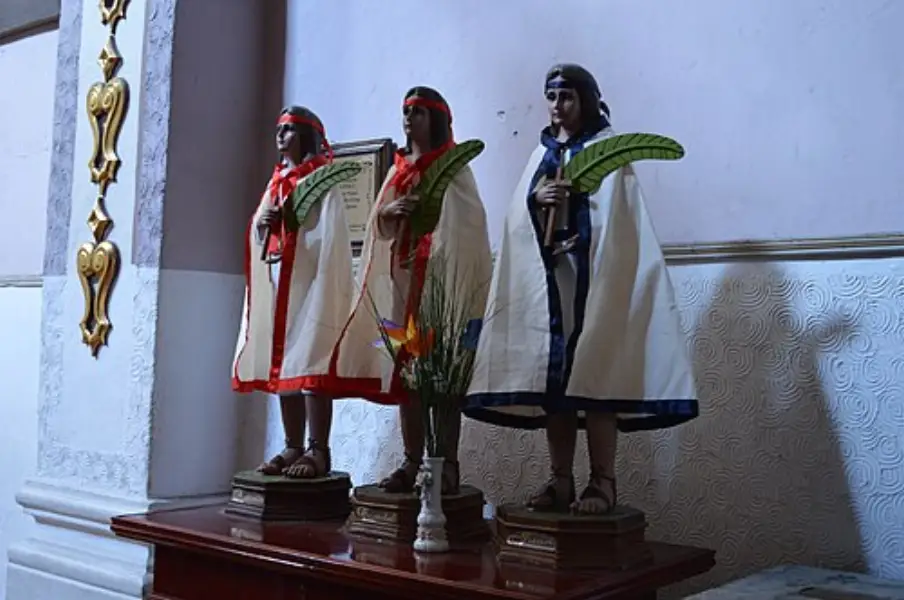
What is known of the three children rests principally upon Toribio Benavente Motolinia, who described their lives in 1539, upon later Nahuatl texts by Juan Bautista, and upon the record those sources furnished to the twentieth-century cause. Devotion has gathered above all in their homeland: Tlaxcala counts them among its patrons, and in June 2016 Agenzia Fides announced their declaration as patrons of Mexican childhood. They are also invoked for people ridiculed for their piety, an office that mirrors the contempt their own families showed their zeal. In the Church's memory they stand as witnesses from the first generation of native converts in New Spain, children who accepted baptism at the friars' first school and would not retract it. Their iconography clothes them with the martyr's palm, the crucifix, and the rosary, the emblems of the death, the faith, and the devotion that together cost them their lives. Their feast, kept on 23 September, joins an heir, a noble's grandson, and a servant boy who died within two years of one another at the hands of their own relatives, and whose canonization without a confirmed miracle rested on the recognition that their deaths were themselves their testimony.
§ Life
Timeline
- 1514
Cristobal is born at Atlihuetzía, son and expected heir of the Tlaxcaltec leader Acxotécatl.
§ Cristobal
- 1516
Antonio, first grandson and heir of the noble Xiochténacti, and Juan, later his servant, are born at Tizatlán.
§ Antonio and Juan
- 1527
Cristobal dies of burns inflicted by his father after refusing to abandon his Catholic faith.
§ Cristobal
- 1528
The Franciscan friar Andrea locates Cristobal's concealed remains and arranges their exhumation for formal burial elsewhere.
§ Cristobal
- 1529
Antonio and Juan are murdered at Cuauhtinchán after being caught desecrating indigenous religious effigies.
§ Antonio and Juan
- 1529
The Dominican friar Bernardino recovers the boys' bodies, thrown from a cliff, and takes them to Tepeaca for interment.
§ Antonio and Juan
- 1539
Toribio Benavente Motolinia writes the principal surviving account of the three children's lives.
§ Life
- 7 Jan 1982
The cause opens as the Congregation for the Causes of Saints issues its nihil obstat, titling the three Servants of God.
§ Canonization
- 8 Nov 1985
The Congregation validates the Tlaxcala diocesan inquiry, and historians approve the cause the same day.
§ Canonization
- 24 Nov 1989
Theologians approve the positio dossier sent to Rome that year.
§ Canonization
- 3 Mar 1990
John Paul II confirms the three teenagers were killed in hatred of the faith.
§ Canonization
- 6 May 1990
John Paul II beatifies the teenagers at the Basilica of Our Lady of Guadalupe during his visit to Mexico City.
§ Canonization
- 23 Mar 2017
Francis approves their canonization without the miracle normally required.
§ Canonization
- 20 Apr 2017
A gathering of cardinals formalizes the date of the canonization.
§ Canonization
- 15 Oct 2017
The three children are canonized in Saint Peter's Square.
§ Canonization
In Their Own Words
in odium fidei
The Record
- Patron of
- Patrons of Tlaxcala·Patrons of Mexican children·People ridiculed for their piety
- Symbols
- Martyr's palm·Crucifix·Rosary
- Canonization
- Beatified by Pope John Paul II on 6 May 1990 in Mexico City; canonized by Pope Francis on 15 October 2017 in Saint Peter's Square.
Prayer
Bibliography
Show 7 sources
- AMERICA/MEXICO – The child martyrs of Tlaxcala declared Patrons of Mexican childhood. Agenzia Fides, 30 June 2016.
- Three Child Martyrs of Tlaxcala. Saints SQPN.
- Blessed Juan of Tlaxcala. Saints SQPN, 21 March 2016.
- Tlaxcala, Martyrs of, Bb. Encyclopedia.com, 2003.
- The Martyrs of Tlaxcala. Tripod.
- Blessed Cristobal, Antonio and Juan. Santi e Beati.
- Haskett, R. (2008). Dying for conversion: Faith, obedience, and the Tlaxcalan boy martyrs in New Spain. Colonial Latin American Review, 17(2), 185–212.
Profile text adapted from the Wikipedia article, licensed CC BY-SA 4.0.
Pray with this saint every day
Save Sts. Cristobal, Antonio and Juan to your favorites, read the full profile, and get feast-day reminders in the Saints app.
Get the Saints AppFree on the App Store for iPhone and iPad