
3rd century – 283·Feast October 25
Sts. Chrysanthus and Daria
Husband and Wife Martyrs of Rome
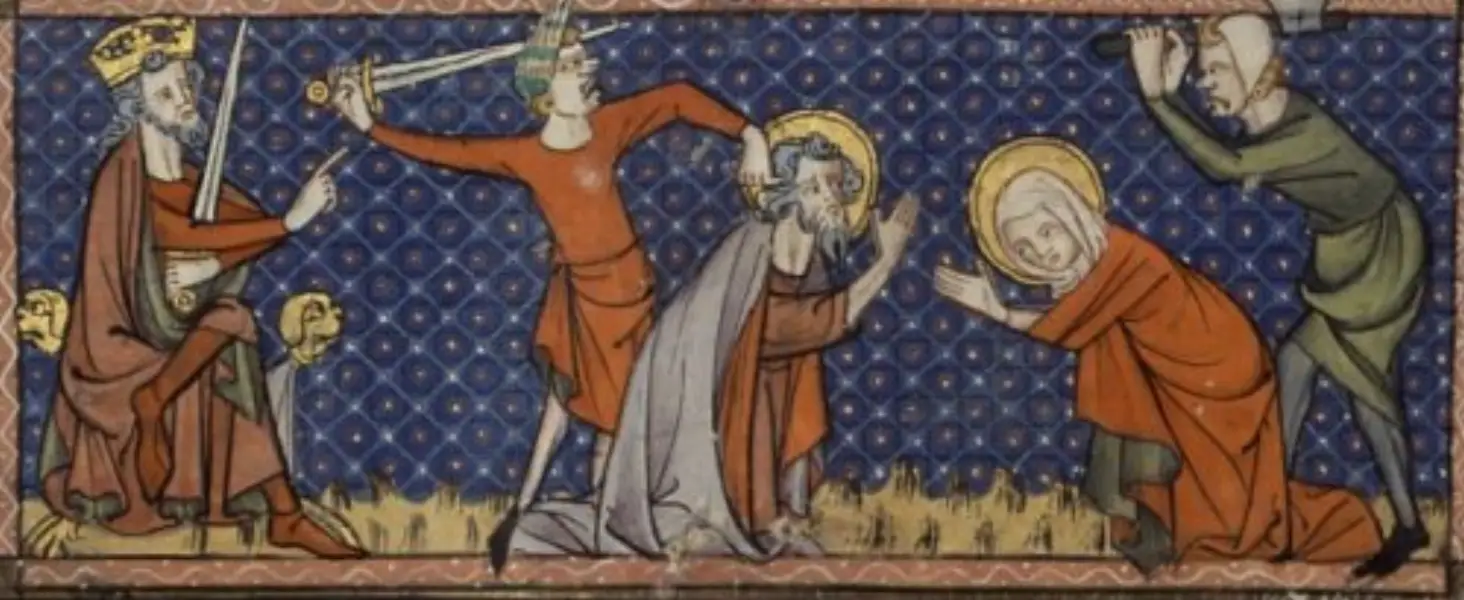
Overview
Chrysanthus and Daria are saints of the Early Christian period who died, by tradition, in 283 at Rome. Their names stand in the Martyrologium Hieronymianum, an early roll of martyrs, and over their reputed grave on the Via Salaria Nova a church in their honour was afterwards raised. The Acts of the Martyrs recounting their story survive in Greek and Latin versions dating from the fifth century, which the scholar Johann Peter Kirsch judged to be without historical value as records, though they preserve an ancient tradition. In the legend Chrysanthus figures as the sole son of an Egyptian grandee called Polemius, or in some texts Poleon, who relocated from Alexandria to Rome under Numerian. Disenchanted with the excess of Roman life, the young man read the Acts of the Apostles, was baptized, and was instructed in the faith by the priest Carpophorus. His father, angered by the conversion, arranged for him to wed Daria, a Roman priestess of Minerva or, by some accounts, a Vestal Virgin. Chrysanthus brought his bride to Christ, and the pair resolved on a continent life together, drawing many Romans into the church. Arrested by the tribune Claudius, Chrysanthus was tortured; his fortitude so moved Claudius that the tribune, his wife Hilaria, his two sons, and seventy soldiers became Christians and were themselves put to death. Daria was condemned to a brothel, where her chastity was defended by a lioness, and was finally buried alive beside her husband in a sand pit. A scientific study in 2011 found the remains to be those of a young man of seventeen or eighteen and a young woman of twenty to twenty-five, dated between AD 80 and 340, with no signs of violence, consistent with death by suffocation.
The Complete Life
An Egyptian Heir in Rome
The legend of Chrysanthus begins in Alexandria. His father, an Egyptian patrician named Polemius in some texts and Poleon in others, moved from that great Greek city to Rome during the reign of the emperor Numerian, bringing with him his only son. In the capital the boy received the finest education the era could provide, the rhetoric, philosophy, and refinement that marked a young man of his rank for public life. Yet the same world that formed him repelled him. Disenchanted with the excess he saw everywhere in Roman society, the luxury, the cruelty, the emptiness of refined pleasure, Chrysanthus began to read the Acts of the Apostles, the plain narrative of the first Christians and their fellowship. The scriptures did what philosophy had not: they answered his hunger for truth with a person. He sought out a priest named Carpophorus, was baptized, and was educated in the Christian faith under his guidance. His father's reaction was swift and worldly. Unhappy with a conversion that threatened the family's standing and succession, Polemius determined to cure his son of the new religion by the oldest of remedies, a brilliant marriage. He chose Daria, in most accounts a Roman priestess of Minerva, in others a Vestal Virgin, a woman whose office embodied everything Chrysanthus had renounced. The father's plan to draw his son back into the world instead delivered the world's own priestess into the hands of a young Christian who had already learned to conquer himself.
§ Legend
A Marriage Made a Consecration
The union of Chrysanthus and Daria is the heart of their story and the reason the church has never let their names be separated. Married by a father's calculation, the couple transformed the arrangement into a common vocation: Chrysanthus succeeded in winning his wife to the faith, and the pair resolved on a life of continence, turning a Roman marriage into a partnership of continence and prayer. In the age of the early church such voluntary continence within marriage was a recognised form of consecration, a living sign that the kingdom of God was nearer than the claims of family and property. Their house became a centre of mission. The two of them went on to bring a number of Romans into the church, and it was this success, no less than their private virtue, that brought them to the attention of the authorities. When word of their activity reached Claudius, the tribune, Chrysanthus was seized and put to torture. The torturers intended to break his faith; instead his faith and fortitude under torment broke theirs. Claudius himself was so impressed by the young man's endurance that he and his wife Hilaria, his two sons Maurus and Jason, together with seventy of the soldiers under him, embraced the Christian faith. The emperor answered this betrayal of the pagan cause with a massacre of his own officer's household: Claudius was drowned, his sons beheaded, his wife hanged at the gallows. The convert tribune and his family thus entered the martyrology alongside the couple whose constancy had won them.
§ Legend
Witness Before the Emperor
Daria's trial belongs to the strange logic of Roman persecution, which feared the corruption of a vestal more than the death of a Christian. The legend states that she was forced to live as a prostitute, because virgins could not be executed; the law that shielded consecrated virginity was to be turned into the instrument of its destruction. The story answers the outrage with a wonder: her chastity was defended by a lioness, sent, in the manner of the old acts, to guard what the empire could not dishonour. Brought before the emperor Numerian, Daria was ordered to death, and the tradition preserves many variations of her end: some say she was stoned, others that she was beheaded, and yet others again that she was entombed alive in a deep pit at her husband's side. It appears that the last torment was the one chosen, for live burial in a subterranean pit was precisely the execution reserved for unchaste Vestal Virgins, so that the penalty designed for the violation of virginity became the crown of a virgin who had kept it. The pair lay buried in a sand pit beside the Via Salaria Nova, among the catacombs of Rome, and upon that reputed grave a church in their honour would in time be raised. Even the grave did not end the witnessing. The surviving Acts state that on the anniversary of the deaths a great crowd of Christians had assembled at the underground crypt to honour the martyrs when the Roman persecutors fell upon them, sealed the entrance under stones, and left the whole company entombed alive, Diodorus a priest and Marianus a deacon among them.
§ Legend
The End Under Numerian
The final scenes of the two martyrs are told with the vivid economy of the passions. Chrysanthus had already passed through torture under the tribune Claudius, and had emerged from it not broken but triumphant, the accidental missionary of his own jailer's household. Daria, condemned to the brothel and delivered by the lioness, stood before Numerian himself, and the emperor's order of death closed the record of her testimony. The manner of their shared end, burial alive in a deep pit beside one another, united the couple in a single tomb as they had been united in a single vocation, and the sand pit near the Via Salaria Nova became one of the remembered stations of the Roman catacombs. The dating of their deaths to 283, and the setting in the reign of Numerian, come from the tradition rather than from documentary record, for the fifth-century Acts that carry the story were judged by Johann Peter Kirsch, writing in the Catholic Encyclopedia, to be without historical value as evidence. Yet the church that read them understood that a legend of this kind is not a falsified record but a sermon in narrative form, teaching that continency is stronger than appetite, that torture can convert the torturer, and that a marriage can be a martyrdom shared. Whether every detail stands as history, the couple buried by the Salarian way were confessed by their community as martyrs within living memory of the persecution, and their anniversary drew the faithful underground until the persecutors sealed the crypt with stones and with the living.
§ Legend
Relics, Science, and an Enduring Cult
The cult of Chrysanthus and Daria spread wherever their reputed bones were carried, and no fewer than three places lay claim to their bones. In the ninth century relics were brought to Prüm in modern Rhineland-Palatinate; they are today in the church of Chrysanthus and Daria at Bad Münstereifel in Germany, whose Eifel marble columns still mark the shrine. In 1011 Pope Sergius IV gave the reputed bodies to Fulk III, Count of Anjou, upon he came back from pilgrimage to Jerusalem, and Fulk in turn enriched with them the monastery of Belli Locus, the modern Beaulieu-lès-Loches, only lately founded by his own hand. Northern Italy's cathedral of Reggio Emilia, too, guards relics traditionally ascribed to the pair. In 2011 a scientific investigation coordinated by Ezio Fulcheri, a paleopathologist at the University of Genoa, examined the remains and highlighted their compatibility with the received story: radiocarbon dating placed the two young people, a male aged seventeen to eighteen and a female aged twenty to twenty-five, between AD 80 and 340, while a high concentration of lead in the bones pointed to a wealthy background, since only the rich had running water conducted through lead pipes. Neither body showed signs of violence or illness, leaving the cause of death compatible with suffocation, exactly the mode of execution the legend assigns. The feast of the pair is kept on 25 October in Western Christianity and on 19 March in the East, and their story, retold from Ælfric to Calderón, remains one of the church's great tales of married chastity crowned by martyrdom.
§ Relics
Timeline
- 283
Martyred at Rome under Numerian: Chrysanthus dies under torture, and Daria is buried alive beside him in a sand pit near the Via Salaria Nova.
§ Introduction
- 1011
Pope Sergius IV gives the reputed bodies to Fulk III, Count of Anjou, who bestows them on his monastery of Belli Locus.
§ Relics
- 2011
A scientific study led by Ezio Fulcheri dates the remains to AD 80-340 and finds no sign of violence, consistent with suffocation.
§ Historicity
The Record
- Symbols
- Crosses·Lioness defending chastity·Buried together in a sand pit
- Canonization
- Pre-congregation; named in the Martyrologium Hieronymianum and venerated in the Eastern Orthodox and Roman Catholic churches.
Prayer
Bibliography
Show 7 sources
- Kirsch, Johann Peter (1908). "Sts. Chrysanthus and Daria". In Herbermann, Charles (ed.). Catholic Encyclopedia. Vol. 3. New York: Robert Appleton Company.
- "Martyr Daria and those with her at Rome", Orthodox Church in America
- Moss, Candida (2013). The Myth of Persecution. HarperCollins. p. 86. ISBN 978-0-06-210452-6.
- Guerin, Paul. "Saint Chrysanthus and Saint Daria", Les Petits Bollandistes: Vies des Saints, (Bloud et Barral: Paris, 1882), Vol. 12
- Byker Than (2011-04-16). "Legendary Saints Were Real, Buried Alive, Study Hints". National Geographic.
- Bachrach, Bernard S. (1993). Fulk Nerra, the Neo-Roman Consul 987-1040: A Political Biography of the Angevin Count. University of California Press. p. 125.
- Ælfric of Eynsham (1881). "Of Crisantus and Daria". Ælfric's Lives of Saints. London, N. Trübner & co.
Profile text adapted from the Wikipedia article, licensed CC BY-SA 4.0.
Pray with this saint every day
Save Sts. Chrysanthus and Daria to your favorites, read the full profile, and get feast-day reminders in the Saints app.
Get the Saints AppFree on the App Store for iPhone and iPad