
died c. 287 or c. 303·Feast September 26
Sts. Cosmas and Damian
Twin Physician Martyrs, the Silverless Healers
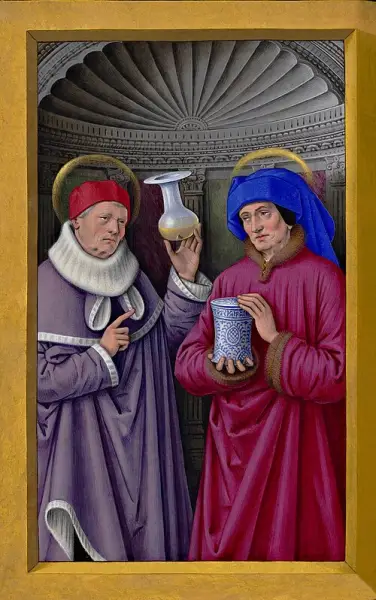
Overview
Cosmas and Damian were twin brothers, born in Arabia in the third century, who practised medicine and surgery in the seaport of Aegeae in the Roman province of Cilicia and suffered martyrdom during the persecution of the emperor Diocletian. They embraced Christianity and treated their patients without any fee, an act of charity that earned them the Greek title anargyroi, the silverless, and by which, as tradition records, they drew many to the Christian faith. They were credited with curing blindness, fever, and paralysis, with expelling a serpent, and with healing the sick miraculously as they slept in the practice known as incubation. Their fame as healers and their open confession of Christ brought them to the notice of Lysias, governor of Cilicia, who arrested them and, when they refused to sacrifice, subjected them to a sequence of torments, hanging, stoning, and arrows, before they were beheaded. Their three younger brothers, Anthimus, Leontius, and Euprepius, who had never left their side, shared their death. Devotion to the twin physicians spread with extraordinary speed across the Christian world: churches rose in their honour from Jerusalem to Rome, Justinian honoured them after a cure attributed to them, and their names were written into the Canon of the Mass, where they are invoked to this day.
The Complete Life
Twin Brothers from Arabia
Of the lives of Cosmas and Damian little is recorded beyond the outline that Christian tradition has always preserved: they were twin brothers, born in Arabia in the third century, who became skilled doctors. Arabia, the province of their birth, lay at the edge of the Roman world, and their names, Greek in form, belong to the Hellenized East in which the Christian faith first spread. The brothers travelled to the province of Cilicia in what is now southern Turkey and settled at Aegeae, a seaport whose position brought them patients of every nation and condition. There they practised their profession together, as twins in life as in work, and with them were their three younger brothers, Anthimus, Leontius, and Euprepius, who were inseparable from them throughout their lives and would eventually share their crown. Beyond this the ancient sources are almost silent, a silence that centuries of legend have surrounded but never filled. What the first generations of Christians remembered was not their parentage or their schooling but the manner of their practice and the manner of their death: they healed without charge, and they died rather than betray the faith that had made their healing an act of worship.
§ Lives
The Silverless Physicians
The distinguishing mark of the two brothers was that they practised medicine and surgery without a fee. For this they were named anargyroi, the silverless or unmercenary, a title that became the name of a whole class of saints in Eastern Christianity. Theirs was not simply professional generosity; the Eastern churches understand the Unmercenary Physicians as saints who heal from sheer love of God and man, keeping without compromise the Lord's charge to give freely what they have received without payment. Their charity was itself an evangelistic force: tradition records that by healing gratis they attracted many to the Christian faith, for the patients who came to them as to physicians left them as disciples of Christ. The eastern tradition holds that they worked cures of incubation, healing the sick even as they slept, so that sufferers came to the saints and were restored in their slumber, a practice that joined the mending of bodies to the conversion of hearts in a single act of devotion. In their skill they also left a mark on the history of medicine: the fifteenth-century Italian physician Saladino d'Ascoli credited the twins with inventing the medieval electuary known as opopira, a compound medicine used to treat diverse maladies, among them paralysis.
§ Eastern Christianity
Healing in the Name of Christ
The miracles attributed to Cosmas and Damian during their lives were remembered by the church with a physician's particularity. They reputedly cured blindness, fever, and paralysis, and reportedly expelled a serpent, deeds that made their name a byword throughout Cilicia and far beyond. Their fame as healers was inseparable from their confession of Christ, and it was precisely this combination, faith and healing together, that gave their mission its power and eventually its cost. In the centuries after their death their intercession continued the work of their practice. The Emperor Justinian ascribed his own cure to their prayers, and in gratitude built and adorned their church at Constantinople, which became a celebrated place of pilgrimage. Their relics, deemed miraculous, were buried at Cyrrhus in modern Syria, and the sick sought them there as they had once sought the living twins at Aegeae. The most famous of the posthumous wonders is the Miracle of the Black Leg, in which the saints are said to have transplanted after death the healthy limb of a deceased Ethiopian man onto a white church verger whose diseased leg they removed, an image that occupied painters from the fifteenth century onward and fixed the physician martyrs in the imagination of Christian Europe.
§ Veneration
Love of God and Man
The spirituality of Cosmas and Damian is expressed in a single, demanding idea: that healing, the most costly of services, must be given away as freely as it is received. The Eastern churches classified them as Unmercenary Physicians precisely to name this disposition: saints whose healing springs from sheer love of God and man, and who obey without compromise the Lord's charge — freely you have received, so freely give. Their medicine was therefore a form of prayer, and their prayer was confirmed in works of mercy. The tradition of incubation cures, in which the saints were believed to heal the faithful as they slept at their shrines, extended their charity beyond their own lifetime and made their sanctuaries places where the physical and the spiritual were treated together. When persecution came, the same integrity that had refused payment for their art refused also to offer sacrifice to the Olympian gods, whom Diocletian favoured; the brothers had healed by the power of Christ and would not deny the source of their healing. Their endurance under torture, according to the legends, kept them true to their faith through hanging, stoning, and arrows, so that their death sealed the vocation of their life: everything held, nothing sold, nothing denied.
§ Eastern Christianity
Martyrdom at Aegeae
The end of the twin physicians came with the great persecution of Diocletian, an emperor devoted to the Olympian gods who issued edict after edict against the Christians, aiming at nothing less than the extinction of their religion across the Roman world. Arrest followed: Lysias, Prefect of Cilicia and otherwise unknown to history, had the two brothers seized and put to the torture, demanding that they recant. Legend tells how they held firm through one torment after another: they were hung on a cross, stoned, and shot with arrows, and finally suffered execution by beheading. Their three younger brothers, Anthimus, Leontius, and Euprepius, companions of their whole life, were martyred with them, five dying together for the faith the twins had lived. The date of their death is variously given as about 287 or about 303, the latter fitting the Diocletian persecution with which their passio associates them. The place was Aegea in the Roman province of Cilicia, the modern Yumurtalık on the coast of Adana Province in Turkey. The traditions of the Eastern churches keep several memories of their death, with the Cilician saints remembered on October 17 as brothers beaten and beheaded together with their companions.
§ Lives
Venerated by the Whole Church
The veneration of Cosmas and Damian spread quickly beyond Constantinople, and their cult belongs to the church's earliest and widest devotions. Accounts of their martyrdom were rewritten by authors including Andrew of Crete, Peter the Wonderworker, Theodore II Laskaris, and a certain Maximus around 1300, and the legends were preserved in Syriac, Coptic, Georgian, Armenian, and Latin. Churches dedicated to the twins existed at Jerusalem, in Egypt, and in Mesopotamia as early as the fourth century. Their names were inserted among the saints invoked in the Communicantes of the Roman Canon of the Mass, and they are invoked likewise in the Litany of the Saints, honours reserved for the most ancient and universal martyrs. Their feast, long kept on September 27, was moved in 1969 to September 26 in the General Roman Calendar, and is kept on September 25 in Canada and on November 1 in the Eastern Orthodox Church, where the Synaxis of the Unmercenary Physicians also commemorates all their fellow silverless healers on the first Sunday of November. The Orthodox honour three distinct pairs of saints named Cosmas and Damian, of Cilicia, of Asia Minor, and of Rome, testifying to how deeply the twin physicians entered the memory of the East.
§ Veneration
Patrons of Medicine and of Twins
The twin martyrs stand as patron healers of physicians, surgeons, and pharmacists, and artists sometimes show them bearing the emblems of medicine; twins likewise claim them as their own patrons in heaven. Their patronage extends to dentists, barbers, and veterinarians, to orphanages and day-care centers, to confectioners, and to the protection of children, with a particular invocation against hernia and against the plague. On the arms of the British Dental Association Damian takes his place as dexter supporter. In Brazil the twins are honoured as protectors of children, and September 27 is kept with particular joy in Rio de Janeiro, where children receive bags of candy printed with the saints' effigy, while in Bahia Catholics and adherents of Candomblé, who syncretise the twins with the Ibeji, offer the dish called caruru to seven children no older than seven years. The Church of Saints Cosmas and Damian at Igarassu in Pernambuco, built in 1535, is Brazil's oldest church. Their relics drew pilgrims for centuries: skulls venerated in Madrid since 1581, a silver shrine in Munich, and an annual pilgrimage in Utica, New York, that draws thousands each September. Their ancient Roman basilica, rededicated by Pope Felix IV, still glows with sixth-century mosaics of the silverless physicians.
§ Veneration
Timeline
- 303
Arrested at Aegeae by Lysias, governor of Cilicia, during the Diocletian persecution; after torments they and their three brothers were beheaded.
§ Lives
- 350
By the fourth century churches in honour of the twin saints already stood at Jerusalem, in Egypt, and in Mesopotamia.
§ Veneration
- 526
Pope Felix IV rededicated the Library of Peace in the Roman Forum as the basilica of Santi Cosma e Damiano.
§ Veneration
- 965
Archbishop Adaldag of Bremen is said to have brought relics of the holy physicians from Rome to Bremen.
§ Veneration
- 1334
Archbishop Burchard Grelle retrieved relics said to be the saints' from the choir of Bremen Cathedral; they were translated at Pentecost 1335.
§ Veneration
- 1535
Built at Igarassu in Pernambuco, the Church of Saints Cosmas and Damian is regarded as the oldest church in Brazil.
§ Veneration
- 1581
Maria of Austria, Holy Roman Empress, gave skulls said to be the saints' to the Convent of Las Descalzas Reales in Madrid.
§ Veneration
- 1649
Bremen's chapter, Lutheran by then, sold the relic shrine without the heads to Maximilian I, Elector of Bavaria.
§ Veneration
- 1969
The General Roman Calendar moved their feast from September 27 to September 26.
§ Veneration
In Their Own Words
Freely have you received, freely give.
Saints Cosmas and Damian pray for us
The Record
- Major works
- The electuary known as opopira, a compound medicine for diverse maladies including paralysis, credited to them by Saladino d'Ascoli
- Patron of
- Surgeons and physicians·Pharmacists and barbers·Dentists and veterinarians·Twins, especially identical twins·Protectors of children, orphanages, and day-care centers·Confectioners·Against hernia and against the plague
- Symbols
- Depicted as twins·Beheaded·Medical emblems·Medicine boxes and crossed-handled spoons in icons
- Canonization
- Pre-congregation; martyrs venerated from the earliest centuries in East and West
Prayer
Bibliography
Show 6 sources
- Kazhdan, Alexander; Ševčenko, Nancy Patterson (1991). "Kosmas and Damianos". In Kazhdan, Alexander (ed.). The Oxford Dictionary of Byzantium. Oxford and New York: Oxford University Press. p. 1156. ISBN 0-19-504652-8
- Foley, Leonard. "Sts. Cosmas and Damian", Saint of the Day (revised by Pat McCloskey OFM). Franciscan Media
- Cyril Elgood (31 October 2010). A Medical History of Persia and the Eastern Caliphate - From the Earliest Times Until the Year A.D. 1932. Cambridge University Press. p. 207. ISBN 978-1-108-01588-2
- Csepregi, I. (2024). Incubation in Early Byzantium. The Formation of Christian Incubation Cults and Miracle Collections. Brepols. ISBN 978-2-503-60660-6
- van Gulik, Thomas M. (1 February 2024). "The miracle transplantation of a black leg by the surgeon saints Cosmas and Damian". Hepatobiliary Surgery and Nutrition. 13 (1): 1–2. doi:10.21037/hbsn-24-26
- "Catholic Encyclopedia - Sts. Cosmas and Damian". Archived from the original on 27 August 2005
Profile text adapted from the Wikipedia article, licensed CC BY-SA 4.0.
Pray with this saint every day
Save Sts. Cosmas and Damian to your favorites, read the full profile, and get feast-day reminders in the Saints app.
Get the Saints AppFree on the App Store for iPhone and iPad