
died 285 or 286·Feast October 25
Sts. Crispin and Crispinian
Twin Shoemaker-Martyrs and Patrons of Craftsmen
Overview
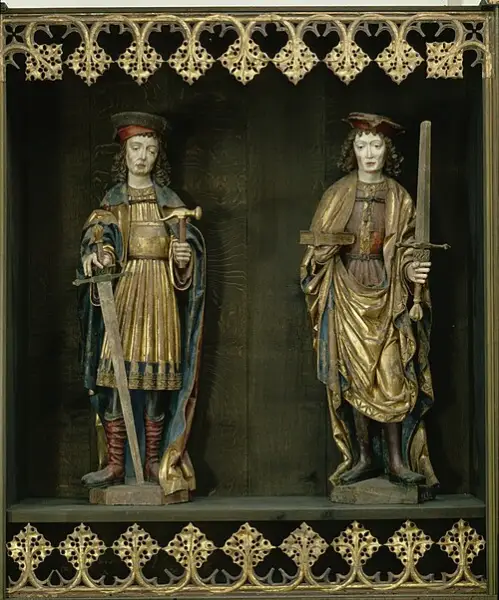
Crispin and Crispinian, remembered as twin brothers of a noble Roman house, are the patron saints of everyone who works in leather: cobblers, curriers, tanners, saddlers, glovers, and lace makers among them. The story places them in the third century, driven from home by persecution for the faith and settling at Soissons in Gaul. There they combined two callings — preaching Christ to the Gauls by day and making shoes by night — and from their trade they supported themselves and relieved the poor. Their success aroused the governor Rictus Varus, who subjected them to torture and had them thrown into the river with millstones at their necks; when they emerged alive, the emperor ordered them beheaded, on 25 October 285 or 286. A basilica soon rose over their graves at Soissons, and their cult spread across Europe. Though removed from the universal Roman calendar after the Second Vatican Council, they remain in the Roman Martyrology on their ancient day, are kept by the Church of England as a commemoration, and were immortalized by Shakespeare in the St. Crispin's Day speech of Henry V.
The Complete Life
Sons of a Noble House
Tradition makes Crispin and Crispinian twins, sons of a noble Roman family born in the third century. Of their childhood and education nothing is recorded; their story, as it has come down, begins with the persecutions that periodically shook the Christian communities of the empire. Rather than renounce their faith, the brothers left home and traveled north into Gaul, eventually reaching Soissons, in the lands of the Belgic tribes. The move inverted every expectation of their rank: young men of good family became itinerant evangelists in a frontier province, dependent for bread on a craft learned for the occasion. They took up shoemaking, and by this humble trade they lived. The choice defined their sanctity. Later generations of craftsmen would recognize in them not aristocrats condescending to labor but workers honored among workers, saints who had known the awl, the bench, and the long hours of the night. Their Roman birth gave them standing to preach; their trade gave them a livelihood, an entry into every household, and, in time, a host of guilds across Europe who took them for their own.
§ Story
Preaching by Day, Shoemaking by Night
At Soissons the brothers worked out a rhythm of life that became their legend: preaching to the Gauls by day, making shoes by night. The arrangement served every purpose at once. The craft kept them fed, allowed them to live among the people without charge, and left them free to speak of Christ without asking anyone's permission. Their earnings did more than maintain them, for the account insists that they supported themselves and gave aid to the poor of the town. Work and word belonged together in their hands, and the memory of that union explains why leather workers, glovers, and lace makers across Europe claimed them as patrons. They were, in effect, missionaries of a new kind — laymen unbacked by imperial favor, sustained by their own labor, and known to every customer in the market. Two brothers of noble blood bending over the bench of an evening threatened no one; two preachers whose honesty and charity had won the town threatened an order the authorities could not ignore. It was this visibility, as much as their words, that finally drew the attention of the Roman administration in Belgic Gaul and set a persecution in motion against them.
§ Story
Trial before Rictus Varus
The success of the two missionaries provoked the anger of Rictus Varus, the Roman governor of Belgic Gaul. Modern scholars have doubted whether such an official ever existed, since the northern Gallic provinces in that era were ruled by the Caesar Constantius and there was no persecution of Christians there; the Prosopography of the Later Roman Empire judges him most probably a fictitious character. But the legend records a savage trial. The governor had the brothers tortured and, when that failed to break them, ordered them thrown into the river with millstones tied around their necks. The brothers survived, delivered, as their devotees believed, by the hand of God. Their death followed nonetheless: by order of the emperor himself they were beheaded, on 25 October in 285 or 286. Whatever the exact course of events, the tradition has always located their witness at Soissons, where their graves became a shrine; the basilica built there and the relics distributed across Europe trace back to that place and that date. The brothers who had arrived as fugitives remained as the apostles of the region.
§ Story
The Death of the Brothers
The deaths of Crispin and Crispinian were spread across a series of torments rather than a single blow. First came the tortures ordered by Rictus Varus; then the river, millstones and all; and at last the sword of the executioner by the emperor's command, around the year 286. Each stage was remembered because each, in the legend's telling, failed: the bodies endured, the water gave them back, and only the final stroke of the blade completed what the persecutors intended. The brothers were buried at Soissons, and the fidelity that had carried them through the torments became the property of the Christian community that gathered at their tomb. Their feast was fixed on the day of their death, 25 October, a date that would echo down the centuries. In France and England the day brought solemn processions and merry-making, with the guilds of shoemakers marching at their head. It brought war as well: the Battle of Agincourt was joined on Saint Crispin's feast day. And it brought poetry, for Shakespeare gave King Henry V the speech about the happy few, the band of brothers, that made Crispin's name a household word far beyond the workshops of the craftsmen who first claimed it.
§ Story
An Ancient and Enduring Cult
Crispin and Crispinian were honored as martyrs from the moment of their burial, long before any process of canonization existed; they rank among the pre-congregation saints of the first centuries. The sixth century saw a grand basilica rise above the place of their burial at Soissons, the surest sign of an established cult, and St. Eligius, the celebrated goldsmith-bishop, wrought a costly reliquary to hold the head of St. Crispinian. Their remains were later divided under Charlemagne, part going to Osnabrück and part to the church of San Lorenzo in Panisperna in Rome. The feast of 25 October stood in the universal calendar of the Roman Church for centuries. The liturgical reforms that followed the Second Vatican Council removed it, yet the most recent edition of the Roman Martyrology still commemorates the two saints on that day, and the Church of England keeps a commemoration of them on 25 October. Such an afterlife — basilica, reliquary, royal translations, guild fraternities, and a place in two national calendars — is more than most martyrs of the early Church received, and it shows how deeply the image of the preaching shoemakers took root in the imagination of Christian Europe.
§ Veneration
Saints of Poetry, Stage, and Workshop
Few martyr pairs have entered popular culture so deeply. The Battle of Agincourt was fought on Saint Crispin's feast day, and Shakespeare's St. Crispin's Day Speech in Henry V — the band-of-brothers oration — has kept the date famous ever since. Wagner set the saints on stage as well: in the third act of Die Meistersinger, at the Midsummer Day festival, the shoemakers' trade guild comes on stage singing a hymn in praise of St. Crispin, a tribute to their oldest patrons. English tradition even relocated the twins, placing them at Canterbury rather than in Gaul. In the sixteenth century a local legend bound them to the town of Faversham in Kent, where a plaque still commemorates the association, and an old public house at Strood in Kent bears the name 'Crispin and Crispianus.' Institutions carried their name into later centuries: the Order of the Knights of St. Crispin, the Daughters of St. Crispin, St Crispin Street Fair, and the city livery companies all kept the martyrs attached to the craft. In the Philippines, a barangay of San Pablo City, Laguna, is called San Crispin in their honor.
§ Cultural references
Timeline
- 25 Oct 286
Beheaded on 25 October, in 285 or 286, after torture on the orders of Rictus Varus, governor of Belgic Gaul.
§ Introduction
- 500
In the sixth century a grand basilica rose above their burial place at Soissons, and St. Eligius wrought a costly reliquary for the head of Crispinian.
§ Veneration
- 800
Charlemagne removed portions of the remains to Osnabrück and to the church of San Lorenzo in Panisperna in Rome.
§ Veneration
- 1500
A sixteenth-century legend attached the two saints to the town of Faversham in Kent.
§ Cultural references
The Record
- Patron of
- cobblers·curriers·tanners·leather workers·glove makers·lace makers·lace workers·saddle makers·saddlers·shoemakers·weavers
- Symbols
- depicted holding shoes
- Canonization
- Pre-congregation; honored as martyrs from the time of their burial at Soissons
Prayer
Bibliography
Show 4 sources
- Meier, Gabriel (1908). 'Sts. Crispin and Crispinian.' The Catholic Encyclopedia, Vol. 4. New York: Robert Appleton Company
- Jones, A. H. M.; Martindale, J. R.; Morris, J. (1971). The Prosopography of the Later Roman Empire, Vol. I, A.D. 260–395. Cambridge University Press, p. 766. ISBN 978-0-521-07233-5
- Martyrologium Romanum, 2nd ed. Vatican City: Libreria Editrice Vaticana, 2004, p. 590
- Chisholm, Hugh, ed. (1911). 'Crispin and Crispinian.' Encyclopædia Britannica, Vol. 7 (11th ed.). Cambridge University Press, p. 468
Profile text adapted from the Wikipedia article, licensed CC BY-SA 4.0.
Pray with this saint every day
Save Sts. Crispin and Crispinian to your favorites, read the full profile, and get feast-day reminders in the Saints app.
Get the Saints AppFree on the App Store for iPhone and iPad