
c. 240 – 304·Feast September 26
Sts. Cyprian and Justina
Martyrs of Antioch: Magician and Virgin
Overview
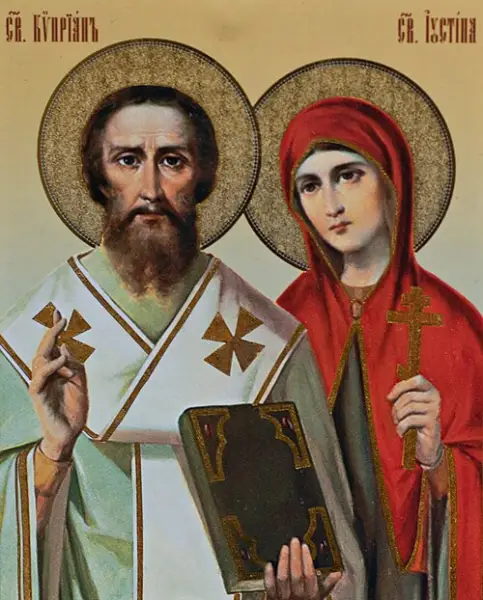
Cyprian and Justina were Christians of Antioch put to death at Nicomedia on September 26, 304, during the Diocletianic Persecution. Cyprian, remembered in the legend as 'the Magician,' had received a liberal education and applied himself to astrology, traveling through Greece, Egypt, and India before settling in Antioch as a practitioner of sorcery. Justina was a young woman of the city who had consecrated herself to Christ by private vows of chastity, sustaining herself through prayer and fasting. When a pagan lawyer sought Cyprian's help in winning her, every demon he dispatched was repelled by the sign of Christ; vanquished, Cyprian made the sign himself, burned his books of magic before a bishop, and was baptized. He rose successively to deacon, priest, and bishop of Antioch as successor to Anthimus, while Justina became an abbess. Under Diocletian both were arrested, tortured at Damascus, and brought before the emperor at Nicomedia, where they were beheaded alongside a convert named Theoctistus. Their story, attested from the fourth century by Gregory of Nazianzus and Prudentius, circulated in the Golden Legend and inspired drama and folklore across Europe, although the Roman Catholic Church deleted their feast in 1969 for lack of historical evidence.
The Complete Life
A Legend Born Early
The tale of Cyprian and Justina appears to have taken shape remarkably early. Gregory of Nazianzus and the poet Prudentius both knew it in the fourth century, although each mistakenly identified its hero with Cyprian of Carthage, a confusion that would be repeated for centuries. The legend circulated in Greek and in Latin, was printed in the Acta Sanctorum for September, and traveled as far as Syria and Ethiopia, where ancient Syriac and Ethiopic versions were eventually published. Medieval writers retold it at length: Symeon Metaphrastes furnished a diffuse account filled with descriptions and dialogues, the story found a place in the Golden Legend, and the empress Aelia Eudocia made it the subject of a poem. Within this tradition Cyprian is remembered as a figure of the third-century pagan world, given every advantage of a liberal education. He applied himself above all to astrology, the science of those who wished to read the workings of fate, and then traveled through Greece, Egypt, India, and other lands in pursuit of further improvement. He settled in Antioch, where he worked as a magician and dealer in sorcery, acquiring the title 'the Magician' to set him apart from the African bishop whose name he shares. Justina, by contrast, enters the story as a young woman of Antioch whose birth, beauty, and accomplishments drew admiration, set apart from her city by her Christian consecration to virginity.
§ Origin
The Defeat of the Magician
The turning of Cyprian's life came through a suit he was hired to secure. A pagan lawyer of Antioch desired Justina in marriage and, finding her unmoved, sought the aid of the celebrated sorcerer. Cyprian dispatched a demon to inflame carnal passion in the Christian virgin, but she spent her days in prayer and fasting, and the assault found nothing to seize. He tried again with a stronger spirit, even 'the chief of the demons,' and it too was conquered by a certain 'Sign of Christ' that she made. Brought to despair by the failure of his art, Cyprian drew the conclusion his magic could not evade: he made the sign of Christ himself, and in that moment was freed from the toils of Satan. The conversion was total and public. Before a bishop of the Church he burned the books of spells and sorcery that had been his livelihood, sealing his renunciation of the occult. He was baptized and received into the Christian community, and the tradition relates that he was made preeminent by miraculous gifts. The pagan suitor, himself persuaded by what had happened, likewise embraced Christianity in a short time. What had begun as a commission against a young woman ended in the conquest of the magician by the faith of the woman he had been paid to seduce.
§ Legend
Prayer, Fasting, and the Sign of Christ
The spirituality the legend sets before its readers belongs chiefly to Justina. She is described as a young woman who had taken private vows of chastity, and her defense against every demonic assault is portrayed not as struggle but as composure: in chastity and purity she passed her time in prayer and fasting, so that when the spirit of lust was sent against her there was nothing in her to which it could cling. The 'Sign of Christ' is the legend's summary of an entire way of discipleship, an unhesitating identification with Christ that rendered the powers of the air powerless. In Cyprian's story the same way of life appears in its converted form. His first Christian act was the burning of his books, an ascetic rejection of the occult arts that had formed him; his new life was marked by the sacraments of the Church and, according to the tradition, by charismatic gifts. Both saints closed that life in witness under torture, their faith never wavering while their bodies suffered. Prayer, fasting, the sign of the cross, and constancy unto death are the disciplines in which the old magician and the consecrated virgin are shown to stand as equals before God.
§ Legend
Bishop of Antioch and Abbess
Once Cyprian had been received into the Church, the legend traces a swift ascent through its orders. He was made a deacon, then a priest, and finally bishop, named as the successor to Anthimus in the see of Antioch. The career is presented as providential reversal: the man who had been the city's most notorious sorcerer became its chief shepherd, and the one-time master of demons now presided over a flock delivered from them. Justina's path ran parallel. The virgin whose consecration had defeated the demons became an abbess, placed at the head of a community of women living as she did. In this way the story binds the two figures together for the remainder of their lives: he a father and governor of the church of Antioch, she a mother of consecrated virgins. The mission they shared was costly, for the church they led was about to enter the last and fiercest of the imperial persecutions. When Diocletian's assault on Christians came, it was such prominence that made them targets, and their histories gave their arrest its meaning: the converted magician turned bishop and the virgin turned abbess were seized together as leaders of a community each had, in very different ways, been converted to serve.
§ Legend
Torture at Damascus, Beheading at Nicomedia
The persecution of Diocletian reached the pair on a date the tradition preserves: on the sixth day of the seventh month the two were arrested and carried to Damascus to be put to torment. Cyprian, in Foxe's later summary, was torn with pincers, and Justina was chastised, with other torments following; neither wavered in faith. They were then brought before Diocletian himself at Nicomedia. At the emperor's command on September 26, 304, they were beheaded beside the waters of the Gallus, the stream that flows into the Sangarius. A third martyr joined them at the scaffold: Theoctistus, a bystander who, observing Cyprian's constancy, declared himself a Christian and suffered the same fate. Cyprian was sixty-four years old, and the legend notes that he was beheaded on his birthday, the anniversary at which his life in Christ was understood to have begun. Justina's age at death the record does not preserve. For six days the bodies of the saints lay unburied. Christian sailors then brought them across the sea to Rome, where a noble lady named Rufina received the remains on her estate and where they later found a resting place in Constantine's basilica, in the city that would keep their memory for well over a thousand years.
§ Legend
An Ancient Cult, A Contested Calendar
Neither saint required a formal canonization: both were honored as martyrs from the earliest memory of the Church, and their cult spread across the Christian East and West. Their feast day entered the General Roman Calendar of the Roman Rite in the thirteenth century and remained there for more than six hundred years. In 1969, however, the revision of the Calendarium Romanum deleted it, because of the lack of historical evidence for the saints' existence; Catholic sources preserve the related note that no Bishop of Antioch actually bore the name Cyprian. When the Roman Martyrology, the official though professedly incomplete register of recognized saints, was revised in 2001, their names likewise vanished from it, even though that register still carries five further saints named Cyprian and two called Justina. Some traditionalist Catholics continue to observe the feast according to pre-1970 versions of the Roman Calendar. In the Christian East the cult has never been interrupted: the Eastern Orthodox Church keeps their memory on October 2, the Coptic Orthodox Church on 21 Thout, and they are venerated across Oriental and Eastern Orthodoxy as martyrs of the Diocletianic persecution, whose story was told in the Golden Legend and illustrated in manuscripts such as the eleventh-century Menologion of Basil II.
§ Veneration and liturgical celebration
From Faust to the Great Book
Few martyr legends have shown the cultural staying power of Cyprian and Justina. The historian of religion Gilles Quispel argued that the story of Cyprian, the magician who surrenders his art before a power greater than his demons, is a prototype of the Faust story, a suggestion that places these early martyrs near the head of one of Western literature's defining myths. In the Spanish Golden Age, Pedro Calderón de la Barca took their legend as the basis of his drama El mágico prodigioso, and the tradition has continued into the present: in 2005 the American author Tono Rondone published The Martyrs, a novel conceived as a continuation of the story. A stranger afterlife belongs to Cyprian's name in folk religion. The Great Book of Saint Cyprian, a volume full of prayers and spells, is widely sold across the Portuguese- and Spanish-speaking world, and in Scandinavian folklore 'Cyprianus' is a popular name for a grimoire. The irony of a bishop who burned his books of magic lending his name to books of spells was not lost on the tradition, but it testifies to how deeply the converted sorcerer entered the imagination of Christian Europe, standing forever as proof that no bondage to the occult lies beyond the reach of Christ.
§ In popular culture
Timeline
- 240
Cyprian is born in the third century; the tradition records that he was sixty-four years old when he was beheaded.
§ Legend
- 304
During the Diocletianic Persecution the two are seized and taken to Damascus, where they are tortured without their faith wavering.
§ Legend
- 26 Sep 304
The pair is beheaded at Nicomedia by order of Diocletian, on the bank of the Gallus River, together with the convert Theoctistus.
§ Introduction
- 304
Sailors carried the bodies, left unburied six days, to Rome for burial on the estate of the noble lady Rufina.
§ Legend
- 350
The story is already circulating, mentioned by Gregory of Nazianzus and Prudentius, though both conflate Cyprian with the bishop of Carthage.
§ Origin
- 1200
The feast of Cyprian and Justina appears in the General Roman Calendar of the Roman Rite.
§ Veneration and liturgical celebration
- 1969
The feast is deleted from the General Roman Calendar because of the lack of historical evidence for the saints' existence.
§ Veneration and liturgical celebration
- 2001
The revised Roman Martyrology dropped their names, though it keeps five other Cyprians and a pair called Justina.
§ Veneration and liturgical celebration
- 2005
American author Tono Rondone publishes The Martyrs, a novel continuing the tradition of the saints' story.
§ In popular culture
In Their Own Words
A pagan gentleman applied to Cyprian, to promote his suit with the beautiful Justina; this he undertook, but soon himself converted, burnt his books of astrology and magic, received baptism, and felt animated with a powerful spirit of grace.
The Record
- Major works
- The fourth-century legend, preserved in Greek and Latin acta and in ancient Syriac and Ethiopic versions·Empress Aelia Eudocia's poem on the legend·Symeon Metaphrastes' diffusely retold account with dialogues
- Canonization
- Pre-congregation martyrs; venerated from antiquity, though the Roman Catholic Church removed their feast in 1969 for lack of historical evidence
Prayer
Bibliography
Show 9 sources
- Gabriel Meier (1908). "Sts. Cyprian and Justina". In Catholic Encyclopedia. 4. New York: Robert Appleton Company.
- Gilles Quispel, "Faust: Symbol of Western Man", in G. Quispel, Gnostic Studies (Two volumes, Istanbul: Nederlands Historisch-Archaeologisch Institut, 1975), Vol. II p. 288-307. Originally published in 1967 as a monograph (Zurich: Rhein-Verlag).
- "The Lives of Sts. Cyprian and Justina", The Orthodox Word, Vol. 12, No. 5 (70) (September-October, 1976), pp. 135-142, 167-176
- Stracke, Richard. "Saints Cyprian and Justina: The Iconography", Christian Iconography, Augusta University, 2017
- Goodspeed, Edgar J. (1903). "The Martyrdom of Cyprian and Justa". The American Journal of Semitic Languages and Literatures. 19 (2): 65–82. doi:10.1086/369468
- "Virginmartyr Justina of Nicomedia". Retrieved 25 October 2016.
- Foxe, John (1926). Fox's Book of Martyrs: A History of the Lives, Sufferings and Triumphant Deaths of the Early Christian and the Protestant Martyrs. John C. Winston Company. p. 27.
- "Calendarium Romanum" (Libreria Editrice Vaticana, 1969), p. 140
- Rondone, Tono. The Martyrs
Profile text adapted from the Wikipedia article, licensed CC BY-SA 4.0.
Pray with this saint every day
Save Sts. Cyprian and Justina to your favorites, read the full profile, and get feast-day reminders in the Saints app.
Get the Saints AppFree on the App Store for iPhone and iPad