
died c. 304·Feast June 16
Sts. Cyricus and Julitta
The Child Martyr of Tarsus and His Mother
Overview
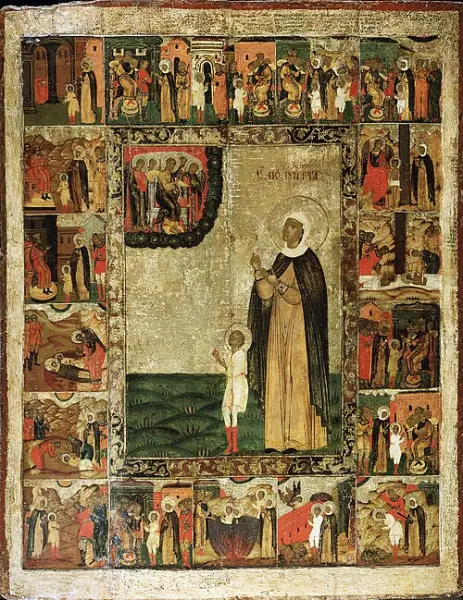
Cyricus and Julitta, a young boy and his mother, are venerated as early Christian martyrs put to death at Tarsus, by tradition in the year 304, at the outbreak of the Diocletianic Persecution. Fleeing their home in Iconium, Julitta reached Tarsus with her three-year-old son and was there identified as a Christian. In the Greek account, preserved in a letter of Theodore of Mopsuestia to Pope Zosimus, the governor tortured the mother while the child, held in his hands, scratched the magistrate's face and was flung down a flight of stairs; Julitta, far from weeping, rejoiced that her son had won the crown, and was himself ripped with hooks and beheaded. A Latin, Syriac, and Arabic version instead has the boy summoned as a judge between one God and many, declaring himself a Christian, and strengthening his frightened mother by his own prayers. Their cult traveled astonishing distances: Amator of Auxerre carried relics to France in the fourth century, the laws of Hywel Dda made their feast a principal Welsh holiday, the Svans of Georgia hold an annual pilgrimage at Lagurka, and the Saint Thomas Christians of India dedicated churches to Cyricus before the year 1301. More than two hundred Italian churches bear their names.
The Complete Life
Iconium, and the Flight to Tarsus
Julitta was a Christian woman of Iconium in Asia Minor, the city known today as Konya, and Cyricus — called also Cyriacus, Quiricus, Cyr, or in Amharic Qirqos — was her son, three years old when the story that made them famous begins. Their home city lay in the heart of Anatolia, where Christian communities had grown for two centuries and where the coming of the great persecution found them exposed. According to the Greek version of their martyrdom, Julitta fled Iconium with her small son as the storm broke, seeking safety in Tarsus, the Cilician city on the road toward Syria. Flight, however, offered only distance and not anonymity: in Tarsus the mother was identified as a Christian and hauled before the governor. There is some evidence pointing to a child martyr of that name at Antioch, otherwise unrecorded, and it is believed that the legends of Cyricus and Julitta refer to him — which would help explain why so many places across Europe and the Middle East are named for Cyricus alone, without Julitta. Whether the legend preserves one martyr, two, or a tradition reshaped in the telling, the mother and child of Tarsus became among the most widely honored of the early martyrs of Asia Minor.
§ History
The Trial at Tarsus
The two surviving versions of the martyrdom tell the same ending in different keys. In the Greek account, handed down in a letter that Theodore of Mopsuestia sent to Pope Zosimus and in the Acta Graece Sincera, Julitta was tortured while her child stood by; held in the governor's own arms, little Cyricus scratched the magistrate's face, and the furious official dashed him down a flight of stairs to his death. Julitta did not weep. She rejoiced, the tradition says, that her boy had won the martyr's crown — and for that rejoicing the governor, enraged, decreed that her sides be ripped apart with hooks and that she then be beheaded. The Latin, Syriac, and Arabic version shifts the drama into the courtroom. Julitta, captured without Cyricus, refuses to sacrifice to idols and defies the governor with a challenge: let him find a child and ask whether homage belongs to a single god or to many. The child fetched is her own son, and before the tribunal Cyricus declares himself a Christian. Every torture inflicted on mother and child fails against them; when Satan enters Julitta's heart and she grows afraid of death, it is the boy who emboldens her with encouragement and prayers, until both are finally decapitated.
§ History
The Burial in the Field
The governor's rage did not end at the scaffold. The bodies of the mother and her child were flung outside the walls of Tarsus, onto the heap where the corpses of criminals were discarded, denied the burial that even Rome's own law usually permitted its dead. Two maids — figures the tradition preserves without further detail — came in secret, took up the bodies of mother and child from the refuse, and laid them in a nearby field. That field became the seed of one of the widest cults in Christendom. Constantine I is credited with finding their relics and with founding a monastery outside Constantinople and a church close to Jerusalem, and in the fourth century Amator, Bishop of Auxerre, carried relics from Antioch back to France, after which devotion to the saints grew strong there. The Acts of Cyricus and Julitta fared less well with the learned: in the sixth century the Decretum Gelasianum, a list erroneously attributed to Pope Gelasius I, rejected them among apocryphal documents. But the people of the churches had already decided the matter; the martyrdom of a child too young to understand, and of a mother who praised God for it, proved indestructible in the memory of East and West alike.
§ History
A Cult Without Borders
Cyricus and Julitta were never canonized, for their veneration predates every machinery of canonization; they belong to the pre-congregation martyrs honored across all the ancient churches. The Catholic Church keeps their feast on June 16, while the Assyrian Church of the East, the Eastern Orthodox Church, and the Oriental Orthodox Churches keep it on July 15. Cyricus is invoked again and again in the daily prayer of the Church of the East, within the vast store of that church's services, the Hudra — a fact that suggests the memory of the martyrs traveled early and widely across churches divided in doctrine. In Ethiopia and Eritrea, where Cyricus is Qirqos and Julitta is Iyäluta, the pair rank among the most popular of saints, with a feast on the fifteenth of the month of Terr and a whole literature of their own: the Täʾamrä Qirqos, or Miracles of Qirqos, the Mälkʾa Qirqos, the Sälam lä-Qirqos, and the Gädlä Qirqos, his Spiritual Combat, preserved in manuscript after manuscript of the Ethiopian monasteries. In India, Cyriacus ranks among the saints honored by the Saint Thomas Christians, and important churches were dedicated to him, the church at Pālūr — one of the seven founded in the mission of Thomas the Apostle — having originally borne his name.
§ Veneration
Saint-Cyr, Kvirikoba, and Two Hundred Churches
The names of the two martyrs are written across the map of Europe and the Near East. Cyricus alone lives on in the many French place-names beginning Saint-Cyr and the San Quirico of several Italian towns; in Italy more than two hundred churches, monasteries, and localities show signs of devotion to one or both saints, the most famous at San Quirico d'Orcia in Tuscany, where a twelfth- or thirteenth-century church stands on the base of an eighth-century baptistery. In Celtic Britain the cult of St. Giric was once far more widespread; English churches at Newton St. Cyres, Tickenham, Swaffham Prior, and Stonehouse still carry the dedication, as do Cornish villages at Luxulyan and St Veep and a church at Llanilid in Wales under the names St. Ilid and St. Curig. In the highland Georgian province of Svaneti the saints are patrons of the Kala community, and the eleventh-century Lagurka church, at 2200 meters, draws the whole province each July 28 for kvirikoba, the day of Cyricus — for the Svans, in the words of the historian Ekvtime Taqaishvili, what Delphi was for the ancient Greeks. From a dream of Charlemagne comes the saints' strangest emblem: the child riding a wild boar, who once demanded clothes of an emperor and a repaired cathedral roof of the bishop of Nevers.
§ Veneration
Timeline
- 304
Traditional accounts say Julitta and her small son Cyricus win the crown of martyrdom at Tarsus, the boy aged about three
§ Introduction
- 304
Two maids rescue the corpses of mother and child from the criminals' heap outside the city and bury them in a nearby field
§ History
- 350
Amator, Bishop of Auxerre, brings relics from Antioch to France, where the saints' cult becomes strong
§ Cyricus
- 500
The Acts of Cyricus and Julitta are rejected as apocryphal in the Decretum Gelasianum
§ Cyricus
- 1050
The Lagurka church is built in highland Svaneti, later the scene of the annual kvirikoba pilgrimage each 28 July
§ Georgia
- 1301
A document records the church at Kodungallur in India dedicated to Cyriacus among the Saint Thomas Christians
§ India
The Record
- Major works
- Acts of Cyricus and Julitta (recovered in Greek, Latin, Syriac, and Arabic versions; listed among apocrypha by the Decretum Gelasianum)
- Patron of
- prayed to for family happiness·for the restoring to health of sick children
- Symbols
- Cyricus depicted as a naked child riding a wild boar (from the Charlemagne story)
- Canonization
- Pre-congregation martyrs, venerated since antiquity across the Church of the East, the Catholic Church, and the Eastern and Oriental Orthodox churches
Prayer
Bibliography
Show 14 sources
- "Saint Martyrs Julitta (Giulietta, Julietta) and Cyricus (Kirik, Cyr, Cyriacus, Quiriac, Quiricus) mother and son of Tarsus". www.icon.lt. Retrieved 4 September 2017.
- Farmer, David Hugh (2011). "Cyricus (Cyriacus, Quiriac, Quiricus, Cyr) and Julitta". The Oxford Dictionary of Saints (5th ed. rev.). Oxford: Oxford University Press. doi:10.1093/acref/9780199596607.001.0001. ISBN 9780199596607.
- Papebroch, Daniel (1867). Acta Sanctorum, Junii, vol. 3. Paris & Rome. pp. 19–23.
- van Hoof, Gulielmus (1882). Analecta Bollandiana 1. Bruxelles. pp. 192–208.
- Terpelyuk, Alisa (2009). Martyrdom of Mār Qūryāqūs and Yōlīṭī (Cyriacus & Julitta). Critical text, Russian translation from Syriac, and research by Alisa A. Terpelyuk. Moscow: Institute for Oriental and Classical Studies, Russian State University for the Humanities. p. 5.
- Wade-Evans, Arthur. Welsh Medieval Laws, p. 343. Oxford Univ., 1909.
- "ISTRA.HR". www.istra.hr. Retrieved 22 July 2025.
- Pisani, Vitagrazia (2013). Il culto di San Qirqos nell'Etiopia storica: analisi storico-filologica, con edizione critica della "Passio" (Gädlä Qirqos) (Ph.D. dissertation). Naples: Università degli Studi di Napoli "L'Orientale".
- Pisani, Vitagrazia (28 April 2012). The Martyrdom of Saint Cyricus (Qirqos) in North Ethiopia: Elements of the devotion and of the manuscripts tradition. University of Hamburg.
- Voell, Stéphane (2013). "Oath of Memory: The Taking of Oaths on Icons in Svan Villages of Southern Georgia". Iran & the Caucasus. 17 (2): 158, 163. doi:10.1163/1573384X-20130203.
- Taqaishvili, Ekvtime (1937). არქეოლოგიური ექსპედიცია ლეჩხუმ-სვანეთში [Archaeological expedition to Lechkhumi and Svaneti] (in Georgian). Paris. pp. 179–184.
- Brock, Sebastian P. (2011a). "Thomas Christians". In Brock, Butts, Kiraz, Van Rompay (eds.). Gorgias Encyclopedic Dictionary of the Syriac Heritage: Electronic Edition. Gorgias Press.
- Whitehouse, Thomas (1873). Lingerings of light in a dark land: researches into the Syrian church of Malabar. William Brown & CO. p. 31.
- Ünser, Şükran (2025). "Tracing Sacred Intercession in Childbirth Across Byzantine Tradition and Its Western Reception, from the Virgin's Girdle to Saints Julitta and Kerykos". Religions 16, no. 11: 1346. doi:10.3390/rel16111346.
Profile text adapted from the Wikipedia article, licensed CC BY-SA 4.0.
Pray with this saint every day
Save Sts. Cyricus and Julitta to your favorites, read the full profile, and get feast-day reminders in the Saints app.
Get the Saints AppFree on the App Store for iPhone and iPad