
815 & 826 – 885 & 869·Feast February 14
Sts. Cyril and Methodius
Byzantine Missionary Brothers and Apostles to the Slavs
Overview
Cyril, baptized Constantine, and Methodius, baptized Michael, were brothers born at Thessalonica in the Byzantine Empire, Methodius around 815 and Cyril around 826 or 827. Educated in Constantinople under the protection of the chief minister Theoktistos, Cyril became a priest and taught philosophy at the university of Magnaura, while Methodius served as a deacon and later abbot. About 860 Emperor Michael III and Patriarch Photius dispatched Cyril to the Khazars, who had asked Constantinople for a scholar able to argue with Jews and Saracens, though the accounts that place Methodius at his brother's side on that journey may be a later invention. In 862 Prince Rastislav of Great Moravia asked Constantinople for missionaries, and the brothers set out with an innovation of lasting consequence: a new alphabet, later called Glagolitic, and translations of the Gospels and liturgical books into the Slavonic tongue. Their preaching in the vernacular won the people but provoked Frankish clergy who claimed the region. Summoned to Rome, they won the approval of Pope Adrian II for the Slavic liturgy; Cyril died there in 869 as a monk. Methodius, consecrated archbishop with jurisdiction over Moravia and Pannonia, endured imprisonment and accusations of heresy before securing papal vindication. He died in 885, leaving disciples who carried Slavonic Christianity into Bulgaria and beyond.
The Complete Life
Brothers of Thessalonica
Thessalonica, a busy Byzantine port where Greek-speaking citizens lived alongside Slavic settlers of the surrounding countryside, produced few sons more consequential than these two brothers. Methodius, the elder, was born around 815 and named Michael; Cyril followed around 826 or 827, named Constantine and remembered as the youngest of seven boys. Their father Leo served as a droungarios, a military commander, in the theme of Thessalonica, and their mother was named Maria. When their father died, the fourteen-year-old Constantine and his brother came under the patronage of Theoktistos, the powerful logothete who, with the regent Bardas, was reshaping Byzantine education. That connection opened the imperial capital to the brothers: Constantine received the finest schooling available and eventually taught philosophy at the university of Magnaura, while Michael entered imperial administration and monastic life, becoming abbot of Polychron monastery at Mysian Olympus, where he received the name Methodius. The precise ancestry of the family has long been debated, with scholars divided between Greek, Slavic, and mixed origins; what is certain is that the brothers knew the Slavic dialect of their home region, a fact that would shape the history of Europe.
§ Early life
Envoy to the Khazars
Around 860 the imperial court required a scholar who could debate with Jews and Muslims, for the Khazar khaganate north of the Black Sea had asked Constantinople to send one. Emperor Michael III and the patriarch Photius, who had been Constantine's professor, chose the future Cyril for the assignment; later accounts give Methodius a place on the journey as well, though this may be a later embellishment. Preparation was characteristically thorough: the Latin legend of Cyril's life records that he studied the Khazar language at Chersonesos in the Crimea before setting out. The mission accomplished its diplomatic and religious purposes, and the brothers returned with honors. On Cyril's side, the journey confirmed a pattern that would define his career: scholarship placed at the service of evangelization, with languages learned as instruments of preaching. Back in Constantinople he took up the chair of philosophy in the university, while Methodius rose in administrative and monastic affairs. Neither man could have predicted that within two years the skills honed on this embassy would be redirected toward a people whose conversion would outlast the empire that sent them.
§ Mission to the Khazars
The Moravian Mission and the New Alphabet
In 862 Prince Rastislav of Great Moravia addressed a request to Emperor Michael III and Patriarch Photius for teachers who could instruct his subjects in the Christian faith. His motives mingled faith and politics, for he sought to loosen Frankish tutelage over his kingdom, and his letter conceded that his people had already turned from paganism. The emperor chose Cyril, with Methodius at his side. Their preparation produced the decisive innovation of their lives: an alphabet, later called Glagolitic, designed for the sounds of Slavonic, and a translation of the Gospels and essential liturgical texts into the people's own speech. The brothers arrived in Moravia in 863 and their work prospered, but it collided with clergy of East Francia who regarded the region as their missionary territory and insisted on the Latin Roman Rite. The brothers had also composed a Slavic civil code for use in the country. Precisely how much they translated remains uncertain, and whether their liturgical source was Roman or Byzantine is still debated, though the Prague Fragments suggest Latin-type liturgical language. The conflict with the German episcopate, particularly the bishops of Salzburg and Passau who claimed jurisdiction over Pannonia as well, made a judgment from Rome unavoidable.
§ Mission to the Slavs
Methodius Alone: Trial and Vindication
After Cyril's death in Rome, Methodius carried the mission forward as archbishop, first laboring in Pannonia while Moravia's politics convulsed. Rastislav fell captive to his nephew Svatopluk in 870, and in the same turmoil the East Frankish rulers and their bishops moved against the archbishop whose jurisdiction threatened Salzburg's claims. Hauled before Adalwin of Salzburg, Ermanrich of Passau, and Anno of Freising, Methodius was declared deposed and confined to a monastery in the German lands for two and a half years, probably at Reichenau Abbey, where signatures in the confraternity book preserve his name and those of his companions. Rome did not abandon him. Over Frankish objections, Pope John VIII secured his release in 873, though with an order to suspend the Slavonic liturgy. Methodius returned to a fruitful decade, and evidently celebrated in the vernacular despite the restriction. Accusations followed, touching the Filioque and the liturgy, and in 878 he was summoned to Rome; his defense persuaded the pope, who sent him back acquitted and with the disputed permission restored. He accepted the Swabian Wiching as coadjutor, survived further strife with papal support, and died on 6 April 885, his burial place in the Moravian capital now lost to history.
§ Second mission of Methodius
Honored by the Churches
Cyril was regarded as a saint almost immediately. Crowds who lined the Roman streets at his funeral were said to have called for his enrollment among the saints, and devotion to both brothers spread through the lands they evangelized and then across the whole Church. Formal papal recognition came slowly by modern standards: the brothers first appear in a papal document with Grande Munus, the encyclical of Leo XIII issued in 1880, which placed their feast on the calendar of the Roman Rite on 14 February, the anniversary of Cyril's death. The Orthodox churches keep 11 May, a date that falls on 24 May for communities following the Julian calendar. Czech and Slovak Catholics celebrate on 5 July, a date set by Pius IX. The Church of England keeps a Lesser Festival, and the Episcopal Church and Lutheran churches likewise commemorate the pair. In 1980 John Paul II, the first Slav pope, declared them co-patrons of Europe together with Benedict of Nursia, and ten years earlier he had beatified their disciple circle as the Seven Saints of Bulgaria, honored there since the tenth century. Public holidays in Bulgaria, North Macedonia, the Czech Republic, and Slovakia still mark their day.
§ Commemoration
Letters That Outlasted Empires
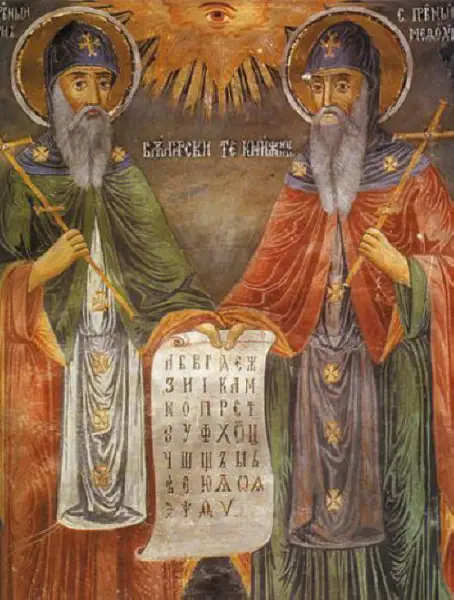
The brothers' most durable monument is scriptural in the literal sense: an alphabet. The Glagolitic script, traditionally credited to Cyril and confirmed as his invention by the papal letter Industriae tuae of 880, served in Great Moravia from the brothers' arrival in 863 until the expulsion of their students in 885, both for church books and for government documents. Their disciples carried it south and east. At the Preslav Literary School, founded after Boris I of Bulgaria welcomed the exiles, students devised the early Cyrillic alphabet, a simplification of Glagolitic modeled on Greek letterforms; it displaced Glagolitic, became the official script of the First Bulgarian Empire, spread to Kievan Rus', and eventually became the standard alphabet of the Orthodox Slavic world. Clement of Ohrid, one of the five disciples ordained in Rome, taught some 3,500 students in Slavonic letters over seven years at the Ohrid school. The liturgical language descended from their translations, Church Slavonic, remains in use among Orthodox and Eastern Catholic communities. National libraries, universities, a Bulgarian naval vessel, a peak in Antarctica, and the title 'Apostles to the Slavs' all testify that the work begun at Thessalonica's modest school of languages reshaped the religious and literary map of a continent.
§ Invention of the Glagolitic and Cyrillic alphabets
Timeline
- 815
Methodius is born at Thessalonica, named Michael, into the family of a Byzantine military officer.
§ Early life
- 827
Cyril is born at Thessalonica, named Constantine, reputedly the youngest of seven brothers.
§ Early life
- 860
Emperor Michael III and Patriarch Photius dispatch Cyril to the Khazars; he studies their language at Chersonesos.
§ Mission to the Khazars
- 862
Prince Rastislav of Great Moravia asks Byzantium for missionaries to instruct his Slavic subjects.
§ Mission to the Slavs
- 863
The brothers begin rendering the Gospels and liturgical books into Old Church Slavonic using their new alphabet, and travel to Moravia.
§ Mission to the Slavs
- 867
Pope Nicholas I invites the brothers to Rome amid disputes with Frankish bishops over jurisdiction.
§ Journey to Rome and death of Cyril
- 868
Pope Adrian II formally approves the Slavic liturgy; Methodius is ordained a priest and five Slavic disciples receive orders.
§ Journey to Rome and death of Cyril
- 14 Feb 869
Cyril becomes a monk, takes his religious name, and dies in Rome on 14 February.
§ Journey to Rome and death of Cyril
- 870
Methodius, named Archbishop of Sirmium, is seized by East Frankish bishops and imprisoned for about two and a half years.
§ Second mission of Methodius
- 873
Pope John VIII obtains Methodius's release and restores his archiepiscopal jurisdiction over Moravia and Pannonia.
§ Second mission of Methodius
- 878
Summoned to Rome on charges of heresy and of celebrating in Slavonic, Methodius is acquitted and regains permission for the vernacular liturgy.
§ Final years of Methodius
- 880
The papal letter Industriae tuae approves Old Church Slavonic and credits Constantine the Philosopher with inventing the new alphabet.
§ Invention of the Glagolitic and Cyrillic alphabets
- 6 Apr 885
Methodius dies on 6 April and is buried in the principal cathedral church of Great Moravia.
§ Final years of Methodius
- 886
Expelled disciples, including Clement of Ohrid and Naum, reach Bulgaria and establish Slavic theological schools at Ohrid and Preslav.
§ Invention of the Glagolitic and Cyrillic alphabets
- 11 May 1851
The first recorded secular celebration of the brothers' day, as the Day of the Bulgarian script, is held at Plovdiv on 11 May.
§ Commemoration
- 1880
Pope Leo XIII, in the encyclical Grande Munus, places the brothers on the calendar of the Roman Rite.
§ Commemoration
- 1980
Pope John Paul II declares the brothers co-patrons of Europe alongside Benedict of Nursia.
§ Commemoration
In Their Own Words
a man of apostolic life
a man of great wisdom
The Record
- Major works
- Glagolitic alphabet·Translation of the Gospels and liturgical books into Old Church Slavonic·First Slavic civil code
- Patron of
- Europe·Bulgaria·North Macedonia·Czech Republic·Slovakia·Serbia·Archdiocese of Ljubljana
- Symbols
- The brothers shown together·Eastern bishops holding up a church·An icon of the Last Judgment·Cyril in monastic habit and Methodius vested as a bishop with omophorion
- Canonization
- Pre-congregation; honored as saints soon after their deaths, the feast entered the Roman Rite calendar through Pope Leo XIII in 1880, and Pope John Paul II named them co-patrons of Europe in 1980
Prayer
Bibliography
Show 6 sources
- Betti, Maddalena (2013). The Making of Christian Moravia (858-882): Papal Power and Political Reality. Leiden-Boston: Brill.
- Bowlus, Charles R. (1995). Franks, Moravians, and Magyars: The Struggle for the Middle Danube, 788-907. Philadelphia: University of Pennsylvania Press.
- Curta, Florin (2006). Southeastern Europe in the Middle Ages, 500-1250. Cambridge: Cambridge University Press.
- Dvornik, Francis (1962). The Slavs in European History and Civilization. New Brunswick: Rutgers University Press.
- Fine, John Van Antwerp Jr. (1991) [1983]. The Early Medieval Balkans: A Critical Survey from the Sixth to the Late Twelfth Century. Ann Arbor, Michigan: University of Michigan Press.
- Abraham, Ladislas (1908). "Sts. Cyril and Methodius". The Catholic Encyclopedia. Robert Appleton Company.
Profile text adapted from the Wikipedia article, licensed CC BY-SA 4.0.
Pray with this saint every day
Save Sts. Cyril and Methodius to your favorites, read the full profile, and get feast-day reminders in the Saints app.
Get the Saints AppFree on the App Store for iPhone and iPad