
died c. 304 or 311·Feast 31 January (Coptic: 6 Tobi; also Roman Martyrology); 28 June (translation of relics, Eastern Orthodox)
Sts. Cyrus and John
Martyrs; Wonderworking Unmercenary Physicians
Overview
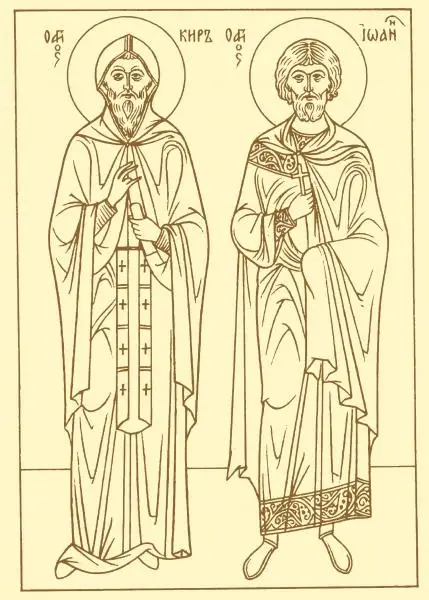
Cyrus and John are the great physician-saints of Egypt, healer-martyrs whose cult became so entwined with the Nile delta that a city still bears Cyrus's name. Cyrus practiced medicine in Alexandria, treating the sick without payment and winning many from paganism to Christ; when the Diocletianic persecution broke out he fled to the Arabian town of Tzoten, received the monastic tonsure, and gave up medicine for asceticism. John, an officer of high rank in the army and, the Synaxarium says, a familiar of the emperor himself, heard of Cyrus's holiness, fulfilled a vow at Jerusalem, and joined him in Arabia as a companion in the ascetic life. Their quiet was broken when three Christian sisters — Theoctista, fifteen; Theodota, thirteen; and Theodossia, eleven — were arrested at Canopus with their mother Athanasia and taken to Alexandria for torture. Fearing the girls might break under torment, Cyrus and John went into the city to strengthen them, and were themselves arrested. After dreadful tortures all were beheaded on 31 January, around 304 or 311. Their bodies were laid in the church of St. Mark in Alexandria, and in 414 Patriarch Cyril of Alexandria translated the relics to Menuthis to supplant a pagan oracle-shrine there. The Arabic-speaking world remembers Cyrus as Abu Qir, the name of the coastal town near their shrine. Cyril himself claimed to have healed sickness and they were honored as the Wonderworking Unmercenaries — healers who never took a fee for their cures.
The Complete Life
The Physician and the Soldier
Everything known of the two saints flows from the encomium composed by Sophronius, Patriarch of Jerusalem, who died in 638; of their birth, parents and early years even that source is silent. The Arabic Synaxarium of Michael, Bishop of Athrib and Malig, makes both men Alexandrians, though other documents say Cyrus came from Alexandria and John from Edessa. Cyrus practiced the art of medicine in that city and kept a workshop — the ergasterium later converted into a church honoring the Three Holy Children of Babylon. His practice had two currencies: he asked no fee, and he preached. Ministering to the sick gratis, he labored with apostolic ardor and drew many away from pagan superstition, telling patients that sin itself was often the root of bodily illness. When the persecution under Diocletian reached Alexandria he was denounced to the prefect and withdrew to Tzoten, a seaside town in Arabia, where he received the monastic tonsure and exchanged medicine for asceticism. John's road to the desert ran through the army: a man of high rank, numbered by the Synaxarium among the emperor's familiars, he heard reports of Cyrus's virtues and wonders, discharged a vow at Jerusalem, and traveled on through Alexandria to Arabia to put himself beside the hermit as his companion.
§ Life and historicity
Martyrdom at Canopus and Alexandria
The persecution gathered in the saints' deaths is that of Diocletian, though the sources divide between 304 and 311 for the date. At Canopus three young sisters were arrested with their mother: Theoctista, fifteen years old; Theodota, thirteen; and Theodossia, eleven. Hauled to Alexandria to be tortured, the girls faced precisely the danger that moved Cyrus and John to act — that in the agony of torment their youth might fail and they would deny the faith. The two ascetics left their retreat and entered the city to console and embolden the family. The intervention was discovered, and the confessors of others became confessors themselves: all were arrested, put to dire torments, and beheaded together on 31 January. A miniature in the Menologion of Basil II preserves the scene for the Byzantine tradition, and the Church of the East keeps the memory of the martyrs' company, the anargyroi who paid for their healing work with their blood.
§ Martyrdom of Cyrus and John
Relics and the Fight over a Pagan Shrine
The bodies of the two martyrs were first laid in the church of St. Mark the Evangelist in Alexandria. Their cult's decisive hour came under Patriarch Cyril of Alexandria (412–444). At Menuthis, near Canopus and the modern Abu Qir, a pagan temple drew crowds with its oracles and cures, and even simple Christians of the neighborhood were being drawn in. Cyril resolved to strangle the idolatrous cult by planting the martyrs' cult in its place: on 28 June 414 he moved the relics into the church his predecessor Theophilus had built in honor of the Four Evangelists. Strikingly, the written record of the saints seems to begin only with that translation — before it, their names are essentially unknown to documents. In the fifth century, under Pope Innocent I, two monks named Grimaldus and Arnulfus carried relics to Rome, enshrined at the deaconry of Santa Maria in Via Lata and then at Santa Passera on the Via Portuense — the name itself a corruption of Abbas Cyrus, Father Cyrus; Cardinal Angelo Mai argued on historical grounds for the later date of 634, under Honorius I and Heraclius. A marble inscription over the hypogeum there still proclaims that the sacred bodies of Cyrus and John, once given to Rome by great Alexandria, rest in that place. Their tomb became a pilgrimage shrine, three Roman churches carried their name, Cyrus's memory gave the coastal city of Abu Qir its name, and in the Byzantine rite the two saints are commemorated in the Liturgy of Preparation before every Divine Liturgy.
§ Veneration
The Unmercenary Tradition
Cyrus and John stand at the head of the tradition of the holy unmercenaries — the thaumatourgoi anargyroi, wonderworking healers who took no payment — a lineage that includes Cosmas and Damian, Panteleimon and the other physician-saints of the East. The Coptic Church numbers them among its most beloved martyrs and keeps their feast on 6 Tobi, corresponding to 31 January, the same day the Eastern Orthodox Church and the Roman Martyrology commemorate them; the Orthodox add a second feast on 28 June for the translation of their relics. Their major shrine today is the church of Saint Barbara in Coptic Cairo, where Egyptian pilgrims still seek their aid. In art they carry the double insignia of their witness: Cyrus robed as a monk beside John in the court dress he renounced, both holding martyrs' crosses, medicine boxes, and the crossed spoons of physicians who healed for the love of Christ and charged nothing at all.
§ Introduction
Timeline
- 300
Cyrus practices medicine in Alexandria from a workshop later converted into a church, healing without fee and winning many from paganism
§ Cyrus
- 303
Under Diocletian's persecution Cyrus is denounced to the prefect and flees to Tzoten on the Arabian coast, where he takes the tonsure and embraces the ascetic life
§ Cyrus
- 303
John, a high-ranking army officer, makes a vow at Jerusalem, travels on to Alexandria and Arabia, and becomes Cyrus's companion in asceticism
§ John
- 311
Theoctista, Theodota, Theodossia and their mother Athanasia are seized at Canopus and carried to Alexandria; Cyrus and John slip into the city to embolden them and are seized in turn
§ Martyrdom of Cyrus and John
- 31 Jan 311
After dire torments the saints and the three sisters with their mother are beheaded on 31 January
§ Martyrdom of Cyrus and John
- 311
The martyrs' bodies are placed in the church of St. Mark the Evangelist in Alexandria
§ Veneration
- 28 Jun 414
On 28 June Patriarch Cyril of Alexandria moves the relics to Menuthis near Canopus, installing them in his predecessor Theophilus's church to break a pagan oracle-cult there
§ Veneration
- 440
During the pontificate of Innocent I two monks, Grimaldus and Arnulfus, bring relics of the martyrs to Rome, where they are enshrined at Santa Passera on the Via Portuense
§ Veneration
- 634
An alternative dating, defended by Cardinal Angelo Mai, places the Roman translation under Pope Honorius I and Emperor Heraclius
§ Veneration
In Their Own Words
Whoever wishes to avoid being ill should refrain from sin, for sin is often the cause of bodily illness.
The Record
- Patron of
- Vico Equense·The sick and those who heal them (as Unmercenary Physicians)
- Symbols
- Cyrus in the monastic habit, John in court robes·Martyrs' crosses·Medicine boxes and medicine spoons terminating in crosses
- Canonization
- Pre-congregation; venerated as martyrs by the Coptic, Eastern Orthodox, Oriental Orthodox and Roman Catholic Churches
Prayer
Bibliography
Show 6 sources
- "Orthodox Holiness :: Around the Church Year With St John". Orthodox England. Retrieved 2010-01-09.
- William Taylor Hosteter Jr. "St. Cyrus". Institut za onkologiju Vojvodine. Archived from the original on 2010-04-25. Retrieved 2010-01-09.
- P.J. Balestri (1908), Sts. Cyrus and John, The Catholic Encyclopedia, Volume IV (Robert Appleton Company, New York).
- "Wonderworker and Unmercenary Cyrus", Orthodox Church in America.
- Migne, Patrologia Graecae, LXXXVII, 3508 sq.
- Antonio Bosio, Roma Sotterranea, Rome, 1634, p. 123.
Profile text adapted from the Wikipedia article, licensed CC BY-SA 4.0.
Pray with this saint every day
Save Sts. Cyrus and John to your favorites, read the full profile, and get feast-day reminders in the Saints app.
Get the Saints AppFree on the App Store for iPhone and iPad