
died 259·Feast September 22
Sts. Digna and Emerita
Roman maidens martyred in the Valerian persecution
Overview
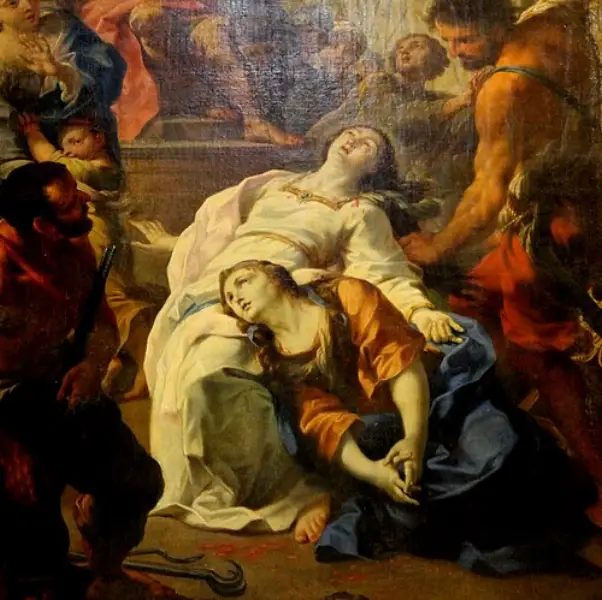
Digna and Emerita, who died in 259 AD, are honoured among the saints of the Catholic Church. They were young Roman women, arrested and tortured for the faith of Christ in the persecution the emperor Valerian waged from 254 to 259 at Rome. Their historical memory is bound up with the archaeology of the Roman catacombs: the catacomb of Commodilla held the grave of a woman named Emerita; it came to light around 757 in the pontificate of Paul I, who caused the relics to be moved to San Marcello al Corso, a Roman church. An inscription, misread, led to the bones being assigned to the two martyrs, and before the middle of the ninth century a legend had arisen telling of two martyrs, cast in the mould of the tale of Saint Afra. The cult of the pair spread with the movement of relics that marked the Carolingian age: on 5 April 838 a monk named Felix presented himself at Fulda with remains of Cecilia, Eugenia, Digna, Emerita, Columbana, Cornelius, Callistus, Agapitus, Georgius, Vincentius and Maximus. Their feast day is celebrated on 22 September, and their principal shrine is the church of San Marcello al Corso, where a chapel of the two saints is adorned with an altarpiece painted by Pietro Andrea Barbieri Pucciardi in 1727.
The Complete Life
Maidens of Persecuted Rome
Digna and Emerita were Roman maidens, and almost nothing of their lives before their arrest has come down to us. What the tradition preserves is the manner of their witness: they were arrested and tortured for the name of Christ in the persecution the emperor Valerian conducted at Rome from 254 to 259. They died in 259, in the closing violence of that persecution, which had aimed in particular at the leaders and property of the Church before it reached the ordinary faithful. The record of their passion is among the many that survive only in outline, preserved in the memorial books of the Roman Church rather than in a detailed passio. It belongs to a company of Roman women and girls — martyrs like Agnes, Cecilia, Emerentiana, Rufina and Secunda, and Martina — whose witness in the imperial city made the catacombs a landscape of memory. For Digna and Emerita, as for many of their companions in honour, the details of interrogation and torment that later ages loved to paint have not survived, and the Church remembers them simply as maidens who confessed Christ and paid for the confession with their lives.
§ Digna and Emerita
A Grave in the Catacomb of Commodilla
Digna and Emerita were never canonized in the modern sense; they belong to the martyrs whom the Church of Rome venerated from the first centuries at their tombs. Their cult, as it is known to history, begins in the catacombs: the catacomb of Commodilla held the grave of a woman named Emerita. Around the year 757, in the pontificate of Paul I, the grave came to light, and the pope caused the relics to be moved to San Marcello al Corso, a Roman church. A misread inscription led to the bones being taken for those of the two martyrs Digna and Emerita, and before the middle of the ninth century a legend had arisen telling of two martyrs, modelled in pattern and colour upon the tale of Saint Afra, the penitent martyr of Augsburg. This is the ordinary way in which the memory of the Roman martyrs lived: a name on a tablet, a grave in the dark, a pope or a monastery gathering the bones to a place of honour, and an inscription half understood becoming the seed of a narrative. Whatever the uncertainties of the identification, the Church received the two maidens as saints, and their feast was fixed on 22 September.
§ Digna and Emerita
Relics on the Road to Fulda
The fame of Digna and Emerita travelled north with the great movements of relics that marked the Carolingian world. It is recorded that on 5 April 838 a monk named Felix presented himself at Fulda, the great abbey of Germany, carrying remains of a company of saints: Cecilia, Eugenia, Digna, Emerita, Columbana, Cornelius, Callistus, Agapitus, Georgius, Vincentius and Maximus. Among heroes and heroines of the Roman martyrology, the two Roman maidens took their place, their bones carried across the Alps to be honoured in a Frankish church. Modern historians read such translations with care, as part of the sacred economy by which monasteries sought the patronage of the martyrs; the journey of 838 belongs to that world. In Rome itself their cult settled at San Marcello al Corso, which remains their major shrine. There the Chapel of Saints Digna and Emerita keeps their memory, its altarpiece painted by Pietro Andrea Barbieri Pucciardi in 1727, showing the two maidens in the style the Roman Church gave its virgin martyrs. Their feast is celebrated on 22 September, and the Church's martyrology still recounts them, briefly and surely, as the maidens tortured for Christ under Valerian.
§ Digna and Emerita
Timeline
- 259
Seized as Christian maidens at Rome, the two women died in the persecution of Emperor Valerian, which ran from 254 to 259.
§ Introduction
- 757
A grave of an Emerita in the catacomb of Commodilla was discovered under Pope Paul I, who had relics moved to San Marcello al Corso.
§ Introduction
- 5 Apr 838
The monk Felix arrived at Fulda carrying remains of several saints, among them Digna and Emerita.
§ Introduction
- 850
From about the middle of the ninth century, a legend modeled on the story of Saint Afra grew up around the two martyrs.
§ Introduction
The Record
- Canonization
- Pre-congregation martyrs; venerated as saints by the Catholic Church from antiquity
Prayer
Bibliography
Show 3 sources
- Monks of Ramsgate. "Digna and Emerita". Book of Saints, 1921. CatholicSaints.Info, 28 October 2012.
- Korn, Frank J. (1989). The Tiber ran red: the age of the Roman martyrs. Boston, MA: St. Paul Books & Media. p. 164. ISBN 978-0-8198-7344-6.
- Geary, Patrick J. Furta Sacra: Thefts of Relics in the Central Middle Ages. Princeton: Princeton University Press, 1990, p. 48.
Profile text adapted from the Wikipedia article, licensed CC BY-SA 4.0.
Pray with this saint every day
Save Sts. Digna and Emerita to your favorites, read the full profile, and get feast-day reminders in the Saints app.
Get the Saints AppFree on the App Store for iPhone and iPad