
died c. 303·Feast May 3
Sts. Diodorus and Rodopiano
Martyrs stoned at Aphrodisias in Caria
Overview
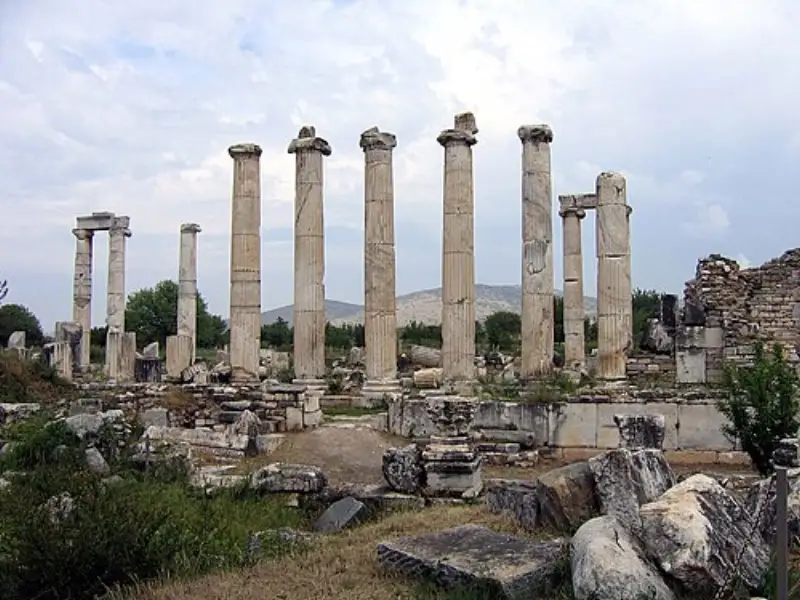
Diodorus and Rodopiano are two early Christian martyrs whose blood was shed at Aphrodisias, the great city of the Roman province of Caria in Asia Minor. They belonged to the ancient Christian community that flourished there from the earliest centuries, and they died during the persecution of the emperor Diocletian, the last and fiercest attempt of the Roman state to destroy the church, when they were condemned to death by stoning. In the Christian era their city received a new name, Stauropolis, 'city of the cross', as if the community that had produced martyrs wished to bear the sign of the cross in its very name; the town became the metropolitan see of Caria under the Patriarchate of Constantinople and remained a bishopric through the first Christian millennium. The memory of the two martyrs was preserved in the Roman Martyrology, which on May 3 recalls Diodorus and Rodopiano, condemned to be stoned at Aphrodisias during the Diocletianic Persecution. Beyond this commemoration and the witness it presupposes, the ancient sources are silent: no acts of their trial survive, no details of their station or circumstances are recorded, and their cult is known today only through the annual mention that keeps their names before the church.
The Complete Life
Martyrdom at Aphrodisias
The witness of Diodorus and Rodopiano was given at Aphrodisias, the principal city of inland Caria in Asia Minor, whose splendid temples to the goddess Aphrodite had given the place its name. There an ancient Christian community had taken root, one of the old churches of the Roman province, and in the last great persecution, that unleashed by the emperor Diocletian at the opening of the fourth century, the two confessors were condemned to die by stoning. Stoning, the executioners' method recorded against them, recalls the death of the first martyr Stephen and marks the two as victims of a mob or tribunal determined to silence the faith by the most public and degrading of deaths. The sources preserve no acts of their passion: we do not know their station in life, whether they suffered together on a single day, or what words they spoke before the stones flew. What remains is the fact the church never forgot, that in that city and in that persecution two Christians named Diodorus and Rodopiano bore witness to Christ at the cost of their lives, and that their fellow believers guarded the memory of where and how they died.
§ History
Remembered in the Roman Martyrology
Diodorus and Rodopiano belong to the vast company of early martyrs whose canonization rests on the ancient practice of the church: they were honoured as martyrs from the tradition of their local community, without any formal process, and their names were handed on through the liturgical books. The Roman Martyrology, the church's catalogue of saints arranged by day, keeps their memory on May 3, where it recalls the martyrs Diodorus and Rodopiano, condemned to be stoned at Aphrodisias during the Diocletianic Persecution. This mention, carried in the martyrology editions in use since the early modern reform of the Roman liturgical books, is the principal surviving testimony to their cult; it was printed, for example, in the edition revised according to the Roman copy of 1914 and published at Baltimore in 1916. No other acts, passions, or calendars of their veneration are recorded in the sources behind the martyrology entry. The brevity of the notice is itself a kind of witness: the church was content to remember the fact of their martyrdom, the place, and the persecution, trusting that the names of those who died for Christ needed no further embellishment to be worth an annual commemoration at the altar.
§ History
The City of the Cross
The city that put the two martyrs to death became, in the Christian era, a city that bore the cross in its name. Aphrodisias, once famous for the sanctuary of Aphrodite, was renamed Stauropolis, 'city of the cross', a change that announces the triumph of the faith for which Diodorus and Rodopiano had died. The town, whose site is now marked by the modern village of Geyre in Turkey, served as the metropolitan seat of the province of Caria within the Patriarchate of Constantinople, and some thirty bishops of the first Christian millennium are known, many through inscriptions and seals discovered on the site. From the earliest recorded bishop, Ammon at the Council of Nicaea in 325, the see stood in the front rank of the church of Asia Minor, ranking twentieth among the metropolitanates of Constantinople in the age of Heraclius with twenty-eight suffragan dioceses. The Christian community there thus endured for a thousand years after the blood of its martyrs was shed, and though the see fell silent with the changing fortunes of Asia Minor, it survives as a titular archdiocese of the Roman Catholic Church. The two martyrs remain the most ancient saints the city can claim, remembered each May 3.
§ History
Timeline
- 325
Ammon, first recorded bishop of their city, is mentioned at the First Council of Nicaea.
§ Residential bishops
- 451
Bishops of the see sign the acts of the Council of Chalcedon as metropolitans of Caria.
§ History
- 640
In the Notitia Episcopatuum of Emperor Heraclius, Stauropolis ranks twentieth among the metropolitanates of Constantinople.
§ History
- 1439
At the Council of Florence, Isaias of Stauropolis flees rather than sign the decree of union.
§ History
- 1916
The Baltimore edition of the Roman Martyrology prints the May 3 commemoration of the two martyrs.
§ History
The Record
- Canonization
- Pre-congregation martyrs of the early church, remembered by name in the Roman Martyrology on May 3
Prayer
Bibliography
Show 6 sources
- Pius Bonifacius Gams, Series episcoporum Ecclesiae Catholicae, (Leipzig, 1931), p. 447
- Michel Le Quien, Oriens christianus in quatuor Patriarchatus digestus, (Paris, 1740), Vol. I, coll. 899-904
- Vincenzo Ruggiari, A historical Addendum to the episcopal Lists of Caria, in Revue des études byzantines, 1996, Volume 54, Num 54, pp. 221–234
- Siméon Vailhé, v. Stauropolis, in Catholic Encyclopedia vol. XIV, (New York City, 1912)
- The Roman Martyrology. Transl. by the Archbishop of Baltimore. Last Edition, According to the Copy (Printed at Rome in 1914). Revised Edition, with the Imprimatur of His Eminence Cardinal Gibbons. Baltimore: John Murphy Company, 1916. pp. 125-126
- Speros Vryonis, The Decline of Medieval Hellenism in Asia Minor and the Process of Islamization from the Eleventh through the Fifteenth Century (Berkeley: University of California, 1971)
Profile text adapted from the Wikipedia article, licensed CC BY-SA 4.0.
Pray with this saint every day
Save Sts. Diodorus and Rodopiano to your favorites, read the full profile, and get feast-day reminders in the Saints app.
Get the Saints AppFree on the App Store for iPhone and iPad