
died c. 288-290·Feast May 24
Sts. Donatian and Rogatian
Brother martyrs and first saints of Nantes
Overview
Donatian and Rogatian, two brothers known in Nantes as les enfants nantais, the children of Nantes, were martyred in that city under the emperor Maximian, around the years 288 to 290, for refusing to deny their Christian faith. Their story rests on a fifth-century document, the Passion of the Children of Nantes, from which all later accounts descend. The Passion presents them as children of the city's chief magistrate, born into a leading Gallo-Roman family whose villa housed the first Christian church built at Nantes. Donatian, the younger, was baptized — by tradition by Saint Similien, third bishop of Nantes — and in turn brought his elder brother to the faith. Denounced as Christians, the brothers refused the prefect's demand to sacrifice to idols, were tortured, and spent a last night in prayer, in which Donatian consoled Rogatian with the assurance that martyrdom would stand in place of baptism. They were put to the spear and beheaded, by one tradition on the morning of May 24, 304. Their relics, scattered in the Revolution, are honored today in the Basilica of Saint Donatien and Saint Rogatien, and their feast is kept on May 24.
The Complete Life
Sons of the First Magistrate
The story of the two brothers is known from a fifth-century document, the Passion of the Children of Nantes, which stands at the head of all later retellings; subsequent works embroidered the outline, adding for example the tradition that the family belonged to an illustrious Armorican line. On the evidence of the Passion, Donatian and Rogatian were sons of the first magistrate of Nantes, children of the city's leading household. The family property was a Gallo-Roman villa, and it carried a hidden significance for the Christians of the region: within it stood the first Christian church built at Nantes, and tradition would later locate the brothers' graves there, in their own home, as the custom of the age allowed. On that ground rises today the Basilica of Saint Donatien and Saint Rogatien. The brothers thus belong to the Christian beginnings of the Loire estuary — sons of its elite, converts of its first generation, and, in the memory of the city, its first martyrs, whose house-church made the villa a cradle of the faith long before cathedrals rose on the French shore.
§ Life
The Younger Brother's Gift
Within that household the brothers traveled different roads to the same faith. Donatian, the younger, was baptized — by tradition at the hands of Saint Similien, the third bishop of Nantes, a prelate whose long life would outlast the brothers he brought into the church. Donatian in turn became the apostle of his own family: he evangelized his older brother Rogatian, who had not yet received baptism. The direction of the story is characteristic of the early Church, in which faith often moved through households rather than through public preaching, and the younger convert becoming the instrument of the elder's conversion gave the legend its emotional center. The two brothers stood together in a city where Christianity was still a minority allegiance, sons of the first magistrate visibly attached to a faith whose supreme loyalty was not the emperor's. Whatever instructions, preparations, and shared prayers filled the years before the crisis, the tradition presents them as of one mind when it came: neither would deny what the younger had taught the older to believe. The bond between the two, forged in catechesis and confirmed in shared danger, is what gave the story of the children of Nantes its lasting hold on the imagination of their city.
§ Life
The Night Before the Morning
The crisis came through denunciation. Named as Christians, the brothers were arrested and brought before the imperial prefect, the provincial governor, in the reign of the emperor Maximian. The terms of the interrogation were the terms of every persecution: they were required to sacrifice to the idols. Their refusal was unconditional, and it condemned them. Torture was carried out upon both, and then the prisoners were granted a final night, which they spent praying together — a vigil the Passion narrates with particular tenderness. In the darkness Rogatian gave voice to the one grief left to him: he was going to die without baptism, his course as a catechumen unfinished. Donatian's answer became the most treasured moment of their passion. He reassured his brother that the blood he was about to shed would avail in the place of baptismal water, for the church of the first centuries reckoned a martyr's blood as truly as the water of the font. Comforted, Rogatian waited with his brother for the morning. The exchange made the elder brother, in the eyes of later devotion, a catechumen received into the Church in the very hour of his death.
§ Life
Outside the Walls of Nantes
The execution took place on the morning of May 24. The brothers were first pierced by a lictor's spear and then beheaded — a double death remembered in the city's calendar to this day. Most accounts place the martyrdom between 288 and 290, in the closing years of the era of the tetrarchs; a persistent tradition, however, fixes the beheading to the morning of May 24, 304. The site of the execution is itself part of Nantes's memory: by tradition it lay outside the city walls, on the old road from Paris, at the location of the present no. 63 rue Dufour, near the Eugene-Livet high school and not far from the basilica that bears the brothers' names. Burial followed the custom of Christian households: the martyrs were laid to rest in the family villa, where their graves became the altar around which the first church of Nantes had already gathered, and over which their great basilica would in time arise. In this way the place of their death and the place of their burial were drawn into a single line of devotion that later generations could walk on foot.
§ Life
From the Loire to Orléans and Back
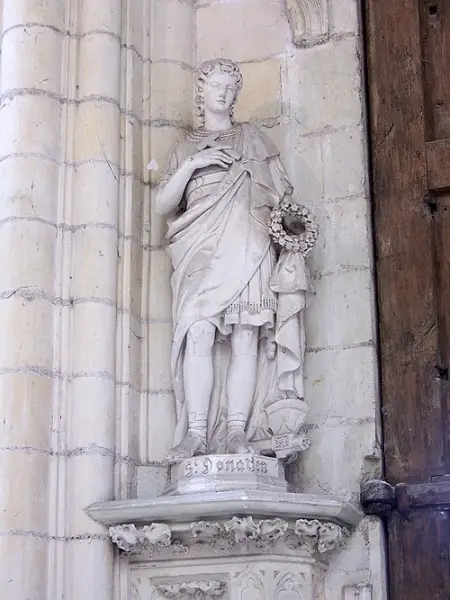
The cult of the enfants nantais spread through the whole Loire valley, reaching as far as Orléans. When the Norman invasions swept up the river, the relics were moved to Orléans for safety, and in the ninth or tenth century they were brought back and deposited in the brothers' own basilica at Nantes within a reliquary of gold. That treasure did not survive the French Revolution: the relics were scattered, and a wooden shrine replaced the golden reliquary. Into that shrine, in 1881, Mgr. Le Coq placed two relics — Donatian's left cubitus, Rogatian's left clavicle — preserving what the upheavals had left. The memory of the brothers is carved into the sacred architecture of Nantes: their statues stand on either side of the great doorway, within the narthex of the cathedral of Saint Peter and Saint Paul, and the cathedral holds a painting of them by Théophile Vauchelet. The crypt of Sacré-Cœur de Montmartre in Paris received a portrayal of the two saints in 1850, and a church in Orléans is named after Saint Donatian. Pre-congregation martyrs of the church of Nantes, the brothers keep their feast on May 24.
§ Veneration
Timeline
- 289
Under Emperor Maximian, around this time, the brothers were denounced, refused sacrifice to idols before the prefect, and tortured.
§ Life
- 24 May 304
One tradition fixes their beheading, outside the walls of Nantes, to the morning of this day.
§ Life
- 1881
Mgr. Le Coq donated two bones for the shrine: an arm bone of Donatian and a collarbone of Rogatian.
§ Veneration
The Record
- Canonization
- Pre-congregation martyrs, venerated since the early centuries by the Catholic and Eastern Orthodox Churches
Prayer
Bibliography
Show 5 sources
- "May 24." Latin Saints of the Orthodox Patriarchate of Rome.
- Delaroque, Rodolphe. "Sur les pas des enfants nantais." Nantes au quotidien, no. 136, June 2003.
- Cathédrales et basiliques de Bretagne. EREME, 2009, p. 75.
- Berranger, Henri de. Évocation du vieux Nantes. Éditions de Minuit, 1966, p. 14.
- Travers, Nicolas. Histoire civile, politique et religieuse de la ville et du comté de Nantes. Forest, 1836, p. 24.
Profile text adapted from the Wikipedia article, licensed CC BY-SA 4.0.
Pray with this saint every day
Save Sts. Donatian and Rogatian to your favorites, read the full profile, and get feast-day reminders in the Saints app.
Get the Saints AppFree on the App Store for iPhone and iPad