
fl. 2nd century·Feast April 18
Sts. Eleutherius and Antia
Bishop of Illyricum martyred with his mother
Overview
Eleutherius and his mother Antia are venerated as martyrs in Albania, Greece, Cyprus, and Italy, though the story told of them is among the most tangled in the martyrologies. Eleutherius, whose Greek name means 'liberator', was said to have been born in Rome, orphaned of his father as a small child, and brought by his mother to Anicetus, bishop of Rome, who taught him the divine scriptures. Ordained deacon, priest, and then bishop, he was appointed to Illyricum, with Messina, Aeca in Apulia, and the town of Aulon all claimed in one tradition or another as his seat. A comes named Felix cast him into prison, and mother and son were conveyed to Rome for judgment under Hadrian. Condemned and tortured, Eleutherius was clubbed to death and Antia beheaded. His cult, whatever the truth of his legend, is ancient and widespread: his name stands in Greek calendars, the Martyrologium Hieronymianum, the Marble Calendar of Naples, and the Mozarabic books. Rieti claims their relics, translated with papal honor to its cathedral in 1198.
The Complete Life
A Widow and Her Son in Rome
The Greek source, which dates from before the fifth century, gives the outline of the saints' early life. Eleutherius was born in Rome, and his father, a consul named Eugenius, died while the boy was still young. His widow Antia was left to raise him alone, and she made a choice that shaped everything after: she brought her son to Anicetus, the bishop of Rome, entrusting his education to him. Anicetus taught the child in the divine scriptures, so that Eleutherius grew up within the household of the Roman church rather than in the schools of the city. Messina tells a different story of his origins, claiming him as a native of that Sicilian city, born there on 18 April in the year 121, who later became a bishop of Illyricum. Modern scholars suspect that the whole Roman setting may rest on a case of mistaken identity, since the name Eleutherius was borne by a pope who may himself have been a deacon of Anicetus; but the picture of the widow Antia and her son at the feet of the bishop of Rome has held the imagination of the faithful for well over a thousand years.
§ History
Ordination and an Uncertain See
In the Greek tradition Eleutherius was ordained deacon and priest, and then consecrated bishop, by Anicetus, and at the age of twenty he was appointed bishop of Messana and Illyricum, settling in the town of Aulon in what is now Albania. A Latin translation of his passion, made around the eighth century, changes the geography: in that version Anicetus, after consecrating him, assigned him to the see of Aeca in Apulia. Which city, if any, he actually served has never been settled. Hippolyte Delehaye judged the association with Aeca erroneous; centuries earlier Florus had thought Apuliam Aecanam a copyist's corruption of Apuliam Messenam, Messina, though even that link may be wrong. The confusion deepens because his name means 'liberator' and was rendered in Latin as Liberator or perhaps Liberalis, opening the way for confusion with other saints of that name, and because Baronius, consulting the Greek source, styled him simply Episcopi Illyrici in the Roman Martyrology. Behind all the uncertainty stands the ancient and unanimous memory of a bishop who bore the name of freedom and died for his Lord.
§ History
Arrest and Martyrdom
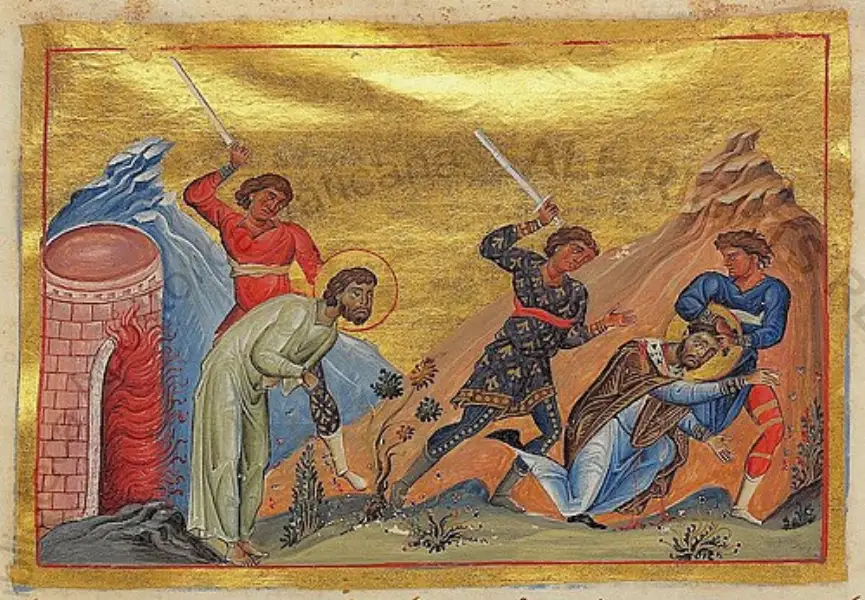
The passion relates that a comes named Felix threw Eleutherius into prison, and that prisoner and mother alike were conveyed to Rome, where Hadrian would judge them in person. The tortures catalogued in the Messina tradition were of the usual ferocity: boiling oil, resin, and heated irons were all tried upon them, and then the lions; the tortures achieved nothing, and only then was the sentence of death carried out. The Greek source gives the date of their condemnation as 15 December; the Latin version of the passion prefers 18 April for the killing. Tradition tells of Eleutherius put to death by clubbing, of Antia by the sword. The Latin text then relates how the people of Aeca reclaimed the martyrs' bodies in Rome and carried them home in triumph, an ending that served the pride of the Apulian town; Rome's own traditions sent the bodies instead to the church of Santa Sabina, to the altar of San Lorenzo, and later to San Giovanni della Pigna near the Pantheon, shared with the relics of Genesius of Rome.
§ History
Bodies and Their Wanderings
The remains of the two martyrs were claimed from the first by more than one city, and the claims themselves became part of the legend. Messina, insisting that Eleutherius was her own son, kept his cult beside those of her other saints; Aeca, by the account of the Latin passion, carried the bodies home from Rome. Rome's own account had them laid to rest at Santa Sabina, then at the altar of San Lorenzo, and afterward translated to San Giovanni della Pigna by the Pantheon, where they rested with the relics of Genesius of Rome; though even this chain has its doubts, since the relics said to lie at San Giovanni della Pigna may belong instead to Pope Eleuterus, another victim of the name's many bearers. From Rome, in the view of the Rieti tradition, Christians of that Sabine city carried the relics north to their own town, which claims them to this day. Whatever the truth, the multiplicity of the tombs testifies to how eagerly the early church gathered the bones of its witnesses, and how little it minded the contradictions.
§ History
Rieti and the Widespread Cult
Eleutherius's cult, despite every confusion about his identity, is ancient and remarkably widespread. Ancient Greek calendars carry his name, and so does the Martyrologium Hieronymianum, under 18 April, 5 September, and 24 November, annotated in civitate Riatensi — Rieti, where he was honored as well; in the Marble Calendar of Naples under 18 April; and in the Mozarabic calendars of Spain. At Rieti the church of Sant'Eleuterio rose outside the walls around the fifth century, claiming the relics carried from Rome by Bishop Primus, and around the fifth or sixth century the Benedictine Stephen of Rieti founded a monastery beside the martyrs' tomb. Devotion deepened after a legend of Bishop Probus, to whom the saints Eleutherius and Juvenal were said to have appeared in vision to escort him to heaven. Confirmed with solemn honors by the Lombard king Liutprand, restored with new splendor by the abbot Peter after the year 1000, and granted to the cathedral by Count Grimald in 1122, the church reached its crowning day on 13 August 1198, when Bishop Adolphus Secenari and Pope Innocent III translated the relics into the cathedral of Santa Maria, raising it to a collegiate church. Eleutherius was honored across Italy besides, at Nepi, Vasto, and Poreč, at Chieti, Benevento, Salerno, and Sulmona, at Terracina, Arce, and Canne, with churches also at Rome on the Via Labicana, Mugnano del Cardinale, and Ariano Irpino.
§ Rieti
Timeline
- 18 Apr 121
Messina's tradition holds that Eleutherius was born in that Sicilian city on 18 April.
§ History
- 154
A pre-fifth-century Greek source has him ordained and consecrated bishop under Anicetus of Rome (c. 154–164), possibly through confusion with Pope Eleutherius.
§ History
- 400
The church of Sant'Eleuterio was built outside the walls of Rieti around the fifth century.
§ Rieti
- 550
The Benedictine Stephen of Rieti founded a monastic community beside the martyrs' tomb, in the fifth or sixth century.
§ Rieti
- 700
A Latin rendering of the Greek passion, from about the eighth century, assigned Eleutherius to the see of Aeca and dated the martyrdom to 18 April.
§ History
- 1000
After 1000 the local abbot Peter restored the church and monastery of Sant'Eleuterio, giving them greater splendour.
§ Rieti
- 1122
Count Grimald granted Sant'Eleuterio, its monastery, and its lands to the Cathedral of Santa Maria of Rieti.
§ Rieti
- 13 Aug 1198
On 13 August, alongside Pope Innocent III, Rieti's bishop Adolphus Secenari moved the martyrs' relics into the cathedral.
§ Rieti
In Their Own Words
in civitate Riatensi
The Record
- Major works
- The church of Sant'Eleuterio at Rieti, raised over the saints' tomb
- Patron of
- venerated at Messina, Rieti, Nepi, Vasto, Poreč, and other Italian cities
- Symbols
- martyr's palm
- Canonization
- Pre-congregation martyrs, venerated since antiquity in East and West
Prayer
Bibliography
Show 6 sources
- Elsie, Robert (2000). "The Christian Saints of Albania". University of Mississippi.
- "Santi Eleuterio ed Anzia Martiri". Santie Beati. October 12, 2002. Retrieved August 6, 2008.
- Knight, Kevin (2008). "Pope St. Eleutherius (Eleutheros)". Catholic Encyclopedia, New Advent. Retrieved August 7, 2008.
- "Eleutherius and Antia". Catholic Online. 2010. Retrieved January 22, 2010.
- Tozzi, Ileana. "La memoria dei Santi martiri Eleuterio ed Anzia presso la cattedrale di Rieti" (PDF). Outdoor Rieti.
- Borrelli, Antonio (September 14, 2002). "San Liberatore Vescovo e martire". Santie Beati. Retrieved August 7, 2008.
Profile text adapted from the Wikipedia article, licensed CC BY-SA 4.0.
Pray with this saint every day
Save Sts. Eleutherius and Antia to your favorites, read the full profile, and get feast-day reminders in the Saints app.
Get the Saints AppFree on the App Store for iPhone and iPad