
died c. 300·Feast August 30
Sts. Emeterius and Celedonius
Soldier martyrs of Calahorra
Overview
Emeterius (also called Hemeterius or Madir) and Celedonius were two Roman legionaries, very likely brothers, who gave their lives for the Christian faith at Calahorra in La Rioja around the year 300. The poet Prudentius records that the two served in the Legio VII Gemina and were put to death at Calahorra, though the precise day of their martyrdom has not survived. Legend makes them sons of Marcellus the Centurion, himself a martyr, and says that under the persecutions of Diocletian or Valerian they were thrown into prison and ordered to choose between abandoning Christ and leaving the army. They chose Christ. After torture they were beheaded on the bank of the Cidacos River outside the city walls, on the ground where Calahorra's cathedral now stands. Pious tradition holds that their heads were carried by sea to Santander in a boat of stone, where monks kept them; that city takes its very name from Emeterius. The brothers are patron saints of Calahorra and Santander, and their feast is kept on August 30.
The Complete Life
Brothers in Arms
The earliest surviving testimony to the two saints comes from the Christian poet Prudentius, who relates that Emeterius and Celedonius were soldiers of the Legio VII Gemina and suffered martyrdom at Calahorra, the ancient Calagurris in La Rioja. Nothing certain is recorded of their origin or their youth; later tradition filled the silence by calling them sons of Marcellus the Centurion, a martyr whose own witness had already been celebrated. Whether the kinship is historical cannot now be established, but the tradition of their brotherhood, by blood or at least by service in the same legion, has never been doubted. Both were serving in Calahorra at the close of the third century or the opening of the fourth, a time when the empire's attitude toward Christianity turned violently hostile. According to the legend preserved in their acts, the two were seized during the persecution of either Diocletian or Valerian and faced a characteristically military dilemma: they might save themselves by sacrificing to the gods, or they might leave the army and confess Christ. They refused the bargain and were cast into prison to await torture and death.
§ Legend
Martyrdom on the Cidacos
The legend relates that after imprisonment and cruel torture the two soldiers were led outside the walls of Calahorra and beheaded on the banks of the Cidacos River. The place of their execution became holy ground almost at once: the cathedral of Calahorra now stands there, which accounts for its unusual position beyond the city defenses. Prudentius, writing in the generation after the persecutions, confirms the martyrdom at Calahorra while admitting that the exact date has been lost, and modern scholars place it around the year 300. The Spanish church preserved the memory of the two soldiers with unusual tenacity, giving them a place among its earliest and best-attested witnesses. A stranger and more poetic tradition concerns the saints' heads. It tells that they were set adrift and floated to Santander on the Cantabrian coast aboard a boat made of stone, where a community of monks received them and became custodians of the relics. Whatever the truth of the tale, it had lasting consequences, for the city's very name is traced not to Saint Andrew, as the sound of the word suggests, but to Santemter, a contraction honoring Saint Emeterius, joint patron of the place with Celedonius.
§ Legend
A Cult That Named a City
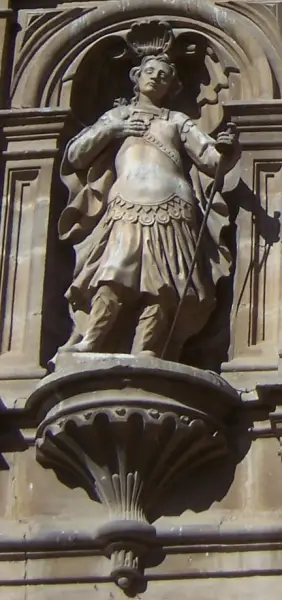
Devotion to the two martyrs flourished early. In the fourth century, pilgrims from distant lands made their way to the tomb at Calahorra, and their relics are still preserved in the city's cathedral. On the northern coast, Alfonso II founded the abbey of Saints Hemeterius and Celedonius, known from the first saint's name as Santander Abbey, to house the holy heads; its church, rebuilt between the thirteenth and fourteenth centuries, serves today as the cathedral of Santander. The brother martyrs became patrons of Calahorra, of Santander, and of other towns across Cantabria, and their images entered the public heraldry of the region: the arms of Calahorra display the saints' names, while the coat of arms of Cantabria bears their heads. Statues of Emeterius and of Celedonius stand in the cathedral of Santo Domingo de la Calzada in La Rioja, a reminder that their cult spread well beyond the city of their death. Their feast is kept on August 30 in the Catholic Church, and they are venerated also by the Eastern Orthodox. Few martyr cults anywhere left so deep a mark upon the map, the heraldry, and the very speech of a region.
§ Veneration
Timeline
- 300
Serving at Calahorra near the century's turn, the two legionaries were imprisoned and ordered to renounce their faith or leave the army.
§ Legend
- 300
They were tortured and beheaded beside the Cidacos outside the walls of Calahorra, in the Diocletian or Valerian persecution.
§ Legend
- 350
By the fourth century pilgrims from distant lands were coming to pray at the martyrs' tomb, whose relics remain in Calahorra Cathedral.
§ Veneration
- 1200
Santander Cathedral was built between the thirteenth and fourteenth centuries over the abbey guarding the martyrs' heads.
§ Veneration
The Record
- Patron of
- Calahorra·Santander·towns of Cantabria
- Symbols
- depicted as two young soldiers
- Canonization
- Pre-congregation; honored as martyrs since the early centuries of the Church
Prayer
Bibliography
Show 4 sources
- Butler, Alban (1866), Lives of the Fathers, Martyrs, and Principal Saints – via CatholicSaints.Info
- Hinojosa y Naveros, Eduardo de. "Diocese of Calahorra and La Calzada." The Catholic Encyclopedia Vol. 3. New York: Robert Appleton Company, 1908.
- Amadó, Ramón Ruiz. "Santander". The Catholic Encyclopedia. Vol. 13. New York: Robert Appleton Company, 1912.
- Herbermann, Charles, ed. (1913). "Santander". Catholic Encyclopedia. New York: Robert Appleton Company.
Profile text adapted from the Wikipedia article, licensed CC BY-SA 4.0.
Pray with this saint every day
Save Sts. Emeterius and Celedonius to your favorites, read the full profile, and get feast-day reminders in the Saints app.
Get the Saints AppFree on the App Store for iPhone and iPad