
died 310·Feast October 10
Sts. Eulampius and Eulampia
Brother and sister martyrs of Nicomedia
Overview
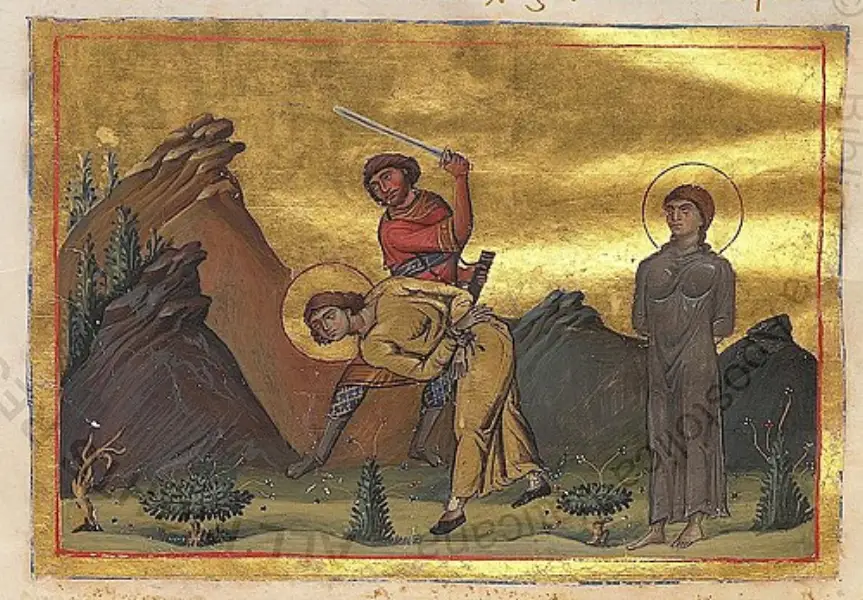
Saints Eulampius and Eulampia were a brother and sister of Nicomedia in Asia Minor who died for the faith together in the year 310, in the course of the persecutions waged under the emperor Maximinus. Tradition remembers Eulampius first as a man of practical charity: when fellow Christians of the city took refuge in caves on its outskirts, he went out to purchase food for them, and Roman officers seized him in the act. Scourged for refusing to deny Christ, he was led away, and his sister Eulampia, watching from among the onlookers, could not restrain herself. She stepped forward and embraced him, and by that embrace revealed herself as a Christian; she was arrested in turn, and the two siblings stood together as confessors. Both were put to death the following day. Christian tradition adds that two hundred soldiers, witnesses of the courage with which the brother and sister met their end, declared themselves followers of Christ and shared their martyrdom. The ancient church numbered them among the martyrs of Nicomedia, and their common memory has been kept on the tenth day of October.
The Complete Life
A Mercy That Cost Everything
Nicomedia, one of the great cities of Asia Minor and at times an imperial residence, sheltered a Christian community that had learned to keep its faith quietly when imperial suspicion turned to open hostility. Eulampius belonged to that community, and tradition records the decisive act of his life: when fellow believers fled the city and hid in caves on its outskirts, he went out to buy them food. It was an errand of simple brotherly care, and it cost him his freedom. Roman officers arrested him in the midst of it, and, interrogated for his faith, he refused to deny Christ and was whipped for his refusal. His sister Eulampia was watching. When her brother was led away beaten, she emerged from the crowd of onlookers and embraced him, and by that embrace declared herself a Christian. The gesture was its own confession: she too was seized, and the brother and sister stood together as prisoners of the state. Their story, as the church preserved it, is less an account of argument before magistrates than a portrait of charity under fire — a man caught while feeding the hungry, and a woman who would not let him suffer alone.
§ Introduction
One Night Between Confession and Death
The account of the passion is brief and severe. Condemned for their confession, Eulampius and Eulampia were executed the day after Eulampia's arrest, dying in the city of their birth. The tradition adds a detail that made the pair memorable far beyond Nicomedia: two hundred soldiers, present at the proceedings, were so moved by the courage with which the brother and sister faced death that they declared themselves Christians. In the logic of the persecution this availed them nothing except a shared fate; they too were put to death, and the church of the first centuries honored them among the martyrs. The narrative thus records a double witness — that of the siblings who died, and that of the soldiers who found in their deaths a persuasion stronger than fear. Nicomedia had already witnessed many such executions under the emperors, yet the memory of this brother and sister endured among them, attached to the tenth day of October, the date on which their festival came to be kept. Execution, in the design of the persecutors, was meant to terrify a city into silence; in the event it multiplied the very confession it was meant to silence. The story of the two hundred has therefore given the siblings' passion a reach beyond Nicomedia itself: it became, in the memory of the church, a standing lesson in how witness is propagated — not by argument won, but by deaths willingly borne and watched.
§ Introduction
Remembered Among the Martyrs of Bithynia
Veneration of Eulampius and Eulampia passed into the ordinary memory of the church as that of two martyrs of Nicomedia rather than as the cult of a famous shrine, for the surviving sources say nothing of where their bodies rested. They are commemorated on October 10. The chief witnesses to their story are the compilations that carry the traditional narrative forward: the entry in the Catholic Online series of saintly lives and the Saint of the Day notice published by St Patrick Catholic Church in Washington, both of which repeat the account of the food bought for the hidden Christians, the sister's public embrace, and the two hundred converted soldiers. Modern hagiographers class them among the martyrs of the era of Maximinus in Bithynia, remembered above all for the family bond in which their witness was made. For readers today they stand for a particular kind of courage: not that of the preacher or the bishop, but of an ordinary brother doing an ordinary errand of mercy, and of a sister whose love would not remain hidden when he was struck.
§ Introduction
Timeline
- 310
Roman officers arrested Eulampius while he was buying supplies for Christians hiding in caves outside Nicomedia.
§ Introduction
- 310
Eulampius was flogged after his arrest for refusing to give up his faith.
§ Introduction
- 310
Eulampia stepped out of the onlookers to embrace and console her brother, exposing herself, and was taken into custody.
§ Introduction
- 310
Brother and sister were put to death the day after her arrest, under emperor Maximinus.
§ Introduction
- 310
Two hundred soldiers, moved by the siblings' courage, declared themselves Christians and were martyred in turn.
§ Introduction
The Record
- Canonization
- Pre-congregation martyrs, honored since the earliest centuries
Prayer
Bibliography
Show 2 sources
- Eulampius and Eulampia. Catholic Online, 2010. Retrieved January 22, 2010.
- Rabenstein, Katherine I. Eulampius and Eulampia. St Patrick Catholic Church (Washington, DC), Saint of the Day, 1998. Archived from the original on August 4, 2019.
Profile text adapted from the Wikipedia article, licensed CC BY-SA 4.0.
Pray with this saint every day
Save Sts. Eulampius and Eulampia to your favorites, read the full profile, and get feast-day reminders in the Saints app.
Get the Saints AppFree on the App Store for iPhone and iPad