
died 300·Feast November 27
Sts. Facundus and Primitivus
Beheaded martyrs of the River Cea near León
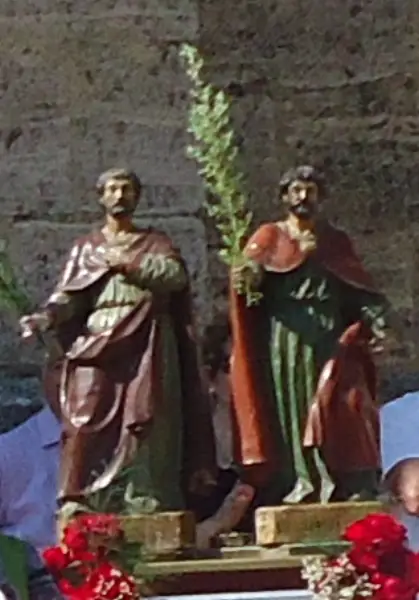
Overview
Facundus (Spanish, Facundo) and Primitivus (Primitivo) are venerated as Christian martyrs who suffered at León at the close of the third century. According to tradition they were natives of León who, as Christians, suffered torture and death by beheading on the bank of the River Cea, close by the modern town of Sahagún. An account of their martyrdom preserves a striking detail: after the execution, milk and blood — lac et sanguis — gushed together from their necks, an image that fixed the memory of their witness in the region. Their bodies became the center of a cult that shaped the landscape itself. A Benedictine monastery dedicated to the two saints arose on the site, and around it grew the town of Sahagún, whose very name is a contraction of San Facundus. By the twelfth century the basilica of the martyrs stood as a station on the pilgrimage way to Santiago de Compostela; the Pilgrim's Guide of that century urges visitors to honor the bodies of the blessed martyrs and records the tradition that Charlemagne himself had built their basilica. The Roman Catholic Church and the Eastern Orthodox Church keep their feast on November 27, and their procession statues are carried through Las Quintanillas in Spain to this day.
The Complete Life
Passion on the River Cea
The tradition of Sahagún preserves the outlines of the two martyrs' end. Facundus and Primitivus were Christians and natives of León, seized in the persecution that marked the transition from the third century to the fourth. They were first tortured and then beheaded on the bank of the River Cea, in the open country near what is now the town of Sahagún. The account of their martyrdom records a prodigy at the moment of death: after the two had been beheaded, milk and blood — lac et sanguis — gushed from their necks together. To the believers who gathered the bodies, the mingling of milk, the sign of newborn life, with the blood of slaughter proclaimed that death had been overcome in the very act of the martyrs' dying. That image carried their memory across the centuries, and it is for this passion, at this riverbank, that the Church of León and the pilgrims of Compostela honored them. The date of their feast, November 27, preserves the commemoration in both the Roman Catholic and the Eastern Orthodox calendars, a rare double witness for martyrs of the Spanish meseta.
§ Introduction
The Town That Took a Martyr's Name
Few martyr cults have reshaped a landscape so completely as that of Facundus and Primitivus. A Benedictine monastery was dedicated to the two saints on the place of their burial, and around that monastery there arose the town of Sahagún — its very name a putative abbreviation and variation of San Fagun, Saint Facundus. What had been a riverbank of execution became a center of monastic life and, in time, one of the great stations of the pilgrimage road to Santiago de Compostela. The twelfth-century Pilgrim's Guide instructs travellers that the bodies of the blessed martyrs Facundus and Primitivus must be visited, and records the tradition, treasured along the route, that it was Charlemagne who constructed their basilica. Whether or not the royal attribution holds, the claim shows the rank the cult had reached by the high Middle Ages: a basilica fit for emperors, on the route every pilgrim walked. The martyrs' memory remains living in the region — their feast is kept on November 27, and carved procession statues of the two saints are borne through the streets of Las Quintanillas in Spain, where the paired martyrs still go together through the fields they died beside.
§ Veneration
Timeline
- 300
Tortured and then beheaded as Christians on the bank of the River Cea, near present-day Sahagún.
§ Introduction
- 300
An account of their martyrdom says milk and blood flowed together from their necks after the beheading.
§ Introduction
- 1100
The twelfth-century Pilgrim's Guide urged visitors to their basilica, crediting its construction to Charlemagne.
§ Veneration
In Their Own Words
Item, visitanda sunt corpora beatorum martirum Facundi scilitet et Primitivi, quorum basilicam Karolus fecit
The Record
- Canonization
- Pre-congregation; venerated as martyrs from antiquity by the Roman Catholic and Eastern Orthodox Churches
Prayer
Bibliography
Show 3 sources
- "Saint of the Day, November 27: Facundus and Primitivus". SaintPatrickDC.org. 2009. Retrieved March 18, 2012
- Burke, James F. History and vision: the figural structure of the "Libro del cavallero Zifar." Volume 28 of Colección Támesis. Serie A, Monografías. Tamesis Books, 1972, p. 27
- León Portilla, Miguel. Bernardino de Sahagún, first anthropologist. University of Oklahoma Press, 2002, p. 31
Profile text adapted from the Wikipedia article, licensed CC BY-SA 4.0.
Pray with this saint every day
Save Sts. Facundus and Primitivus to your favorites, read the full profile, and get feast-day reminders in the Saints app.
Get the Saints AppFree on the App Store for iPhone and iPad