
died c. 580·Feast January 18
Sts. Faustina and Liberata of Como
Noble sisters, Benedictine virgins, and patronesses of childbirth
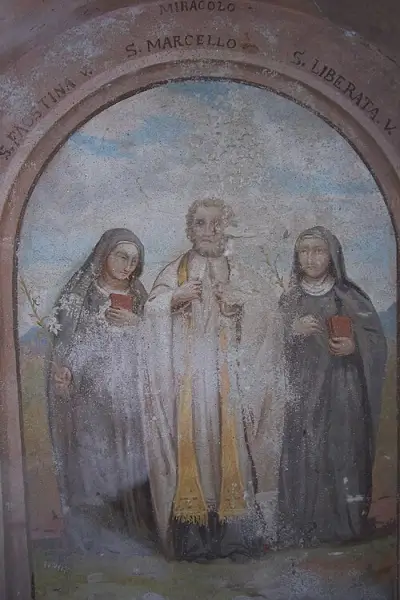
Overview
Faustina and Liberata of Como were two noble sisters of the sixth century, daughters of Giovannato Miles, the lord reputed to have built the fortress of Rocca d'Olgisio in the Val Tidone near Pianello, Italy. Left motherless early, they were formed by a devout tutor named Marcello and were expected to seal alliances through marriage into other noble houses. Instead, after a vision showed them the grief of a widow mourning her husband, and wishing to spare themselves the pains of childbirth, they renounced their rank and fled down the Po River to Como, where they joined the Benedictines, then newly spreading through Italy. There they founded a monastery dedicated to St. Margaret and lived as holy virgins; a healing worked by Liberata for a woman near death persuaded their father, at first an opponent of their vocation, to endow their work with part of his wealth. They died around 580 and were buried at their own monastery. Their cult spread across northern Italy, above all at Como and in the Camonica Valley, where they were remembered as hermits and workers of miracles over water. Patronesses of women in labor and of fertility, they are honored especially at the Church of Saints Faustina and Liberata in Capo di Ponte, and their feast is kept at Como on January 18.
The Complete Life
Daughters of Rocca d'Olgisio
The sisters who became two of Como's most beloved saints were born into the highest rank of the sixth-century nobility. Liberata and Faustina were the daughters of Giovannato Miles, a lord to whom tradition ascribes the founding of the fortress of Rocca d'Olgisio, which rises in the Val Tidone near modern Pianello, Italy. Their mother died while they were still young, leaving them orphans of her care in a great house, and their upbringing was entrusted to a devout man named Marcello, who guided their spirits as a tutor guides the mind. Under his direction the girls grew in piety even as their father looked toward the future he had planned for them. As noble daughters of their station, they were expected to marry into other noble families, weaving alliances that would strengthen the house of their father. Nothing in their outward circumstances suggested the direction their lives would take: they had wealth, lineage, and the prospect of advantageous marriages. But the formation they received from Marcello had prepared their hearts, and when the moment of decision came, the two sisters were ready to weigh their father's ambitions against the call of God and to find the ambitions wanting.
§ Traditional biography
The Vision and Flight to Como
The turning point in the sisters' lives came through a spiritual vision. Faustina and Liberata were granted a vision in which they saw the anguish of a widow weeping for her dead husband, and beholding such sorrow impressed upon them the cost of the married life their family intended. Desiring also to avoid the pain of childbirth, they resolved to renounce the privilege of their rank altogether. Their choice was made real by flight: the two young women abandoned the fortress of their childhood and escaped by way of the Po River, making their way to Como. There they joined the Benedictines, an order which at that time had only recently begun to spread within Italy, and took up the life of consecrated virgins. Their father opposed their vocation at first, as noble fathers often did when daughters chose religion over dynastic marriage, but the sisters persevered. In time even the lord of Rocca d'Olgisio was persuaded. A miracle attributed to Liberata helped to change his mind — the healing of a woman who had been crucified by her own husband and was near death — and Giovannato at last gave his daughters a share of his wealth to support the work they had undertaken in religion.
§ Traditional biography
A Monastery at Como and a Life of Piety
At Como the sisters built the foundation for which they are chiefly remembered: a monastery dedicated to St. Margaret, where they lived lives of piety with the women who gathered to them. Within the walls of that house Faustina and Liberata embodied the Benedictine pattern of prayer and work in a city still receiving the Gospel's monastic impulse, and their reputation for holiness drew the attention of the faithful far beyond their enclosure. Wonder stories gathered around them. The healing of the crucified woman, restored to life and health by Liberata's intercession, was among the first, and tradition credits both sisters with miraculous help extended to those who called upon them in trouble. The Church of Como embraced them as its own virgin saints, and after their deaths, which occurred around the year 580, they were buried in the monastery they had founded, so that the house they built for God became their first memorial. From Como their cult spread through parts of northern Italy, above all into the Camonica Valley, where the sisters would be remembered not only as founders and intercessors but as hermits and protectors of the mountain villages, a second chapter of their legend rooted deep in local devotion.
§ Traditional biography
Death and the Wanderings of the Relics
The sisters died at Como around the year 580, and for four centuries they rested in their monastery's ground. Then the age of invasions made even the dead uneasy. For reasons of security their bodies were translated to the Cathedral of Santa Maria in Como — around the year 1000, or, as other authorities hold, between 1096 and 1125 — under the episcopate of Bishop Guido Grimoldi. On January 18, 1317, the remains were once more moved within the cathedral, to rest beneath its high altar; and on May 14 of the same year, under Bishop Leone de' Lambertenghi, they were carried out of the cathedral altogether to the Church of San Carpoforo in Como, a translation in the course of which additional relics may well have been created. Devotion sent other portions of the saints abroad: Liberata's tibia is reported to have been carried to Piacenza for keeping at Sant'Eufemia, while her heart, tradition says, was deposited in the crypt of a Piacenza church honoring St. Margherita. Archaeological research conducted between 1960 and 1980 revealed that crypt's church to be the remains of a sixth-century building dedicated to Santa Liberata herself — a fitting home for the heart of the saint.
§ After death
Patronesses of Water, Birth, and Children
In the Camonica Valley the sisters' cult took on a character all its own. At Capo di Ponte, local tradition holds that Faustina and Liberata lived as hermits, and the Church of Saints Faustina and Liberata there preserves the legend of their miracle during a flood at the village of Serio: aided by Marcello, the two saints halted a destructive boulder with their hands, and a rock bearing six handprints — Christian-era carvings, likely made to commemorate the event — is shown as the print of the sisters and their tutor. In 1580 Bishop Charles Borromeo ordered the site protected and formally recognized the relics, incorporating the engraved rock into the sacred space where it remains venerated. Water ran through all their intercessions: they were believed to divert floodwaters, save homes, restrain dangerous rivers, and heal through springs and wells. Connected with this care was their patronage of fertility and childbirth. Oral tradition tells that babies were born in the caves near the church, and statuettes of naked figures with bandaged faces, resembling children, stand at the high altar — thought to represent unborn children or those who died before baptism, commended to the sisters' intercession. Fifteenth- and sixteenth-century frescoes at Montalto Dora castle, Avogadro Castle at Quinto Vercellese, and San Filastro at Tavernole sul Mella show St. Faustina clasping infants in her arms.
§ Cult, miracles, and iconography
Timeline
- 580
Died at Como around this year and were buried in the monastery they had founded there.
§ After death
- 1000
Remains moved for safekeeping to the cathedral of Santa Maria in Como, around now or between 1096 and 1125 under Bishop Guido Grimoldi.
§ After death
- 18 Jan 1317
Bodies reinterred beneath the high altar of the cathedral.
§ After death
- 14 May 1317
Relics carried from the cathedral to Como's San Carpoforo church, during the episcopate of Bishop Leone de' Lambertenghi.
§ After death
- 1580
Bishop Charles Borromeo ordered the Capo di Ponte sanctuary protected and formally recognized the relics preserved there.
§ Cult, miracles, and iconography
The Record
- Major works
- Monastery dedicated to St. Margaret at Como
- Patron of
- Women in labor·Fertility·Water and rivers·Springs and wells
- Symbols
- Red book·Children
- Canonization
- Pre-congregation; venerated in the Roman Catholic Church
Prayer
Bibliography
Show 6 sources
- "Santa Faustina di Como". santiebeati.it.
- "Santa Liberata di Como Vergine benedettina". santiebeati.it.
- Troletti, Federico. "The continuity between pagan and Christian cult". Scandinavian Society.
- "Rocca d'Olgisio". castelliemiliaromagna.it. Retrieved June 24, 2025.
- "La vita di Santa Liberata". santaliberata.org. Archived from the original on December 7, 2021.
- "Diocese of Como, Italy". gcatholic.org. Archived from the original on May 22, 2025. Retrieved June 24, 2025.
Profile text adapted from the Wikipedia article, licensed CC BY-SA 4.0.
Pray with this saint every day
Save Sts. Faustina and Liberata of Como to your favorites, read the full profile, and get feast-day reminders in the Saints app.
Get the Saints AppFree on the App Store for iPhone and iPad