
died 120·Feast February 15
Sts. Faustinus and Jovita
Brother martyrs of Brescia under the emperor Hadrian
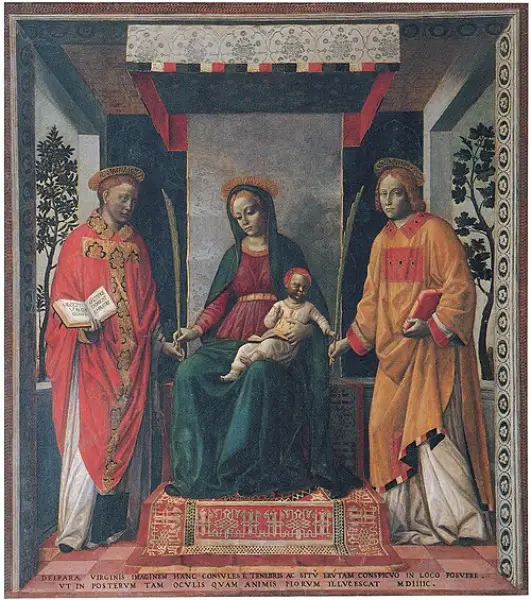
Overview
Faustinus and Jovita were said to be noble brothers of Brixia — present-day Brescia in Lombardy — who suffered martyrdom under the emperor Hadrian, traditionally in the year 120. According to the traditional account, Jovita, the elder, was a preacher, while Faustinus served the church as a deacon; for their fearless proclamation of the Gospel the two were arraigned before Hadrian himself and subjected to frightful torments at Brixia, Rome, and Neapolis before being beheaded in their native city. Modern scholarship treats the detailed Acts that narrate their passions with great reserve: the Jesuit Bollandist Fedele Savio questioned nearly every detail except the fact of their martyrdom, which is amply attested by their place in the early martyrologies and by an exceptional cult at Brescia, where since memory's beginning they have ranked as the city's foremost patrons. Their relics are shared with Rome, Bologna, Verona, Pietradefusi, and Malečnik. Their joint feast of February 15 stood in the General Roman Calendar until 1969, when it was withdrawn because the legendary Acts present Jovita as a preacher despite her being a woman — both saints nonetheless remain listed in the Roman Martyrology, and at Brescia their memory has never faded.
The Complete Life
Noble Sons of Brixia
Tradition states that Faustinus and Jovita came from a noble family of Brixia, the Roman town that is now Brescia in Lombardy, northern Italy. They belonged, therefore, to the class that had the most to lose by offending the empire, and their Christianity put them exactly there. Within the church of their city the brothers took different roles: Jovita, the older of the two, is remembered in the traditional accounts as a preacher, while Faustinus served as a deacon, a ministry of service, teaching, and charity. The Acts that tell their story are late and embellished, and sober historians read them with caution, yet they preserve the shape of a household in which two brothers consecrated their gifts to the Gospel — one speaking it in the assembly, the other serving it at the altar. That such men existed in second-century Brixia is beyond reasonable doubt, for the church there grew strong enough to honor them as its founders in martyrdom and to keep their memory alive from time immemorial. Whatever the legends added, the brothers of Brixia who died for the faith they preached stand at the head of their city's Christian history.
§ Traditional vita
Preachers Before the Emperor, Victims of the Torments
For their fearless preaching of the Gospel the two brothers were arraigned before the Roman emperor Hadrian himself. The traditional vita recounts a passion spread across three cities: at Brixia, at Rome, and at Neapolis the confessors were subjected to frightful torments designed to break their constancy, and the legends multiply the ordeals — among the images that survived them in art is an angel saving the brothers from drowning. Neither rank nor torture could silence them, and the sentence was finally carried out at Brixia, where they were beheaded. On the date the tradition is nearly unanimous: the Bollandists accepted the year 120, while the historian Paul Allard, in his history of the persecutions of the first two centuries, assigned the deaths to 118. Their Acts were compiled centuries later by Faustinus of Brescia, a bishop of the city said to be their descendant — a sign of how deeply the martyr brothers had entered the identity of Brescia's church. However the legends have embroidered the details, the substance remained fixed: two sons of the city's nobility who preached Christ without fear and paid for it with their blood at the edge of their own hometown.
§ Traditional vita
Chief Patrons of Brescia and the Question of the Acts
The cult of Faustinus and Jovita flourished uniquely in their native city, where they have ranked as chief patrons from beyond memory, and their appearance in so many early martyrologies convinced even the most skeptical critics that the fact of their martyrdom was beyond question. The Jesuit Fedele Savio, working in the critical tradition of the Bollandists, questioned nearly every detail handed down by the Acts — most famously the portrayal of Jovita as a preacher, since the name belonged to a woman — and insisted the saints not be confused with the fabulous figures of the legends. The brothers were believed martyred at a site that was, or became, a Roman cemetery, where the church of Santi Faustino e Giovita ad sanguinem was built; its dedication was later changed to Saint Afra, and that church was destroyed in the bombing of the Second World War. Their joint feast of February 15 entered the General Roman Calendar and was removed in 1969 on account of the fabulous Acts, yet the two remain listed in the Roman Martyrology, and their relics are divided among Brescia, Rome, Bologna, Verona, Pietradefusi, and Malečnik. In modern devotion St. Faustinus has even become a patron of single people, honored around an "Anti-Valentine's" feast day.
§ Veneration
Timeline
- 120
Beheaded at Brixia after torments at Brixia, Rome, and Neapolis under Hadrian, the year accepted by the Bollandists; Paul Allard prefers 118.
§ Traditional vita
- 15 Feb 1882
Judge Edmund F. Dunne named a Florida lake Lake Jovita in the martyrs' honor.
§ Cultural legacy
- 1969
Their February 15 feast was deleted from the General Roman Calendar because the Acts are judged legendary; the pair remain in the Roman Martyrology.
§ Veneration
The Record
- Patron of
- Brescia·Single people (modern devotion to St. Faustinus)
- Symbols
- Two knightly brothers holding the palms of martyrdom·Jovita richly dressed on horseback·An angel saving them from drowning
- Canonization
- Pre-congregation; ancient martyrs venerated in the Catholic and Eastern Orthodox churches
Prayer
Bibliography
Show 6 sources
- Murphy, John F.X. "Sts. Faustinus and Jovita." The Catholic Encyclopedia Vol. 6. New York: Robert Appleton Company, 1909.
- Monks of Ramsgate. "Faustinus". Book of Saints 1921. CatholicSaints.Info. 26 February 2013.
- Richardson, Jessica N., "Through Water and Stone: The Brescia Sarcophagus Crossing of the Red Sea", in Exodus: Border Crossings in Jewish, Christian and Islamic Texts and Images (Annette Hoffmann, ed.). Germany, De Gruyter, 2020. p. 53. ISBN 9783110618549.
- Calendarium Romanum, Libreria Editrice Vaticana (1969), p. 117.
- Martyrologium Romanum (Libreria Editrice Vaticana 2001, ISBN 978-88-209-7210-3), p. 142.
- Horgan, James J. (1990). Pioneer College: The Centennial History of Saint Leo College, Saint Leo Abbey, and Holy Name Priory. Saint Leo, FL: Saint Leo College Press. ISBN 978-0-945759-01-0.
Profile text adapted from the Wikipedia article, licensed CC BY-SA 4.0.
Pray with this saint every day
Save Sts. Faustinus and Jovita to your favorites, read the full profile, and get feast-day reminders in the Saints app.
Get the Saints AppFree on the App Store for iPhone and iPad