
died 250·Feast September 6
Sts. Faustus, Abibus and Dionysius of Alexandria
Alexandrian clergy martyred under Decius
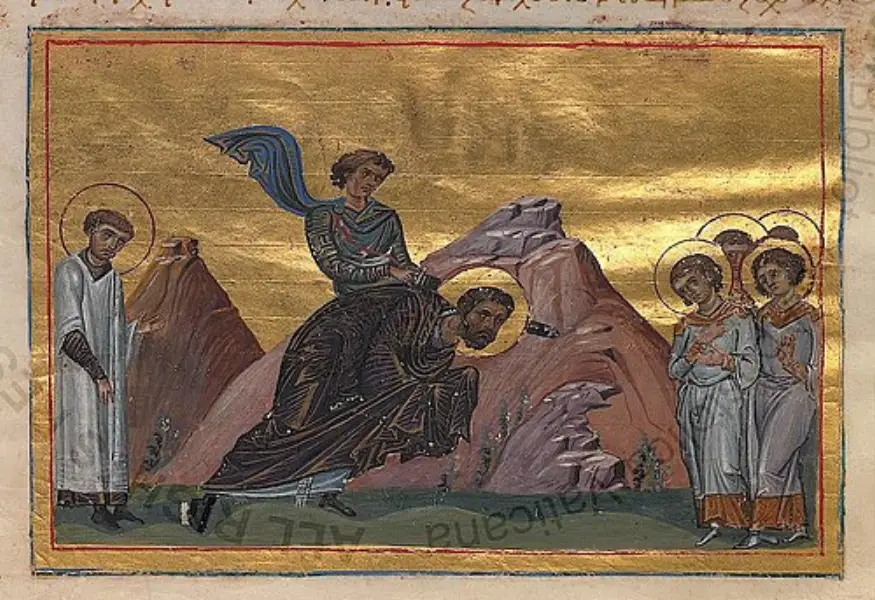
Overview
Faustus, Abibus and Dionysius of Alexandria were three Egyptian clergymen put to death for their faith in 250, in the persecution unleashed by the emperor Decius. Between them they represented the full order of the church's ministry: Faustus was a priest, Abibus a deacon, and Dionysius a lector. They did not die alone. They were executed together with a band of fellow believers whose names the tradition carefully preserves — among them a soldier, a sea captain, an acolyte, and several lay men and women — a small constellation of Alexandrian Christianity caught in the same storm. The Roman Martyrology remembers the group under the heading of Faustus and Macarius with ten companions. Their feast is kept on 6 September, and they are venerated in the Coptic Orthodox Church, in whose calendar of martyrs they hold a place, and in the Roman Catholic Church. Their combined witness shows a church entire — clergy and laity, soldiers and sailors — standing together before the tribunal.
The Complete Life
Three Orders, One Church
The three martyrs of Alexandria represent, in their own persons, the ordered life of a fully developed Christian community on the eve of its persecution. Faustus was a priest, charged with the celebration of the mysteries and the leadership of the flock; Abibus was a deacon, the order of service and charity that stood closest to the bishop and people alike; Dionysius was a lector, one of the minor orders through which a man was formed for the ministry of the word. Theirs were distinct responsibilities, but the persecution of 250 drew no distinctions among them: priest, deacon, and reader were seized together and condemned together. That fact tells us something important about the early Egyptian church — it was not a loose gathering of enthusiasts but a structured body with ranks, duties, and a chain of service, and it was precisely this visible organization that imperial power sought to break. The martyrs' fidelity preserved what the tribunal tried to destroy. Three men, three orders, one confession: the shape of their death mirrored the shape of the church they served.
§ Faustus, Abibus and Dionysius of Alexandria
The Storm of Decius
In 250 the emperor Decius ordered that all subjects of the empire sacrifice to the gods, and the full weight of that edict fell upon the churches. Alexandria, the greatest city of Roman Egypt and one of the chief sees of Christendom, became an arena of arrest and execution, and among those brought to death were Faustus, Abibus, and Dionysius. They were not alone. The tradition preserves the names of those who died with them: Theocistus, a master of ships; Andronicus, a soldier; Macarius; Cyriacus, an acolyte; a second man of the same name; Andreas; Andropelagia; Sarpambo; Thecla; and Caldote. The list itself is a portrait of the Alexandrian church — clergy and laity, a soldier of the army, a master of ships, women and men of every condition, joined in a single fate. The Roman Martyrology, distilling the tradition, commemorates the company as Faustus and Macarius with ten companions. Their execution belongs to the same persecution that claimed some of the most famous names of Egyptian Christianity, and it reminds us that alongside those famous names stood many whose only record is the fact and the date of their witness.
§ Faustus, Abibus and Dionysius of Alexandria
Remembered on 6 September
The memory of the Alexandrian company passed from the calendars of the Egyptian church into the universal roll of the martyrs. The Roman Martyrology lists them, and the feast of 6 September keeps their names before the Church year by year. In the Coptic Orthodox Church — the direct heir of the Alexandria in which they died — they are numbered among the martyrs of the tradition, and the Roman Catholic Church venerates them as well, a rare doubling of remembrance that reflects the antiquity and the breadth of their cult. Their company also carries a lesson in the ecology of sainthood: a reader and a shipmaster, a soldier and an acolyte, stand in one choir of witnesses, with no distinction of rank surviving the arena. For Christians of Egypt their commemoration binds the church of today to the church of the martyrs; for the wider Church they remain an example of a community that, tested at every level of its ministry and membership, did not surrender one of its members to the demand of the state. In their company the old hierarchies of this world count for nothing, and the single question that remains is the one all ten answered rightly.
§ Faustus, Abibus and Dionysius of Alexandria
The Record
- Canonization
- Pre-congregation; listed in the Roman Martyrology
Prayer
Bibliography
Show 1 sources
- Holweck, F. G. A Biographical Dictionary of the Saints. St. Louis, MO: B. Herder Book Co., 1924.
Profile text adapted from the Wikipedia article, licensed CC BY-SA 4.0.
Pray with this saint every day
Save Sts. Faustus, Abibus and Dionysius of Alexandria to your favorites, read the full profile, and get feast-day reminders in the Saints app.
Get the Saints AppFree on the App Store for iPhone and iPad