
died c. 258·Feast August 6
Sts. Felicissimus and Agapitus
Deacon-Martyrs Who Died with Pope Sixtus II
Overview
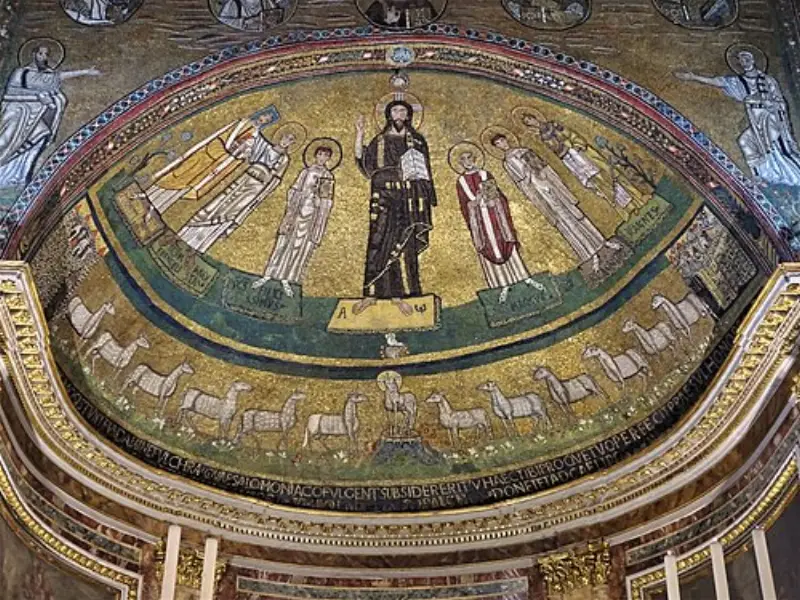
Felicissimus and Agapitus served as two of the six deacons who assisted Pope Sixtus II in the church of third-century Rome. When the pope was seized and condemned, his closest ministers shared his fate: both men were put to death on or about 6 August 258, the same day as their bishop. A seventh deacon of the Roman church, the celebrated Lawrence, followed four days later, on 10 August of that year. The two ministers were laid to rest in the Catacombs of Praetextatus along the Via Appia, and that burial ground remained the natural centre of their remembrance. In 833 Pope Gregory IV commissioned a large mosaic in San Marco Evangelista al Campidoglio in Rome portraying the pair among a company of saints; scholars connect their inclusion with a recent dispatch of their relics to a Bavarian monastery, so that the image preserved their spiritual presence in the city even though their bodies rested far from Rome and outside the immediate jurisdiction of the Holy See. The calendar honoured the two alongside Sixtus until the liturgical reform of 1969.
The Complete Life
Deacons of the Persecuted Church
The earliest notices of Felicissimus and Agapitus identify them by their office rather than by any deed of their own: they were deacons of Pope Sixtus II, members of the sevenfold college that served the church of Rome in the middle of the third century. Six deacons belonged to the pope's immediate circle, and the two men whose memories endure were counted among them. Their ministry was therefore one of service at the heart of the Roman community — assistance at the liturgy, care for the needy, and the daily administration that kept a persecuted congregation alive. In the year 258 that community was struck at its head. Soldiers arrested Sixtus II, and on or about the sixth of August he was executed; Felicissimus and Agapitus were killed the very same day,sharing the lot of their bishop to the end. Only Lawrence, the seventh deacon, survived them briefly, meeting his own death four days afterward. The synchrony of the three deaths fixed the pair forever in the church's memory as the companions of a martyred pope, honoured with him in a single commemoration.
§ Introduction
Remembrance in Stone and Calendar
The bodily remains of the two deacons were deposited in the Catacombs of Praetextatus, on the ancient Appian Way, and Christians honoured them there at the place of burial. Their cult, however, did not remain underground. In the year 833 Pope Gregory IV caused a vast mosaic to be made in the church of San Marco Evangelista al Campidoglio in Rome, showing several saints, among them Agapitus and Felicissimus. Historians of that artwork read the choice of figures as more than decoration: Gregory had apparently recently sent the relics of the two martyrs to a monastery in Bavaria, and the apse image accordingly evoked their continuing spiritual presence in Rome although their physical remains now lay beyond the city, outside the Holy See's immediate reach. The liturgy preserved them in a similar way. The Tridentine calendar joined Sixtus, Felicissimus, and Agapitus to the feast of the Transfiguration on 6 August, and there they remained within the General Roman Calendar until the reform of 1969, which did away with commemorations and gave the pope and his companions the following day instead.
§ Introduction
Timeline
- 6 Aug 258
Two of the six deacons of Pope Sixtus II, they were put to death alongside him around 6 August and laid to rest in the Catacombs of Praetextatus on the Via Appia.
§ Introduction
- 10 Aug 258
Lawrence of Rome, the seventh deacon, was martyred four days after his companions.
§ Introduction
- 833
Pope Gregory IV placed figures of both saints in a large mosaic at San Marco Evangelista al Campidoglio, Rome, perhaps after sending their relics to a Bavarian monastery.
§ Introduction
- 1969
With commemorations abolished, the memorial of Sixtus and his companions moved from the 6 August feast to 7 August.
§ Introduction
The Record
- Canonization
- Pre-congregation; honoured as martyrs since the earliest Roman calendars
Prayer
Bibliography
Show 5 sources
- Michael Ott, "Sixtus II" in The Catholic Encyclopedia
- Butler, Alban. "SS Sixtus II, Agapitus, Felicissimus, and Companions, Martyrs (258)" in Butler's Lives of the Saints: New Full Edition, ed. John Cumming. Burnes & Oates, Tunbridge Wells, 1998, pp. 44-45. ISBN 9780860122579
- Louise Ropes Loomis, The Book of the Popes (Liber Pontificalis). Arx Publishing, 2006, p. 31. ISBN 978-1-88975886-2
- Bolgía, Claudia. "The Mosaics of Gregory IV at S. Marco, Rome: Papal Response to Venice, Byzantium, and the Carolingians", Speculum 81/1 (2006), pp. 1-34. ISSN 0038-7134
- Calendarium Romanum. Libreria Editrice Vaticana, 1969, p. 133
Profile text adapted from the Wikipedia article, licensed CC BY-SA 4.0.
Pray with this saint every day
Save Sts. Felicissimus and Agapitus to your favorites, read the full profile, and get feast-day reminders in the Saints app.
Get the Saints AppFree on the App Store for iPhone and iPad