
d. 303·Feast August 30
Sts. Felix and Adauctus
Priest and Anonymous Companion of the Great Persecution
Overview
Felix and Adauctus are honoured as martyrs of Rome who, by tradition, suffered during the Great Persecution of the emperor Diocletian, in the year 303. The narrative preserved of them is brief and vivid. Felix, a priest of the Roman church, was ordered to sacrifice to the gods and was dragged by the prefect Dracus through the temples of Serapis, Mercury, and Diana; at his prayer the idols crashed shattered to the floor. Led out to execution, he was joined on the road by an unnamed Christian who spontaneously declared his faith and shared his death. Since no one knew the stranger's name, the church baptized his memory with a word: Adauctus, "the added one". Both were beheaded. Modern scholarship treats the story with reserve, reading it as a legendary elaboration of an inscription of Pope Damasus that had been misunderstood, and noting that the prefect Dracus appears in no list of Rome's prefects, that the supposed brother of Felix is in fact Saint Felix of Nola, and that the second priest of the legend is imaginary. Yet the cult itself is ancient beyond dispute: the two are commemorated in the Sacramentary of Gregory the Great and in the oldest martyrologies, their grave-church in the catacomb of Commodilla survives, and their relics travelled to Vienna, Alsace, and Bavaria.
The Complete Life
A Priest of the Roman Church
The Felix of this pair appears in the tradition as a priest of Rome — a presbyter of the city's Christian community at the very moment that community faced its most systematic destruction. The Acts that tell his story, first given to print in the Martyrology of Ado, add that he was the brother of another priest, also named Felix; critics long ago identified this sibling with Saint Felix of Nola and pronounced him imaginary, a doubling of the saint rather than a second man. The historical priest, then, stands nearly alone in the record: no see, no writings, no lengthy ministry described — simply a man bound to the altar of a persecuted church in the capital of the world. His vocation was put to the test when the Great Persecution reached Rome in 303, and it is precisely as a presbyter that he was challenged, for the persecutors understood that if the clergy could be broken, the flock would scatter. The tradition that grew around him remembered the priest and the stranger together, and the church's calendar has kept them inseparably joined ever since: wherever the liturgy names Felix on the thirtieth of August, Adauctus, who had no name of his own to give, is named beside him.
§ Introduction
The Falling Idols and the Nameless Companion
The narrative passion of the two saints unfolds with the economy of legend. Felix, ordered to offer sacrifice to the gods, is led by the prefect Dracus on a tour of Rome's great temples — Serapis, Mercury, and Diana — that he might bow before each in turn. Instead of incense the prefect receives catastrophe: at the priest's prayer the idols fall and shatter, a public disproof of the divinities the state demanded he honour. Condemned for the miracle as much as for the refusal, Felix is led away to death, and here the story produces its unforgettable second figure. A man of whom nothing is known — no name, no parish, no previous confession of faith — steps from the crowd of onlookers and declares himself a Christian, choosing to walk the same road and receive the same blow. Both are beheaded. The Christians who buried them, unable to recover the stranger's name, gave him a fitting one: Adauctus, "added" — the man added to Felix at the last hour. Scholarship reads the tale as a legendary elaboration of a misunderstood inscription of Pope Damasus, and Dracus, the prefect of the story, appears in none of the lists of Rome's prefects. But the narrative power of the anonymous companion has kept the pair alive in devotion for seventeen centuries.
§ Introduction
Commemorated from the Earliest Sacramentaries
Whatever reservations critics hold about the Acts, the antiquity of the cult is beyond challenge. The two martyrs are commemorated in the Sacramentary of Gregory the Great — the sacramental book of the Roman church at the close of the sixth century — and in the ancient martyrologies, which carry their feast on the thirtieth of August. This is recognition by immemorial custom: no pope canonized them, no process was held, because the liturgy itself had already received them while the memory of the persecution was still fresh. Their bodily remains confirmed the antiquity of the veneration. Above their tombs in the Commodilla catacomb, close by the Via Ostiensis and the basilica of Saint Paul Outside the Walls, a church rose and was restored by Pope Leo III around the year 800 — a papal benefaction that presupposes an established shrine. That structure came back to light roughly three centuries ago and was dug anew in 1905, its fabric still witnessing to the devotion of the early Roman church. In art the pair received a fixed iconography: Adauctus, the onetime soldier of legend, is sometimes portrayed as a Roman legionary, the anonymous layman given the dress of the empire whose swords killed him.
§ Veneration
Relics from the Via Ostiensis to Vienna
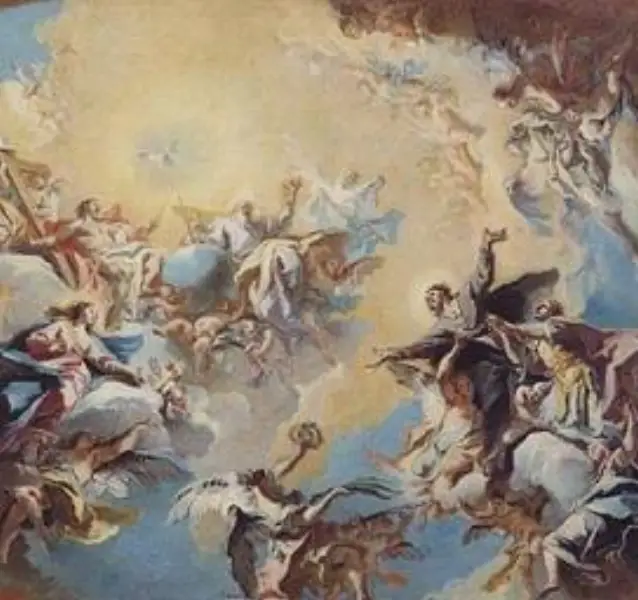
The relics of Felix and Adauctus led more travelled lives than their legend allows. Around the middle of the ninth century Pope Leo IV is said to have presented them to Irmengard, wife of the emperor Lothair I, and she enshrined them in the abbey of canonesses at Eschau in Alsace — the first of a series of translations that scattered the martyrs' remains across Europe. In 1361 further relics were brought to the church of Saint Stephen in Vienna, which the calendar still records as their principal shrine; the two heads became the objects of rival claims from Anjou and Cologne. According to the Chronicle of Andechs, Henry, the last count of that line, received relics of the saints from Pope Honorius III and carried them to the abbey of Andechs in Bavaria. Art, too, kept their memory alive: the painter Carlo Innocenzo Carlone (1686-1775) executed The Glorification of Saints Felix and Adauctus between 1759 and 1761 for the cupola of the church of San Felice del Benaco on Lake Garda, showing the pair in the brightness they were believed to have gained. Thus a priest known from a legend and a martyr known only by a borrowed name came to be honoured from the catacombs of Rome to the Danube.
§ Veneration
Timeline
- 303
Felix, a priest of Rome, was beheaded in the Diocletian persecution; an unknown Christian who joined him on the way to execution was killed with him and named Adauctus
§ Introduction
- 850
Pope Leo IV is said to have given the relics of the two martyrs to Irmengard, wife of Lothair I, who placed them in the canonesses' abbey at Eschau in Alsace
§ Veneration
- 1361
Relics of the martyrs were brought to the church of St. Stephen in Vienna
§ Veneration
- 1760
Carlo Innocenzo Carlone painted The Glorification of Saints Felix and Adauctus (1759-61) for the cupola of San Felice del Benaco on Lake Garda
§ Veneration
- 1905
The martyrs' old grave-church in the Commodilla catacomb along the Via Ostiensis, first brought to light some three hundred years before, was excavated anew
§ Veneration
The Record
- Symbols
- Adauctus sometimes portrayed as a Roman legionary or soldier
- Canonization
- Pre-congregation; commemorated in the Sacramentary of Gregory the Great and the ancient martyrologies
Prayer
Bibliography
Show 1 sources
- Mershman, Francis (1909). "Sts. Felix and Adauctus". In Herbermann, Charles (ed.). Catholic Encyclopedia. Vol. 6. New York: Robert Appleton Company
Profile text adapted from the Wikipedia article, licensed CC BY-SA 4.0.
Pray with this saint every day
Save Sts. Felix and Adauctus to your favorites, read the full profile, and get feast-day reminders in the Saints app.
Get the Saints AppFree on the App Store for iPhone and iPad