
died c. 212·Feast April 23
Sts. Felix, Fortunatus, and Achilleus
Priest and deacon martyrs of Valence
Overview
Felix, Fortunatus, and Achilleus were third-century Christians who gave their lives for the faith at Valence, in Gaul, around the year 212, during the reign of the emperor Caracalla. Felix was a priest, while Fortunatus and Achilleus served as deacons. The three were dispatched to Valence by Saint Irenaeus of Lyon with the task of converting its inhabitants. Living together in a humble lodging and practicing severe penance, they preached the Gospel in the town and its surrounding region, winning many converts and performing numerous miracles. Their success drew the hostility of the authorities: they were arrested, miraculously freed from prison by angels, arrested again after destroying the idols of the temples, and finally put to death by beheading after enduring the breaking of their legs and torture on the wheel. No contemporary account of their lives survives, and modern scholars regard parts of their legend as uncertain, but their cult is ancient. Relics venerated as theirs are honored in Valencia, Spain, relics of Fortunatus are said to rest in Sant'Andrea della Valle in Rome, and the abbey church of Charlieu was dedicated to the three co-martyrs. Their feast is kept on April 23, and they are patrons of Valence in the Drôme.
The Complete Life
Sent from Lyon to Valence
The story of the three martyrs begins with a commission. The three missionaries — Felix a priest, and Fortunatus and Achilleus his deacon companions — received from Saint Irenaeus of Lyon their commission to the town of Valence on the Rhône, with the purpose of converting its people to Christianity. In the early third century, the Christian faith in Gaul was still young and thinly planted, centered on communities like Lyon and Vienne, and the pagan countryside beyond offered both opportunity and danger to preachers of the Gospel. The three accepted this mission and made their home in Valence in a humble lodging, where the tradition records that they lived a life of much penance. Their manner of life was itself a sermon: poverty, discipline, and prayer marked them as men whose message was not about themselves. Whatever the exact historical details — for no contemporary record of their lives has survived, and the scholar T. Scott Holmes noted that the individuals may not be entirely legendary even though no historical incidents are preserved — the memory of the Church in Gaul preserved them as apostles of the Rhône valley, bearers of the faith from the urban church of Lyon to a town that would one day honor them as its own patrons.
§ Legends
Preaching, Miracles, and the Fall of Idols
In and around Valence the three missionaries labored with striking success. The tradition records that they performed many miracles in the area, and that through their preaching a great many people were converted to the Christian faith. Such success could not long go unnoticed by the local authorities, and the three were arrested and imprisoned. The legend tells that angels opened their cell for them and bade them topple every idol that stood in the sanctuaries of the town. The three obeyed: they smashed the images of Mercury and Saturn, and toppled a particularly valuable statue of Jupiter made of amber. This open defiance of the civic cults made their second arrest inevitable. The authorities captured Felix, Fortunatus, and Achilleus again, and subjected them to a sequence of brutal tortures that the legend records in detail: their legs were broken, and they were then tortured on wheels — a punishment of hideous cruelty reserved for the worst offenders. Remarkably, the tradition holds that they survived even these torments. Their perseverance under torture made clear that no suffering could shake their confession of Christ, and the authorities resolved upon the final penalty.
§ Legends
Beheaded for the Faith
Having endured the breaking of their limbs and the torture of the wheel without renouncing their Lord, the three missionaries of Valence were led out to beheading, completing their witness around the year 212, in the closing years of the reign of the emperor Caracalla. Death by the sword made them martyrs in the oldest sense of the word: witnesses who confirmed their testimony with their blood. Their execution did not end their influence. The Christian community they had planted at Valence honored them as its founders and intercessors, and in time the town of Valence in the Drôme took them as its patron saints. The devotion that gathered around their memory spread far beyond the Rhône valley. The abbey church of Charlieu was dedicated to the three co-martyrs, tying their names to one of the great monastic houses of Burgundy. Their feast came to be kept on April 23 throughout the Church, and they are listed among the martyrs of the early Gallic church in both the Roman Catholic and Eastern Orthodox traditions. Whatever history can verify of their individual deeds, the Church has never ceased to venerate them as men who loved Christ more than life.
§ Legends
Relics and Enduring Remembrance
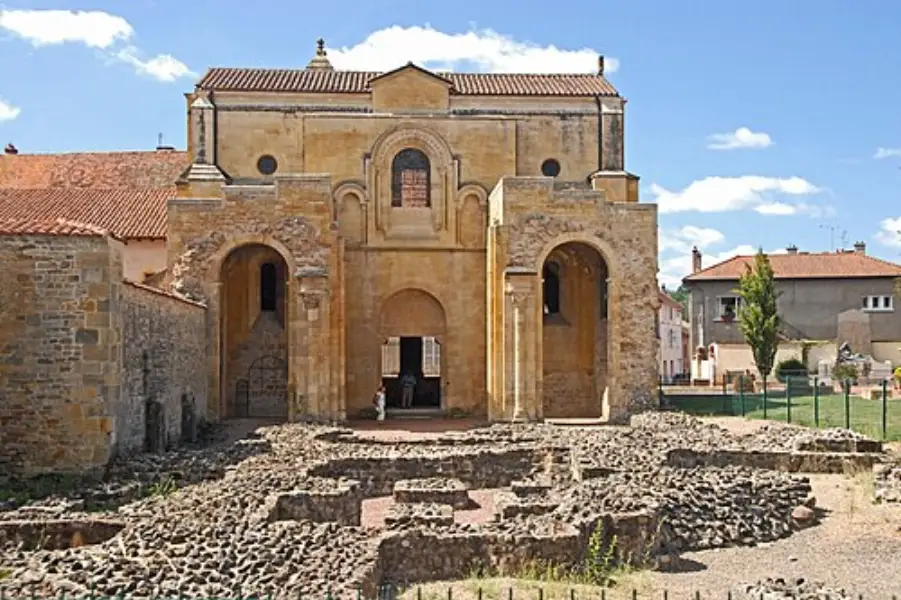
The bodily memory of the three martyrs was scattered across Europe, a sign of how widely their cult traveled. In Valencia, Spain, sacred remains honored as those of the three martyrs receive public veneration — a devotion that may reflect the medieval traffic in sacred remains or a shared name carried across the Pyrenees, but one that has endured for centuries. In Rome, relics said to be those of Fortunatus rest in the church of Sant'Andrea della Valle, one of the capital's great baroque basilicas, placing the deacon of Valence among the host of martyrs honored in the eternal city. In France, the abbey church of Charlieu stood as a lasting monument to the three co-martyrs, its ruins still visible today and still bearing their dedication. The Church keeps their memory liturgically on April 23, and the catalog of early Gallic martyrs has preserved their names alongside those of the great witnesses of Lyon and Vienne. The scholars who handed down their story were candid about its character: even if the men themselves may not be wholly legendary, history has kept no record of any deed from their lives. Yet the absence of documents has not dulled devotion, and the patrons of Valence remain among the honored martyrs of the early French Church.
§ Veneration
The Record
- Patron of
- Patrons of Valence, Drôme, France
- Canonization
- Pre-congregation canonization; venerated as martyrs since the early Church.
Prayer
Bibliography
Show 2 sources
- Monks of Ramsgate. "Felix, Fortunatus and Achilleus". Book of Saints, 1921. CatholicSaints.Info, 10 April 2013
- Holmes, T. Scott. The Origin and Development of the Christian Church in Gaul During the First Six Centuries of the Christian Era, Mac Millan, 1911, p. 55
Profile text adapted from the Wikipedia article, licensed CC BY-SA 4.0.
Pray with this saint every day
Save Sts. Felix, Fortunatus, and Achilleus to your favorites, read the full profile, and get feast-day reminders in the Saints app.
Get the Saints AppFree on the App Store for iPhone and iPad