
died c. 212·Feast June 16
Sts. Ferreolus and Ferrutio
Priest and Deacon, Patron Martyrs of Besançon
Overview
Ferreolus and Ferrutio, remembered in French as Ferréol and Ferjeux, are honored as brother martyrs and the principal patrons of Besançon. Their legendary acts relate that the two men came from Asia Minor and were converted to Christianity by Polycarp of Smyrna, and that Irenaeus of Lyons gave the brothers their orders, Ferreolus as priest and Ferrutio as deacon, and dispatched them to evangelize the land of the Sequani around Besançon. Alban Butler judged it more plausible that they were Gauls who had studied in Asia Minor and there come under Christian influence, and scholars allow that the legend may preserve the memory of a real Ferreolus who helped Irenaeus carry the faith beyond Lyon. According to the tradition, the brothers labored as missionaries among the Sequani for thirty years before being seized in the persecution under Alexander Severus, tortured, and beheaded around the year 212. Their cult at Besançon is well attested long after their deaths: their relics were found in a cave near the city in 370 and enshrined by Bishop Anianus, Gregory of Tours records miracles worked through them, and the Missale Gothicum of about 700 contains a complete Mass in their honor. The Basilica of Saint-Ferjeux stands today in the Besançon neighborhood that bears the saint's name.
The Complete Life
Brothers from the East
The acts of the two saints open in Asia Minor, the Roman province-land of the eastern Mediterranean where Christianity first took deepest root. There, the legend says, the brothers Ferreolus and Ferrutio heard the gospel from Polycarp of Smyrna, the aged bishop whose own martyrdom had made him one of the most revered figures of the early church, and they were converted through his teaching. Modern scholars have doubted the eastern origin: Alban Butler, the eighteenth-century hagiographer, considered it more likely that the two were natives of Gaul who had traveled to Asia Minor for study and there encountered the Christian faith. Whatever the truth of their birthplace, the tradition is unanimous that their formation in the faith connected them to the great Asian church, and that from there their path led west to the Rhone, where the churches of Lyon and Vienne stood as the oldest Christian communities of Gaul. In those communities the brothers found their vocation: Ferreolus was raised to the priesthood and Ferrutio ordained deacon, and both were marked out for the mission that would carry their names to the river country of the Doubs.
§ History
Sent from Lyons
Irenaeus, bishop of Lyons and himself a man formed in Asia Minor by Polycarp, ordained the two brothers and sent them north as missionaries. The tradition thus binds the church of Besançon to the apostolic mission of the Lyonnese church, and behind it to the churches of the East. The historian T. Scott Holmes and others have seen in the legend a likely kernel of fact: one Ferreolus, a helper of Irenaeus in the work of carrying the faith outward from Lyon and its valleys. The land assigned to the brothers was that of the Sequani, the Celtic people whose principal town, Vesontio, is Besançon today, a fortress city set inside a great loop of the river Doubs. To preach there was to carry the gospel into territory where no church yet existed, dependent on the hospitality of a pagan people and on the endurance of the two men themselves. One was ordained to offer the sacraments, the other to serve and to preach alongside him, and in that ordering the two worked as a single mission, the pattern that their joint cult would preserve for seventeen centuries. The pairing of orders mattered to the tradition, which insists on the liturgy's memory: one brother a priest, the other a deacon, each ordained for his own part in the one work.
§ History
Thirty Years Among the Sequani
The tradition gives the brothers' mission a remarkable span: thirty years of labor among the Sequani before their arrest. Whatever else the acts may add, this long endurance is the heart of their witness. They were not missionaries of a single season but settlers of the faith, spending a generation in one region, teaching, baptizing, and building the Christian community that would become the diocese of Besançon. No journeys, no writings, and no miracles are recorded from these decades, only the quiet fact of persistence in a land not their own, under authorities who regarded the new religion with hostility. When the persecution under the emperor Alexander Severus reached the region, the long ministry ended in a single stroke. The brothers were arrested, put to torture, and beheaded, dying within the same persecution in the years 211 or 212, as Butler records. The city that had received their preaching received their blood as well, and the faith they had planted survived the empire's violence to make Besançon one of the ancient sees of Gaul. Butler's entry, written under 16 June, preserves the outline exactly: the two ordained by Irenaeus, sent to preach at Besançon, tormented, and beheaded in the persecution of Severus. The mission that began with an ordination at Lyons thus closed with two heads at Besançon, and the diocese that grew from it never forgot the pairing of its founding priest and deacon.
§ Butler's account
Martyrdom Under Severus
The persecution that ended the brothers' lives is the last event the tradition records of them. Arrested by the local authorities, Ferreolus the priest and Ferrutio the deacon were subjected to many torments, in Butler's phrase, and finally beheaded for the faith around the year 212. Their bodies were buried, and for more than a century and a half even the place of their burial faded from memory. The legend tells that in 370 a military tribune out hunting near Besançon, his dog chasing a fox into a cave, stumbled upon the hidden relics of the martyrs. Bishop Anianus of Besançon enshrined them with honor, and from that recovery the public cult of the two saints begins on solid ground. Gregory of Tours, writing two centuries later, reports that the relics were famous for miracles in his own day and records that his own brother-in-law was delivered from a dangerous illness through the saints' intercession. The cathedral of Besançon came to regard their remains, in Butler's words still true in his own century, as its great treasure. The cave of the discovery lies near the city, and the enshrinement that followed turned a hidden grave into a public shrine; from that moment the two martyrs belonged visibly to Besançon, and the cathedral's claim upon them endured into Butler's own century as its greatest treasure.
§ Butler's account
Patrons on the Walls of Besançon
The cult of Ferreolus and Ferrutio grew steadily in the centuries after the finding of their relics. The Missale Gothicum, compiled around the year 700, preserves a complete proper of the Mass in their honor, evidence that their feast was celebrated with solemnity throughout the region within three centuries of the relics' recovery. In the sixteenth century the people of Besançon invoked them against sickness, naming them alongside Saints Sebastian and Roch, the great plague intercessors. As patrons of the city they were believed to have appeared upon its walls in moments of danger, defenders as well as intercessors. A seventeenth-century catalogue, alone among the sources, styles Ferreolus a bishop of Besançon, yet the city's liturgy has always insisted: it remembers him as a priest and his brother as a deacon, the offices they held in life. Their images fill the churches and chapels of the two dioceses of Franche-Comté, Besançon and Saint-Claude, in stained glass, painting, and statuary, and the Basilica of Saint-Ferjeux rises in the quarter of the city that still bears the martyred brother's name. Their patronage of the city has never lapsed, and the neighborhood of Saint-Ferjeux keeps the deacon's name in its very streets.
§ Veneration
Timeline
- 212
After thirty years as missionaries, arrested under Alexander Severus, tortured, and beheaded.
§ History
- 370
A fox hunt led a military tribune to stumble upon the brothers' relics in a cave near Besançon; Bishop Anianus later enshrined them.
§ Veneration
- 700
The Missale Gothicum, compiled about this time, includes an entire proper of the Mass composed for the two martyrs.
§ Veneration
- 1900
The two saints appear on a French lantern slide dated to this year.
§ Gallery
In Their Own Words
They were ordained by Saint Irenæus, and sent by him to preach the gospel at Besançon, where, after suffering many torments, they were beheaded for the faith in the persecution of Severus in 211 or 212.
The Record
- Major works
- Thirty-year mission among the Sequani, by which the church of Besançon traces its origins
- Patron of
- Besançon
- Symbols
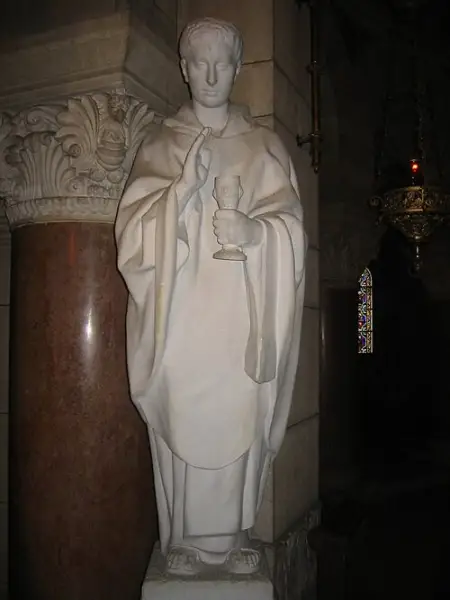
- Priest's and deacon's vestments·Palm of martyrdom·Sword of beheading·Statues at the Basilica of Saint-Ferjeux
- Canonization
- Pre-congregation canonization; venerated as martyrs by the Catholic Church and the Eastern Orthodox Church since antiquity.
Prayer
Bibliography
Show 7 sources
- Butler, Alban, and Paul Burns. Butler's Lives of the Saints. Continuum International, 2000, p. 117
- Rabenstein, Katherine (June 1998). "Ferreolus and Ferrutio MM (RM)". Saints O' the Day for June 16. Archived from the original on 2007-11-05
- "Latin Saints of the Orthodox Patriarchate of Rome". Orthodox Europe
- Holmes, T. Scott. The Origin and Development of the Christian Church in Gaul During the First Six Centuries of the Christian Era. MacMillan, 1911, p. 54
- "L'origine des maladies" (in French)
- Borrelli, Antonio (2003-02-06). "Santi Ferreolo e Ferruccio". Santi Beati (in Italian)
- Butler, Alban (1799). The Lives of the Primitive Fathers, Martyrs, and Other Principal Saints. J. Moir
Profile text adapted from the Wikipedia article, licensed CC BY-SA 4.0.
Pray with this saint every day
Save Sts. Ferreolus and Ferrutio to your favorites, read the full profile, and get feast-day reminders in the Saints app.
Get the Saints AppFree on the App Store for iPhone and iPad