
died c. 290·Feast August 9
Sts. Firmus and Rusticus
Martyred Kinsmen of Verona under Maximian
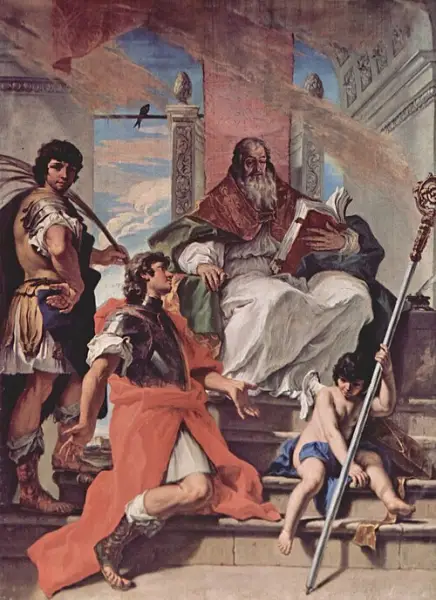
Overview
Firmus and Rusticus, honoured as martyrs of Verona, were kinsmen and prominent citizens of Bergamo whose cult has been celebrated in the Catholic and Eastern Orthodox churches for well over a millennium. According to their legend — preserved in Acts whose reliability the tradition itself concedes to be doubtful — Firmus, a soldier, was arrested for his faith and conducted toward Milan; his relative Rusticus greeted him on the way and was taken as well. Both were delivered to the judge Anolinus at Verona, where their refusal to sacrifice to the pagan idols cost them the torture, a beating with clubs, and finally the sword, in the reign of Maximian, around the year 290. Their veneration is documented from about 800 near Classe at Ravenna, and they are named in the Versus de Verona. Yet modern scholarship has raised a Doublet question: the judge Anolinus is known to have served as pro-consul in Africa, and it has been postulated that the two were originally African martyrs whose relics reached Verona by translation, their Acts being composed to make them heroes of the Veronese church. In 765 Bishop Anno's sister conveyed the relics from Trieste to Verona, and they were laid to rest anew in a leaden casket set inside the high altar; the cult won approval in 1734.
The Complete Life
Citizens of Bergamo
In the tradition's telling, Firmus and Rusticus were kinsmen and prominent citizens of Bergamo, a city in the Lombard plain not far from Milan. Firmus, the more clearly drawn of the two, was a soldier; Rusticus was his relative, bound to him by blood and, in the end, by witness. The Acts that preserve their story are described even within the tradition as unreliable, and modern scholarship treats them with caution, but their narrative shape is clear and was clearly cherished. Firmus was seized on account of his faith — an arrest that singled out a man of standing in his own community — and was conducted under guard toward Milan, the imperial capital of the region. On the way, Rusticus came out to greet his kinsman, an act of loyalty that cost him his freedom, for he too was taken and led along the same road. The two were not returned to Bergamo but delivered instead to Verona, where the judge Anolinus awaited them. Whatever the historical substance behind this account, the legend presents a family bound by more than kinship: two men whose courage and whose fidelity to each other became the reason both were remembered together, as a single cult, from the earliest records of their veneration.
§ Legend
The Refusal Before Anolinus
At Verona, under the emperor Maximian, the two kinsmen faced the test that defined the age of the great persecutions: the command to sacrifice to the pagan gods. Their refusal, the legend reports, was unconditional. For it they were handed over to torture, beaten with clubs, and finally beheaded — the ordinary, terrible sequence of a Roman capital trial, recorded in the passion narrative with the economy the genre demands. The date is given as around 290, in the last years before the empire-wide persecution of Diocletian made such trials general. The figure of the judge, Anolinus, became the hinge of the whole story in a way his contemporaries could not have foreseen. Baring-Gould noted that Anolinus held the consulship in 295 and governed Africa as pro-consul in 303 — posts that set him not beside the Po but on the African coast, and suggest that the passio may have transported to Verona a trial that actually occurred in the African provinces. Within the legend, however, Anolinus serves a simpler purpose: he is the magistrate before whom two ordinary citizens became extraordinary, and the man whose questions drew from the kinsmen the confession that the Christians of northern Italy would treasure for a millennium and a half.
§ Legend
Relics on the Road to Verona
The formal history of the saints' cult begins not with their passion but with the movement of their bones. A tenth-century writer traces the road the bones travelled: Africa first, then Capodistria, and at last Trieste, before Anno of Verona laid them to rest a second time in a leaden casket inside the high altar — the itinerary of relics finding their way to a city that claimed them. In 765 the relics had been brought from Trieste to Verona by the sister of Bishop Anno, the act that created the Veronese cult as an institution. Scholars have drawn the obvious inference: no evidence joins the two martyrs to Verona before the late 700s, and it has been argued that the two were actually martyrs of Africa whose remains were translated to Verona, their Acts being composed to make them heroes of their new home. None of this diminished their veneration. It is documented from around 800 near Classe at Ravenna, they are mentioned in the Versus de Verona, and their cult was formally approved in 1734, with the feast fixed on 9 August in both the Catholic and Eastern Orthodox calendars.
§ Veneration
Art for Two Martyrs
The memory of Firmus and Rusticus is written into the fabric of the cities that claim them. In Verona, the church of San Fermo Maggiore preserves their relics in its presbytery and commemorates their passion in a striking modern cycle: twenty-four bronze tiles by the sculptor Luciano Minguzzi portraying the torture and death of the two saints — among them the scene of Rustico's execution rendered in a herringbone design. The pairing of the two kinsmen in art and devotion reflects the character of their legend, which is inseparable from their companionship on the road to death. Their cult spread across the Lombard countryside as well: a church of San Fermo e Rustico stands at Brignano Gera d'Adda, built in the twelfth century, the parish church of Caravaggio in Lombardy is dedicated to the pair, and frescoes of the two saints appear in the Val Camonica. Historians continue to weigh the evidence of their African origins, and the question remains open; but the devotion of the Veronese, the Ravennese documentation of about 800, and the 1734 approval of the cult together testify to how completely the translated martyrs were adopted by the church of the Adige. Their feast on 9 August keeps two names joined, as they were joined in the tradition from the beginning.
§ Veneration
Timeline
- 290
By tradition, Firmus is captured for his faith at Bergamo; Rusticus joins him and both are tortured and beheaded at Verona before the judge Anolinus.
§ Legend
- 295
Anolinus, the judge of their passion, serves as consul — a detail later used to question the Veronese setting.
§ Veneration
- 303
Anolinus is recorded as pro-consul in Africa, supporting the theory that the two martyrs were originally African.
§ Veneration
- 765
Bishop Anno's sister brings the martyrs' relics from Trieste to Verona.
§ Veneration
- 800
Veneration of Firmus and Rusticus is documented near Classe in Ravenna; they are also named in the Versus de Verona.
§ Veneration
- 1734
The cult of Firmus and Rusticus receives formal approval; their feast is kept on 9 August.
§ Veneration
The Record
- Patron of
- Verona
- Symbols
- palm of martyrdom·sword and club
- Canonization
- Cult approved in 1734; venerated from antiquity in the Catholic and Eastern Orthodox Churches
Prayer
Bibliography
Show 6 sources
- Monks of Ramsgate. "Firmus and Rusticus". Book of Saints, 1921. CatholicSaints.Info, 9 August 2016.
- Pignot, Matthieu. "Cult of Saints, E03246". University of Oxford.
- Schäfer, Joachim. "Firmus und Rusticus". Ökumenisches Heiligenlexikon.
- Baring-Gould, Sabine. The Lives of the Saints, Vol. 3. J. Grant, 1914, p. 435.
- Veronese, Francesco. After Charlemagne: Carolingian Italy and its Rulers (Clemens Gantner and Walter Pohl, eds.). Cambridge University Press, 2020, p. 227. ISBN 9781108840774.
- Miller, Maureen C. The Formation of a Medieval Church: Ecclesiastical Change in Verona, 950–1150. Cornell University Press, 2018, p. 156. ISBN 9781501728853.
Profile text adapted from the Wikipedia article, licensed CC BY-SA 4.0.
Pray with this saint every day
Save Sts. Firmus and Rusticus to your favorites, read the full profile, and get feast-day reminders in the Saints app.
Get the Saints AppFree on the App Store for iPhone and iPad