
martyred 2nd century·Feast August 18
Sts. Florus and Laurus
Twin stonemason martyrs, patrons of horses
Overview
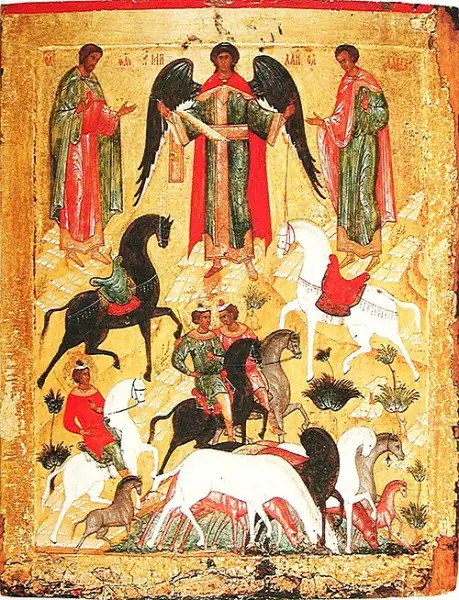
Florus and Laurus, venerated as Christian martyrs of the second century, were twin brothers from Byzantium who worked as stonemasons. According to the Greek tale that preserves their memory, they settled at Ulpiana in Dardania, south of modern Pristina in Kosovo, in the district of Illyricum, and were trained in their craft by two Christians, Maximus and Proculus. Their legend places them at the center of a dramatic confrontation. Likaion, prefect of Illyricum, employed the brothers to build a pagan temple; they gave their wages to the poor, and when the son of a pagan priest named Mamertin was struck by a chip of stone from the building site, the twins cured the boy after he accepted Christianity, bringing his father to conversion as well. When the temple stood finished, Florus and Laurus gathered the local Christians within it, smashed the idols, and raised a cross. The worshippers passed the night in prayer; the authorities burned three hundred of them, including Mamertin and his son, and executed the brothers by casting them into an empty well, which was then covered with earth. Their relics were found incorrupt, and on the same day a severe plague among horses ended — the origin of their lasting association with horses. Translated to Constantinople, the relics were seen there by pilgrims from Novgorod in 1200 and 1350. In Rus and Ukraine the twins became patrons of horses, shown on icons surrounded by them, honored on 18 August.
The Complete Life
Twin Masons from Byzantium
Florus and Laurus were, according to their Greek tale, twin brothers, Christians of the second century, born at Byzantium, the city that would one day be Constantinople. They earned their living as stonemasons, and the craft shaped their whole story: the men who trained them in the art of masonry were two Christians named Maximus and Proculus, under whom the brothers learned both their trade and the faith they would eventually die for.
Leaving their native city, the twins settled at Ulpiana in Dardania, a city lying south of modern Pristina in Kosovo, in the district of Illyricum. There their skill in building brought them to the notice of the provincial authorities, and their open Christianity brought them to the notice of worse.
Masonry was an honorable trade in the ancient world, and builders traveled wherever construction was to be done. In the case of the twins, that ordinary circumstance placed two trained craftsmen and convinced Christians in a pagan city at the very moment when the empire's hostility to their religion could reach them. Their legend turns a workman's journey into the stage on which their confession of Christ was made.
§ References
The Temple Turned Church
Likaion, the prefect of Illyricum, employed Florus and Laurus in the construction of a pagan temple — an ironic commission for Christian masons, which they turned to unexpected purposes. The twins handed their earnings over to the destitute, so that the work itself became almsgiving.
An accident opened the way to grace. A splinter of stone flying from the saints' building work wounded the small son of Mamertin, a priest of the old gods; the twins healed the child once he had come to believe, and his father, seeing him whole again, resolved to follow Christ as well.
When the temple stood complete, Florus and Laurus gathered the local Christians and entered it together. They broke in pieces every idol the shrine contained, and where the gods had towered they planted a cross; all night long the Christian company kept vigil in prayer inside the place they had won for Christ.
The answer of the authorities was merciless. Three hundred of them — Mamertin and Mamertin's son among them — were burned to death. For the brothers themselves Likaion reserved another manner of killing: they were hurled into a dry well, and earth was piled over the mouth. Thus the masons of Byzantium finished the temple as a church and paid for it with their lives.
§ References
Patrons of Horses
The relics of Florus and Laurus are said to have been found incorruptible. On the very day of their discovery a severe plague among horses came to an end, and from that coincidence grew the saints' enduring association with horses, which won them the guardianship of horses throughout Rus and Ukraine. On icons the twin martyrs stand ringed by horses, and the Florivsky Monastery in Kyiv stands dedicated to their memory, together with many Orthodox churches.
The customs of the countryside kept their feast alive in daily ways: no husbandman would yoke a horse on their day, dreading a murrain among his beasts; instead the village horses were walked in procession about the church in the martyrs' honour.
Their relics were translated to Constantinople, where pilgrims from Novgorod attested them: Anthony looked on them in 1200, and Stephen, another Novgorod pilgrim, found their heads in 1350 within the Pantokrator Monastery. The Eastern Orthodox and Roman Catholic churches alike venerate the pair, keeping a common feast on 18 August, the mason twins remain among the best-loved saints of the Slavic countryside.
§ Veneration
Timeline
- 150
Executed at Illyricum as martyrs of the second century: the prefect Likaion has the twin brothers thrown down an empty well, which is covered with earth.
§ Introduction
- 1200
The Novgorod pilgrim Anthony saw the relics of Florus and Laurus in Constantinople.
§ Veneration
- 1350
In 1350 Stephen of Novgorod venerated the martyrs' heads at the Pantokrator Monastery in Constantinople.
§ Veneration
In Their Own Words
On this day the Russians lead their horses round the church of their village
The Record
- Patron of
- horses, in Rus and Ukraine
- Symbols
- depicted on icons with horses around them
- Canonization
- Pre-congregation martyrs; venerated since the early centuries in East and West.
Prayer
Bibliography
Show 5 sources
- "St. Florus & Laurus", Catholic Online, 2009. Retrieved December 31, 2009
- Alban Butler, Herbert Thurston, Donald Attwater, Lives of the Saints, Tome 3: "Florus and Laurus, Martyrs (Date Unknown)"
- Reverend Antonio Gallonio, Tortures and Torments of the Christian Martyrs, 2004, p. 204
- Robert Elsie (2000). "The Christian Saints", University of Mississippi
- "Martyr Florus of Illyria", Orthodox Church in America, 2009. Retrieved December 31, 2009
Profile text adapted from the Wikipedia article, licensed CC BY-SA 4.0.
Pray with this saint every day
Save Sts. Florus and Laurus to your favorites, read the full profile, and get feast-day reminders in the Saints app.
Get the Saints AppFree on the App Store for iPhone and iPad