
martyred 1535-1679·Feast May 4 (England); October 25 (Wales)
Sts. Cuthbert Mayne and Companions (the Forty Martyrs of England and Wales)
Catholic martyrs of the English Reformation, 1535-1679
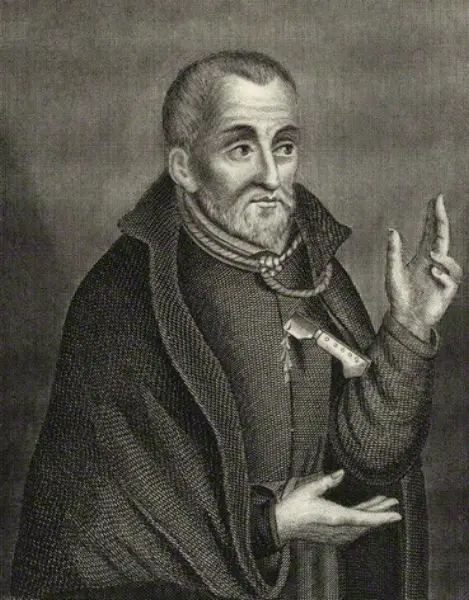
Overview
The Forty Martyrs of England and Wales, formally titled Cuthbert Mayne and Thirty-Nine Companion Martyrs, are Catholic men and women, lay and religious, put to death between 1535 and 1679 on treason charges and related offenses under statutes enacted by Parliament during the English Reformation. Their ranks reach across more than a century of religious conflict, from Carthusian monks who in 1535 refused to accept Henry VIII's Act of Supremacy, to seminary priests ensnared in the supposed Popish Plot against Charles II in 1679. Many went to the gallows after show trials, or without any trial whatsoever. Two perished in prison and one, Margaret Clitherow, was crushed to death; the remainder suffered hanging, drawing and quartering, for the most part at Tyburn. Among their number are celebrated figures such as the Jesuit Edmund Campion and the laywoman Margaret Clitherow. Beatified in two groups under Leo XIII and Pius XI, the forty were canonized together by Pope Paul VI in Saint Peter's Basilica on 25 October 1970, after the bishops of England and Wales had chosen names distinguished by social rank, religious state, geography, and existing popular devotion.
The Complete Life
One Hundred Years of Persecuting Laws
The deaths of the forty were spread across the working of a legal machine built piece by piece over more than a century. The first executions came in the reign of Henry VIII, falling upon those who would not support the 1534 Act of Supremacy and the dissolution of the monasteries; among them were the Carthusian John Houghton and the Bridgettine Richard Reynolds. A sharper phase opened in 1570, when Pope Pius V, lending support to a series of risings in England and Ireland, excommunicated Elizabeth and freed her Catholic subjects from their oath of allegiance. The Crown answered with rigorous enforcement of the penal laws already on the statute book and with new ones. Under the Treason Act of 1571, denying the queen's right to the Crown or branding her a heretic became high treason. Then came the Jesuits, etc. Act of 1584, the law beneath which most of these English witnesses perished: it treated the bare presence of any Jesuit or seminary priest in England as high treason, and harbouring or aiding one as a felony. By such degrees, simply being a Catholic priest became a capital crime.
§ Background
The Forty and Their Witness
The group canonized in 1970 is deliberately representative of the whole suffering Church of the Reformation centuries: lay and religious, men and women, drawn from every social rank. It stretches from Carthusian monks who in 1535 would not accept Henry VIII's supremacy oath to seminary priests trapped in the supposed Popish Plot of Charles II's reign in 1679. Among them are famous names — Edmund Campion, the Jesuit scholar hunted and executed under Elizabeth, and Margaret Clitherow, the York housewife pressed to death for sheltering priests — and humbler ones, men like John Kemble, an aged country priest led out to die in his eighties. Justice was often a formality: condemnation frequently followed show trials, or came without any trial whatsoever. The manner of their deaths tells its own story. Two of the company perished in their cells; one was crushed to death beneath a great weight; the remainder died the traitor's death of hanging, drawing and quartering, for the most part at Tyburn, where London's crowds gathered at executions. All but six of the forty endured that savage sentence, meeting it with the composure that turned spectators into converts.
§ The martyrs
From Beatification to the Altar
The road to canonization stretched through decades of preparation. Following beatifications between 1886 and 1929, England and Wales already possessed numerous martyrs raised to the rank of Blessed, and the bishops of the province set out to identify forty further names for the highest honor. Their criteria were pastoral and practical: a spread of social status and religious rank, a geographical reach across the two countries, and the pre-existence of popular devotion at the shrines of the slain. The list was submitted to Rome in December 1960. Because the cause was one of martyrdom, no miracle was strictly required — for a martyr the Pope need only certify that the servant of God went freely to death, bearing witness to the Catholic faith or performing an act of heroic charity for others. Nevertheless, Cardinal William Godfrey, Archbishop of Westminster, sent Rome an account of twenty-four apparently miraculous cases, among which the healing of a young mother afflicted with a malignant tumour stood out as the strongest. Since Thomas More and John Fisher had already been raised to the altars with a dispensation from miracles, Paul VI judged that this one authenticated cure would suffice, and all forty were declared saints in Rome on 25 October 1970.
§ Canonization process
Feasts of England and Wales
The liturgical memory of the martyrs has shifted with the reform of the calendar. In England the forty were formerly commemorated by a feast on 25 October, a date shared with Saints Crispin and Crispinian; they are now kept on 4 May, in company with the 284 other canonized and beatified witnesses of the English Reformation, in one solemn remembrance of the whole company of the slain. Wales keeps its own tradition: 25 October belongs there to the Six Welsh Martyrs with their companions — the priests Evans, Lloyd, Jones, Lewis, and Roberts, joined by the teacher Richard Gwyn, while those companions are the thirty-four English members of the canonized group. A separate Welsh celebration on 4 May honors those among them who are beatified. In art the martyrs are shown with the emblems of their passion — the noose, the knife in the chest, the book or Bible, the crucifix held at the hour of death — and their patronage embraces the whole United Kingdom whose laws once condemned them. In the emblems that surround them, each instrument of shame has become a badge of honor, held up before a country that has long since learned to revere the men and women its courts condemned.
§ Liturgical feast day
Timeline
- 1534
Henry VIII's Act of Supremacy and the dissolution of the monasteries provoke the first wave of executions
§ Background
- 4 May 1535
Carthusian John Houghton and three companions, who refuse the Act of Supremacy, become the first of the forty to die
§ Introduction
- 1570
Pope Pius V excommunicates Elizabeth I and absolves her Catholic subjects of allegiance, prompting harsher enforcement of the penal laws
§ Background
- 1571
The Treason Act makes it high treason to deny the queen's lawful title or call her a heretic
§ Background
- 1584
The Jesuits, etc. Act, under which most of the forty suffer, makes presence in England by a Jesuit or seminary priest itself high treason
§ Background
- 27 Aug 1679
Jesuit David Lewis dies, the last of the forty, most of the group having perished in the fabricated Popish Plot scare
§ Introduction
- 29 Dec 1886
Eleven of the martyrs are beatified by Pope Leo XIII
§ Introduction
- 15 Dec 1929
Twenty-nine further martyrs are beatified by Pope Pius XI
§ Introduction
- Dec 1960
The bishops submit to Rome their chosen list of forty names, spread across rank, religious order and geography
§ Canonization process
- 25 Oct 1970
Pope Paul VI canonizes all forty in Rome, dispensing from further miracles in the manner of Thomas More and John Fisher
§ Canonization process
The Record
- Patron of
- Patrons of the United Kingdom
- Symbols
- Martyr's palm·Knife in chest·Noose in neck·Book or Bible·Crucifix·Chasuble·Eucharist·Various religious habits·Crown of martyrdom
- Canonization
- Canonized by Pope Paul VI on 25 October 1970 at Saint Peter's Basilica, Vatican City
Prayer
Bibliography
Show 10 sources
- Connor, Charles Patrick (2003). Defenders of the Faith in Word and Deed. Ignatius Press. ISBN 978-0-89870-968-1
- Duffy, Patrick. "The Forty Martyrs of England and Wales", Catholic Ireland, 25 October 2012
- Burton, Edwin, Edward D'Alton, and Jarvis Kelley. "Penal Laws." The Catholic Encyclopedia Vol. 11. New York: Robert Appleton Company, 1911
- Atherstone, A. (2011). "The Canonisation of the Forty English Martyrs: An Ecumenical Dilemma." Recusant History, 30(4), 573-587
- Molinari S.J., Paolo. "Canonization of Forty English and Welsh Martyrs", L'Osservatore Romano, 29 October 1970
- Pullan, Malcolm (2008). The Lives and Times of Forty Martyrs of England and Wales 1535-1680. Athena Press. pp. xvii-xxii. ISBN 978-1-84748-258-7
- "Canonizzazione di quaranta martiri dell'Inghilterra e del Galles", vatican.va (article in Italian)
- "National Calendar for England", Liturgy Office for England and Wales, accessed 31 July 2011
- "National Calendar for Wales", Liturgy Office for England and Wales, accessed 31 July 2011
- "Ordo for Wales", Diocese of Menevia, accessed 11 August 2011
Profile text adapted from the Wikipedia article, licensed CC BY-SA 4.0.
Pray with this saint every day
Save Sts. Cuthbert Mayne and Companions (the Forty Martyrs of England and Wales) to your favorites, read the full profile, and get feast-day reminders in the Saints app.
Get the Saints AppFree on the App Store for iPhone and iPad