
martyred 320·Feast March 9
Sts. The Forty Martyrs of Sebaste
Roman soldiers frozen to death for the Christian faith
Overview
The Forty Martyrs of Sebaste, also called the Holy Forty, were Roman soldiers of the Legio XII Fulminata, the legion 'armed with lightning', who gave their lives for the Christian faith in the year 320 near the city of Sebaste in Lesser Armenia, present-day Sivas in Turkey. They fell victim to the persecutions of the emperor Licinius, who after 316 turned against the Christians of the East. Condemned by the prefect for openly confessing themselves Christians, the forty were stripped and exposed naked on a frozen pond through a bitterly cold night. One of their number broke ranks and sought the heated baths prepared for the weak, dying in the attempt, while a guard named Aglaius, dazzled by a supernatural light over the confessors, declared himself a Christian and took the vacant place, so that their company remained complete. At daybreak the half-living bodies were burned and their ashes thrown into a river, but Christians gathered the precious remains and spread them through many cities. The earliest account of their passion comes from Bishop Basil of Caesarea, and their feast was already old when he preached upon it.
The Complete Life
Soldiers of the Lightning Legion
The Holy Forty were serving soldiers, members of the Legio XII Fulminata, an imperial unit whose proud surname recalled the lightning bolt. They were stationed in the region of Sebaste, in Lesser Armenia, the upland country around what is now Sivas in Turkey. In the year 320 the Eastern provinces lay under the emperor Licinius, who after 316 had broken the peace the Church had begun to enjoy and unleashed persecution upon the Christians of the East. The forty did not suffer for sedition or for any offense against discipline: they were condemned precisely for having openly confessed themselves to be Christians, a declaration that military service made all the more dangerous. Their trial came not before the emperor but before the prefect, the local judge who held power of life and death in the province. That their number is remembered so exactly, and that their names were preserved in the Menaion of the Eastern Orthodox Church and in the lists of later hagiographers such as Antonio Borrelli, shows how deeply the Church treasured the memory of this one complete company of witnesses.
§ Introduction
The Night on the Frozen Pond
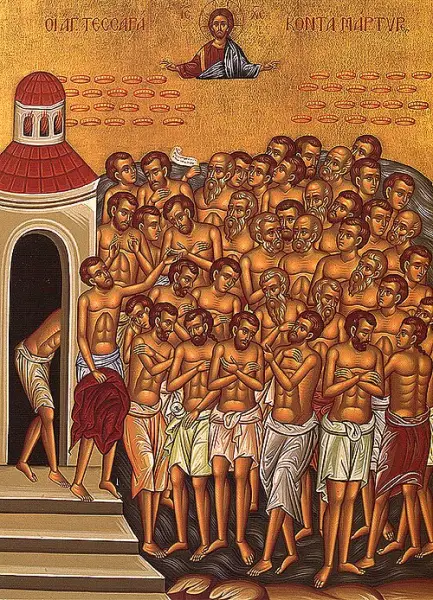
The sentence passed on the confessors was calculated to break them without the shedding of blood. As Saint Basil of Caesarea recounts, they were stripped of every garment and set out upon a frozen pond close to Sebaste through a night of savage cold, that the frost might do the work of the executioner. Near the shore the persecutors heated baths, ready for any who might weaken and choose warmth over death. One of the forty did yield: he left his companions and made for the baths, but plunging into the cauldron's sudden heat he went into shock and died at once, losing both the crown and his life. Then came the miracle that fixed the story in Christian memory. Aglaius, one of the guards set to watch the martyrs, beheld a supernatural brilliancy overshadowing the thirty-nine who remained, and at once he declared himself a follower of Christ, cast aside his own clothing, and took his place among the confessors on the ice. Thus the number forty stood complete. At daybreak the executioners burned the stiffened bodies, which still showed signs of life, and cast the ashes into the river; the faithful, however, gathered up the sacred remains, which were then shared among cities far and wide.
§ Martyrdom
A Cult Older Than Its Chroniclers
The Forty Martyrs were never formally canonized, for they belong to the pre-congregation ages when the Church recognized martyrs by common acclaim. The evidence for the antiquity of their veneration is remarkably precise: our oldest narrative of who they were and how they died comes from Basil, bishop of Caesarea, who preached a homily in their honor on their feast day during his episcopate from 370 to 379 — scarcely two generations after their deaths, honoring a festival already old when he spoke. The first generation of their devotion produced churches as well as sermons: a church was built at Caesarea in Cappadocia, and it was there that Basil delivered his famous homily. Gregory of Nyssa was so devoted to the Forty that he preached two discourses in their praise in a church dedicated to them, and laid his parents to rest beside their relics when they died. Ephrem the Syrian also eulogized them, and Sozomen, an eyewitness, told how the relics were recovered at Constantinople within the shrine of Saint Thyrsus that Caesarius raised there through the influence of the Empress Pulcheria.
§ Veneration
From Saranda to the Roman Forum
Few early martyr cults spread as widely as that of the Holy Forty. In the East, the Forty Saints Monastery at Sarandë in modern Albania, built in the sixth century, gave the city its very name in Greek, Hagioi Saranda, and drew pilgrims for centuries. Their images adorned the churches of Saint Sophia in Ohrid and Kyiv in the eleventh and twelfth centuries; entire temples were dedicated to them, among them Xeropotamou Monastery on Mount Athos and the thirteenth-century Holy Forty Martyrs Church at Veliko Tarnovo in Bulgaria; and Anna Komnene mentioned a church of the forty saints in Constantinople in the Alexiad. Cathedrals in Aleppo and Homs still bear their dedication, and in 2013 the feast of the Forty in Štip entered UNESCO's Intangible Cultural Heritage lists. In Syria, Syriac Christians keep their feast as Rozune, hiding a coin in star-shaped bread, while Jacob of Serugh and George, Bishop of the Arabs, wrote poems in their praise. The West received the ashes early: Bishop Gaudentius of Brescia placed particles of them in his basilica's altar, and a chapel in Santa Maria Antiqua in the Roman Forum preserves a sixth- or seventh-century mural of their martyrdom. Byzantine artists loved the subject for its terrible pathos, portraying the soldiers shivering on the ice, and Orthodox iconographers still paint the scene today, while the Orthodox wedding rite invokes the Forty so that married couples may remain as faithful as they did.
§ Veneration
Timeline
- 316
Emperor Licinius, after 316, began persecuting the Christians of the East, the suppression under which the forty soldiers would die.
§ Introduction
- 320
Forty soldiers of the Legio XII Fulminata, condemned for confessing Christ, were stripped and exposed on a frozen pond near Sebaste.
§ Introduction
- 370
Bishop Basil of Caesarea delivered the earliest surviving account of their martyrdom in a homily preached on their feast day.
§ Introduction
- 400
Santa Maria Antiqua in the Roman Forum, raised in the fifth century, received a chapel consecrated to the Forty Martyrs.
§ In the West
- 500
The Forty Saints Monastery was built at Sarandë in modern Albania, an important pilgrimage site that gave the city its Greek name.
§ In the East
- 1000
Depictions of the Forty Martyrs, datable to the eleventh century, were placed in the Church of St. Sophia at Ohrid.
§ In the East
- 1100
The Church of St. Sophia in Kyiv received images of the Forty Martyrs, datable to the twelfth century.
§ In the East
- 1200
The Holy Forty Martyrs Church was built at Veliko Tarnovo in Bulgaria in the thirteenth century.
§ In the East
- 1220
A Syriac Gospel Lectionary produced near Mosul received a miniature portraying the Forty Martyrs of Sebaste.
§ Martyrdom
- 1969
The Western feast of the Forty Martyrs, kept on 10 March, was suppressed in the calendar reform of that year.
§ In the West
- 2013
The Feast of the Holy Forty Martyrs in Štip was inscribed on the UNESCO Intangible Cultural Heritage lists of North Macedonia.
§ In the East
The Record
- Patron of
- Persecuted Christians
- Symbols
- Crown of martyrdom·Martyr's palm
- Canonization
- Pre-congregation; ancient cult whose feast was already established within a generation of their deaths
Prayer
Bibliography
Show 10 sources
- "Forty Martyrs of Sebaste", Oxford Reference, retrieved 10 March 2024
- Basil of Caesarea, Homilies xix in P.G., XXXI, 507 sqq.
- "Martyr Acacius of the Holy 40 Martyrs of Sebaste", oca.org
- "Santi Quaranta Martiri di Sebaste" (in Italian)
- Gregory of Nyssa, discourses in P. G., XLVI, 749 sqq., 773 sqq.
- Ephrem the Syrian, Hymni in SS. 40 martyres
- Sozomen, Historia Ecclesiastica, IX, 2
- "Feast of the Holy Forty Martyrs in Štip", unesco.org, retrieved 2015-12-23
- Abdalla, Michael (1991). "The Way the Contemporary Western Assyrians take Food in the Middle East during Fasts and Church Holidays", Oxford Symposium on Food and Cookery, pp. 15-26. ISBN 9780907325468
- Barsoum, Ignatius Aphram (2003). The Scattered Pearls: A History of Syriac Literature and Sciences, translated by Moosa, Matti (2nd rev. ed.), Gorgias Press, pp. 31, 200, 335. ISBN 1-931956-04-9
Profile text adapted from the Wikipedia article, licensed CC BY-SA 4.0.
Pray with this saint every day
Save Sts. The Forty Martyrs of Sebaste to your favorites, read the full profile, and get feast-day reminders in the Saints app.
Get the Saints AppFree on the App Store for iPhone and iPad