
died 251·Feast November 5
Sts. Galaction and Episteme
Martyred Couple of Emesa under Decius
Overview
Galaction and Episteme were a Syrian husband and wife of the third century who together shed their blood for Christ at Emesa, today's Homs. Galaction — the name also appears as Galaktion and Galation — was the long-awaited child of Kletophon and Leukippe, wealthy pagan aristocrats whose conversion came through a wandering religious figure, part monk and part beggar, who promised that the true God would hear their petition for offspring. The boy conceived in answer to that promise felt drawn from youth to the cloister, yet he bowed to his parents' wishes and accepted betrothal to Episteme, a lovely young pagan. Over the course of a long engagement he won her for Christ, and afterward her maid Eutolmius as well. Then the two went up the mountain called Publion, he entering the monastery of the men and she the abbey of the women, and to the end of their days neither crossed the threshold nor laid eyes on the other. Under Decius both were arraigned; Galaction died at Emesa in 251 and Episteme, hastening to stand beside him, was slain there too. East and West keep their feast on 5 November, and the Menologion of Basil II depicts their execution side by side.
The Complete Life
A Child Asked of God
Behind every part of this story stands a miracle of answered prayer. Kletophon and Leukippe possessed riches and rank in Syria, but the one thing they wanted most — a child — had been denied them year after year. Their deliverance came through an itinerant monk, a priest who went about in the garb of a beggar, who preached to them of the one true God and undertook that, if they believed, their petitions for offspring would be heard. They believed; they were converted; and in God's time Galaction was conceived. The household thus entered the Church before its heir was born, and the boy grew up amid an atmosphere of gratitude and wonder. Yet his own inclination was not toward the married prosperity his parents now enjoyed but toward renunciation: from his earliest days he hoped to become a monk. When Kletophon and Leukippe, rejoicing in the son they had once despaired of, sought to continue their line by contracting a marriage for him with the beautiful pagan Episteme, the young man faced the first great choice of his life — and chose obedience. In this household of remembered grace the vocation of the future martyr took root, and the wonder that surrounded his birth never quite left the story his tellers loved.
§ Life
A Betrothal That Became a Conversion
The engagement that his parents had intended as the securing of their house became instead the door through which an entire household entered the Church. In the course of their engagement, over the visits that the customs of betrothal allowed, Galaction set about converting his fiancée. Episteme, a pagan of beauty and rank, received the faith from the man to whom she was promised and became a Christian. Galaction's apostolate did not stop there: he next converted Episteme's servant Eutolmius, so that the faith spread from the promised couple to the members of their household. When the time came to live out their respective callings, the two acted with a resolve that startled their world. They went away together as far as the mountain of Publion, where Galaction entered a men's monastery and Episteme an abbey. There the tale of their betrothal ends in an extraordinary fidelity: neither ever left the monasteries, and neither saw the other again until their deaths, each counting the other's holiness a greater good than the marriage that had once been planned. In an age when a betrothal among the wealthy was a contract between houses, the quiet evangelization of one fiancée by another's promise of heaven was itself an act of quiet rebellion against paganism.
§ Life
Two Cloisters on the Mountain of Publion
On the mountain of Publion the promised couple found the life each had secretly desired. Galaction took his place among the monks, and Episteme among the sisters of the abbey, and the record of their remaining years is one of withdrawal, discipline, and constancy. The tradition emphasizes the completeness of their renunciation: they did not leave their monasteries, and they did not see one another. The obedience that had once made Galaction accept an unwanted betrothal now made both of them accept a lifelong separation, trusting that the God who had joined their paths could be served best in the hidden sacrifice of ascetic life. Eutolmius, the servant whom Galaction had converted, remained part of their story, a witness to the faith that had passed from the couple to their household. Their mission, in the hagiographical sense, was thus not one of preaching journeys or foundations but of presence: two lives of prayer offered on a Syrian mountain, known to the monasteries around them, and kept alive in the memory of the churches that would later honor them as martyrs.
§ Life
A Love Purified into Holiness
The spirituality of Galaction and Episteme is written in the shape of their lives together. Each great love in the story was directed first toward God: the childless Kletophon and Leukippe believed the promise of the one true God and received their son; Galaction honored his parents by obedience even when obedience cost him his cherished plan; Episteme received the faith and then gave back even the marriage that had been her future. The couple's withdrawal to Publion expressed a conviction that fidelity could take the form of renunciation, that a betrothal made in Christ could be perfected in two cloisters rather than one household. Their story stands among the traditions of the Eastern churches in which married saints bear witness to a love that transcends the flesh, a love sealed not by the consummation of a wedding but by a shared martyrdom. When the persecution came, neither cloister protected them from trial, and neither hesitated; Episteme, hearing that Galaction stood accused, went to his side of her own will, so that their last act on earth, like their first, was made together.
§ Life
Martyrdom at Emesa
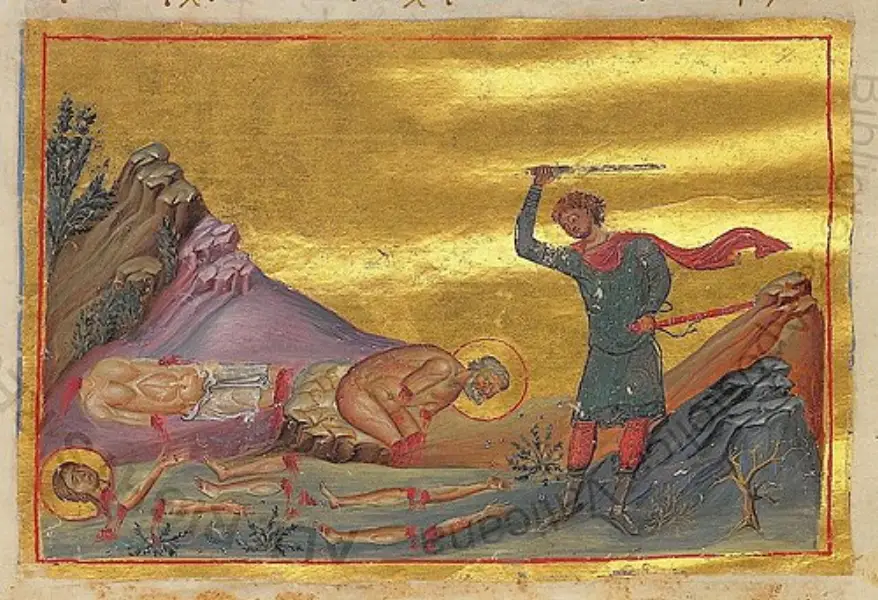
The peace of Publion was ended by a fierce persecution of the Church, the persecution waged under the emperor Decius, which demanded from all Christians a public apostasy that many refused at the cost of their lives. Galaction and Episteme were both brought to trial. Galaction was martyred at Emesa, the city known today as Homs in Syria, in the year 251. Episteme did not remain in the safety of her abbey: she went to his side as he faced death, and was killed with him, so that the betrothed couple who had lived apart for the sake of the kingdom died together in its confession. The hagiographical tradition has always seen in their joint death the completion of their marriage, a union achieved before the tribunal and the executioner rather than at an altar. The Menologion of Basil II, the great Byzantine pictorial menology, preserves the memory of that day in its image of the martyrdom of Saint Galaction and his wife Saint Episteme at Emesa, fixing forever the scene in which their two cloistered lives met again. The tribunal at Emesa demanded what every persecution demands, a denial that would have spared their lives, and the couple who had renounced marriage for the kingdom now refused to renounce the King himself.
§ Life
Remembered on November 5
Galaction and Episteme were never subject to a formal canonization process; they belong to the early martyrs whose veneration arose spontaneously in the communities that kept their memoria and was carried into the universal calendars of the Church. They are honored as saints by both the Roman Catholic Church and the Eastern Orthodox Church, which share a common feast on 5 November. In the Catholic Church they are listed among the martyrs who are saints, the vast roll of witnesses from the age of persecutions and after, and the Eastern tradition preserves their story through liturgical and hagiographical texts, including the OCA account of the 'Martyrs Galaction and his wife, Epistemis, at Emesa' and the menology illustrations of the Byzantine court. Their cult has survived the obscurity that surrounds nearly every detail of their lives: no acts of their trial survive, and the year 251 with the names of Decius and Emesa are nearly all the chronology the sources yield. What the calendars preserve is the pairing itself, a husband and wife inscribed together in the list of the saints.
§ Life
A Couple Engraved in the Menologion
The legacy of Galaction and Episteme rests less on written works than on witness. Their names appear in the company of the martyrs of the early Church on the calendars of both East and West, celebrated each 5 November, and their story is told in the hagiographical collections that trace the fortunes of Syrian Christianity under Decius. The Menologion of Basil II commissioned at the turn of the eleventh century gave their memory a place of honor among the illuminated lives of the saints: its miniature of the martyrdom of Saint Galaction and his wife at Emesa remains one of the most familiar images associated with them, testifying to the esteem in which the Byzantine Church held this married couple. For later generations of Christians, they have stood as an example of two vocations in harmony, showing that engagement, marriage, monastic profession, and martyrdom can be successive chapters of a single fidelity. Their feast keeps alive the memory of the Syrian church of the third century, of the city of Emesa where they died, and of the conviction, old in the East, that holiness within marriage can lead even to the arena.
§ Life
Timeline
- 251
Brought to trial when a fierce persecution broke out, and martyred under Emperor Decius at Emesa, the modern Homs in Syria.
§ Life
- 251
Episteme went to her husband's side as he faced death and was killed with him at Emesa.
§ Life
The Record
- Patron of
- patron of married couples seeking a shared path to holiness
- Symbols
- martyr's palm·cross
- Canonization
- Pre-congregation canonization; venerated by the Roman Catholic and Eastern Orthodox Churches
Prayer
Bibliography
Show 4 sources
- "Άγιοι Γαλακτίων και Επιστήμη" [Saints Galaction and Episteme]
- "Martyrs Galaction and his wife, Epistemis, at Emesa". www.oca.org. Retrieved 2019-11-05.
- "Galaction & Episteme Martyrs", The Byzantine Catholic Archeparchy of Pittsburgh
- Bunson, Matthew and Bunson, Stephen. "Galatian", Our Sunday Visitor's Encyclopedia of Saints, Our Sunday Visitor Publishing, 2003, ISBN 9781931709750
Profile text adapted from the Wikipedia article, licensed CC BY-SA 4.0.
Pray with this saint every day
Save Sts. Galaction and Episteme to your favorites, read the full profile, and get feast-day reminders in the Saints app.
Get the Saints AppFree on the App Store for iPhone and iPad